The ‘Doublet’ Effect: Rare Seismic Sequence Devastates Coastal Venezuela
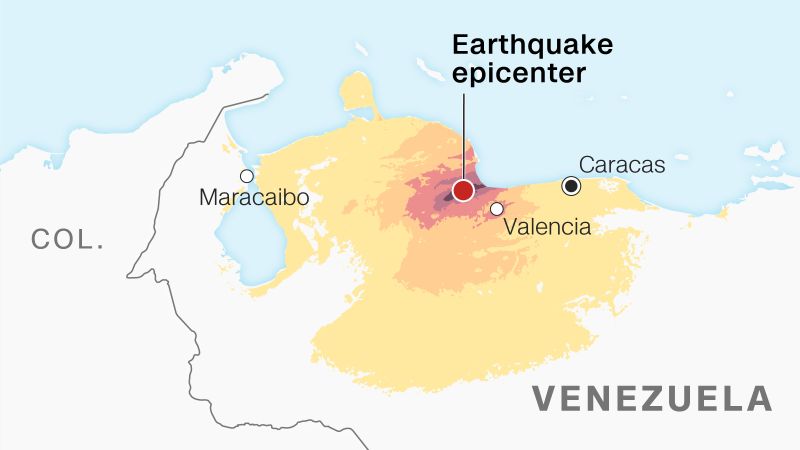
Table of Contents
A Rare Seismic Sequence
Venezuela is grappling with the aftermath of a devastating and geologically rare phenomenon known as a “doublet.” On Wednesday evening, the region was struck by two major earthquakes in such rapid succession that the first barely finished shaking before the second, more powerful shock hit. The sequence began with a magnitude 7.2 earthquake, followed just 39 seconds later by a magnitude 7.5 event.
According to data from the United States Geological Survey (USGS), this doublet sequence represents the most significant seismic activity recorded in Venezuela in over a century. The timing of the events created a compounding effect; structures already weakened by the initial 7.2 shock were effectively leveled by the subsequent 7.5 strike, dramatically increasing the scale of destruction and the resulting casualty count.
The Mathematics of Magnitude
While a difference of 0.3 on the magnitude scale may seem negligible to a layperson, the physics of seismic energy is logarithmic. In the context of the Moment Magnitude Scale, each whole number increase represents roughly 32 times more energy release. Consequently, the 7.5 magnitude quake was not slightly larger, but approximately twice as powerful as the 7.2 foreshock that preceded it by less than a minute.
This energy surge was felt far beyond the immediate epicenters, with significant tremors reported across neighboring Colombia and various regions of the Caribbean. The region’s inherent vulnerability is tied to its position atop a complex network of tectonic plates, where the interaction between the Caribbean and South American plates creates a high-risk environment for high-magnitude events.
Catastrophe in La Guaira
The coastal city of La Guaira has been the hardest hit, officially designated as a disaster zone. The city’s infrastructure, much of it not built to withstand the specific intensity of a doublet event, suffered catastrophic failures. Satellite imagery analyzed by reporting teams reveals a grim landscape of collapsed apartment complexes and flattened industrial warehouses.
Search and rescue operations have shifted into a high-intensity phase, with workers utilizing acoustic sensors and heavy machinery to locate survivors trapped beneath reinforced concrete rubble. Current reports indicate at least 235 fatalities and 4,300 injuries, though officials warn that these numbers are likely conservative as rescue teams reach more isolated sectors of the city.
Infrastructure and Urban Vulnerability
The devastation in La Guaira highlights a critical gap in urban resilience. When a doublet occurs, the ‘damping’ effect of a building’s structure is compromised. The first quake consumes the building’s structural integrity, leaving it unable to absorb the kinetic energy of the second wave. This creates a ‘pancake collapse’ scenario, where floors stack directly on top of one another, leaving very few void spaces for survivors.
As the humanitarian crisis unfolds, the focus has shifted to the stability of remaining structures. Engineers are warning that aftershocks—which typically follow major events—could trigger the collapse of buildings that survived the initial doublet but are now structurally unsound.