Privacy-First Posture Tracking: A Look at Deep Care’s Isa Desk Companion
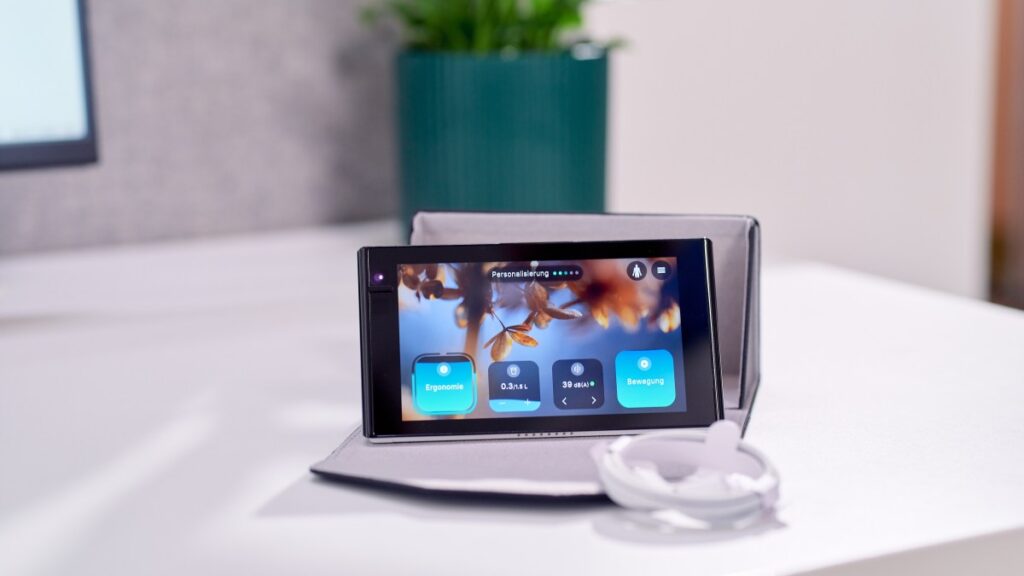
Table of Contents
The battle against the WFH slouch
Working from home has introduced a specific set of physical perils. Between the allure of the couch and the deep dive into a spreadsheet, hours can pass before you realize your spine has curved into a question mark. While there are plenty of apps designed to nudge users to move, they are often too easy to swipe away or ignore in the heat of a deadline.
For many of us, the solution has been an expensive arms race of hardware: ergonomic gaming chairs, adjustable lumbar supports, and standing desks. Yet, none of these tools actually solve the behavioral problem of posture. That is where Isa comes in.
Developed by German startup Deep Care, Isa is a dedicated desk companion that attempts to automate the process of staying healthy while sedentary. At first glance, it looks like a modern table clock with a 5.5-inch IPS HD screen. However, beneath the glass is a suite of sensors designed to monitor everything from your sitting angle to the air quality of your home office.
How it works: Depth sensors over cameras
The defining characteristic of Isa is its commitment to privacy. In an era of always-on surveillance, Deep Care opted out of using a camera. Instead, the device relies on a Time-of-Flight (ToF) 3D depth sensor. This is the same technology found in high-end smartphone facial recognition systems, allowing Isa to map the distance between the device and the user in 3D space.
The ToF sensor operates within a range of 0.15 to 1.8 meters, meaning it can track your posture and movement even if you stand up to stretch. It is paired with an impressive array of other hardware: a 1D ToF sensor, a gyroscope, a barometer, a light sensor, a sound level monitor, and a CO₂/VOC sensor for air quality. All of this is powered by a quad-core 2 GHz processor, ensuring the data processing happens locally.
In practice, the device uses a “squircle” ring on the display—reminiscent of the Apple Watch’s activity rings—to signal your posture. When you slouch, the indicator turns yellow or red. The visual cue is surprisingly effective; there is a psychological trigger that makes you instinctively straighten up when you see the color shift. For those who ignore the screen, the device also vibrates to provide a tactile nudge.
The trade-offs of a camera-free world
While the lack of a camera is a win for privacy, it does introduce some technical quirks. Because the device relies on depth mapping rather than visual recognition, it can be fooled. A water bottle or a stack of papers placed between you and the sensor can sometimes be registered as a human figure, leading the device to believe you are stationary when you aren’t.
Similarly, pets or colleagues walking past the desk can trigger the sensors. While Isa generally recognizes when a user has stepped away and reverts to a standard clock display, the lack of a manual “away” button is a notable omission for those in busy shared environments.
Environmental tracking and the subscription model
Beyond posture, Isa tracks hydration and air quality. The device can actually count how many times you reach for a glass of water, though this remains a beta feature. It also monitors noise and CO₂ levels, helping users identify when their room has become too stuffy or loud for deep work.
Deep Care, founded by former Bosch employees, has transitioned Isa from a B2B corporate wellness tool to a consumer product. This transition comes with a pricing structure that may give some pause. The hardware is priced at €299 (approximately $354), but the full experience is locked behind a subscription.
- Core Plan (€4.99/mo): Includes posture tracking, drinking habits, and the exercise library.
- Pro Plan (€7.99/mo): Adds monitoring for light, noise, and CO₂ levels.
Beyond the desk
The company is already looking to expand Isa’s capabilities into the realm of mental health. By analyzing chest movements and head positioning, Deep Care claims the device can eventually measure breathing patterns. When combined with environmental data like noise and light levels, the goal is to generate a “stress score” to alert users when they are reaching a burnout threshold.
Whether consumers are willing to pay a monthly fee for a posture coach remains to be seen, but as a piece of hardware, Isa is a thoughtful attempt to solve the physical toll of the digital workspace.