Samsung’s 2026 TV Lineup Hits India: Micro LED, QD-OLED, and Neo QLED Expand Across 72 Models
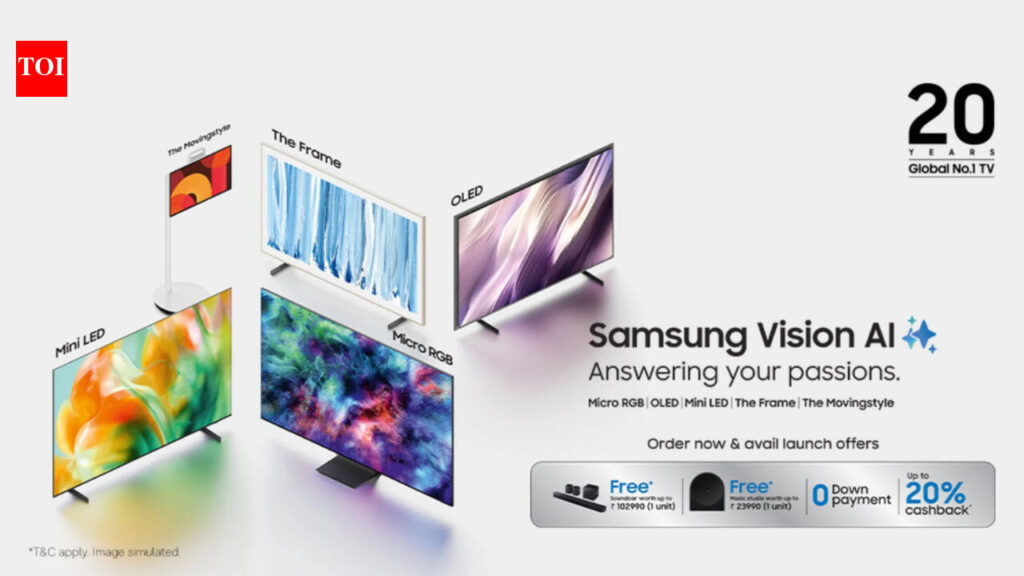
Table of Contents
A Massive Expansion of the Indian Living Room
Samsung has officially unveiled its 2026 television portfolio for the Indian market, a sprawling collection of 72 models designed to capture everything from the budget-conscious apartment dweller to the ultra-high-net-worth home cinema enthusiast. The cornerstone of this rollout is the aggressive push of Micro LED and QD-OLED technologies, signaling a shift in how the company views the premium segment in South Asia.
- Scale: 72 distinct models launched, covering Crystal UHD, Neo QLED, OLED, and the ultra-premium Micro LED.
- Tech Pivot: Integration of Micro RGB and advanced QD-OLED panels to combat traditional LED brightness limitations.
- AI Integration: New NQ8 AI Gen3 processors are standard across high-end models for real-time upscaling.
- Market Strategy: Massive variety in screen sizes, ranging from compact 43-inch sets to massive 110-inch Micro LED walls.
For the average consumer, a 72-model lineup can feel overwhelming. However, from an industry perspective, this is a strategic move to fence off competitors like LG and Sony by saturating every possible price bracket. By introducing Micro RGB technology into the Indian mix, Samsung is betting that there is a growing appetite for ‘true’ black levels and extreme peak brightness that traditional Mini-LEDs simply cannot match.
Decoding the Tech: Micro LED vs. QD-OLED vs. Neo QLED
To understand why this lineup matters, we have to look at the physics of the panels. Many consumers confuse Mini-LED with Micro-LED, but they are fundamentally different animals.
Micro LED (The Holy Grail)
Micro LED is a self-emissive display technology. Unlike OLED, which uses organic compounds that can degrade (burn-in), Micro LED uses non-organic gallium nitride. Each single pixel is its own light source. In the 2026 Indian lineup, these are the ‘halo’ products—massive, modular displays that offer the perfect blacks of OLED with the blinding brightness of LED, without the risk of permanent image retention.
QD-OLED (The Color Powerhouse)
Samsung’s Quantum Dot OLED (QD-OLED) blends the best of both worlds. It uses a blue OLED layer and a layer of quantum dots to convert that light into red and green. The result is a significantly wider color gamut and higher brightness than standard WRGB OLEDs found in competitors’ sets. For the 2026 range, Samsung has refined the heat dissipation, allowing for higher sustained brightness in HDR10+ content.
Neo QLED and Mini LED (The Practical Premium)
For most Indian households, Neo QLED is the sweet spot. By using Quantum Mini LEDs—which are a fraction of the size of traditional LEDs—Samsung can implement thousands of local dimming zones. This minimizes ‘blooming’ (where light leaks from a bright object into a dark area) while maintaining a brightness level that makes these TVs viable even in sun-drenched living rooms with large windows.
| Feature | Neo QLED (Mini LED) | QD-OLED | Micro LED |
|---|---|---|---|
| Contrast | High (Zonal) | Infinite (Pixel) | Infinite (Pixel) |
| Brightness | Extreme | High | Maximum |
| Burn-in Risk | None | Low/Moderate | None |
| Price Point | Mid-to-High | Premium | Ultra-Luxury |
The Intelligence Layer: NQ8 AI Gen3 and Neural Upscaling
Hardware is only half the story. The 2026 lineup is heavily reliant on the NQ8 AI Gen3 processor. In a market like India, where content varies wildly from 720p cable TV to 4K Netflix streams and gaming, upscaling is the most critical feature.
The new processor utilizes a multi-neural network to analyze images in real-time. Unlike previous versions that simply sharpened edges, the Gen3 processor attempts to reconstruct missing textures. For example, when viewing an older sports broadcast, the AI can distinguish between the grass of the pitch and the jersey of the player, applying different sharpening filters to each to avoid the ‘plastic’ look common in early AI upscaling.
Gaming and Connectivity
Samsung continues to double down on the gaming crowd. Most of the Neo QLED and OLED models now feature 144Hz refresh rates and HDMI 2.1 ports across all four inputs. The ‘Gaming Hub’ has also been updated to integrate more cloud gaming services, allowing users to stream AAA titles directly to the TV without a console, provided they have a high-speed 5G or fiber connection.
What This Means for the Indian Consumer
The sheer volume of 72 models suggests that Samsung is no longer just selling a TV; they are selling a tiered ecosystem. For the average buyer, this means more granular choices. You can now pick a TV that is specifically optimized for a bright bedroom, a dedicated gaming nook, or a cinematic living room.
However, it also means that the ‘gap’ between the entry-level Crystal UHD and the premium Neo QLED is widening. While the budget models remain competitive on price, the leap in image quality when moving to the 2026 Mini-LED sets is more pronounced than in previous years. This is a calculated move to push consumers toward the mid-premium segment where margins are higher.
Challenges and Market Reality
Despite the technical brilliance of Micro LED, it remains a niche product. The cost of these units is often higher than a luxury car, making them accessible only to a sliver of the population. The real battle for Samsung in India will be the QD-OLED vs. Mini-LED tug-of-war. Consumers are increasingly aware of ‘burn-in’ risks associated with OLED, and Samsung is leveraging this fear to keep Neo QLED as the dominant choice for those who want a ‘forever’ TV.
Sustainability and Efficiency
Samsung has claimed a reduction in power consumption across the 2026 range, partly due to the move toward more efficient Micro RGB elements and AI-driven brightness management. In India’s climate, where energy efficiency and heat management are crucial, the shift toward lower-heat emitting panels in the OLED line is a welcome improvement.
Common User Questions (FAQ)
Is Micro LED the same as Mini LED?
No. Mini LED is a backlight technology used in Neo QLED TVs to provide better contrast. Micro LED is a completely different display tech where each pixel creates its own light, similar to OLED but without the organic materials that cause burn-in.
Which is better for a bright room: OLED or Neo QLED?
For rooms with significant sunlight, Neo QLED is generally superior due to its higher peak brightness and lack of reflective glare issues common in some OLED panels.
What does ‘Micro RGB’ actually do?
Micro RGB refers to the use of tiny, individual red, green, and blue LEDs. This allows for incredibly precise color control and brightness, resulting in images that look more natural and vivid than those produced by white LEDs with color filters.
Will my old 4K content look better on these TVs?
Yes, specifically on the high-end models featuring the NQ8 AI Gen3 processor. The AI-driven upscaling is designed to make lower-resolution content look closer to native 4K/8K by filling in missing detail.
Do these TVs support 144Hz for PS5 and Xbox Series X?
Most of the premium Neo QLED and QD-OLED models in the 2026 lineup support 144Hz, though consoles currently peak at 120Hz. This provides a future-proof overhead for next-gen hardware.
Final Verdict on the 2026 Portfolio
Samsung’s 2026 TV launch in India is a display of raw industrial power. By flooding the market with 72 variations, they have effectively mapped out every possible consumer need. While the Micro LED sets remain aspirational trophies, the real value lies in the refinement of QD-OLED and the sheer versatility of the Neo QLED range. For the consumer, the challenge is no longer finding a great TV, but navigating the complex specifications to find the one that fits their specific room and budget.