Xi’s Rare Pyongyang Visit Signals Push to Counter Russian Influence and AI-Driven Arms Race
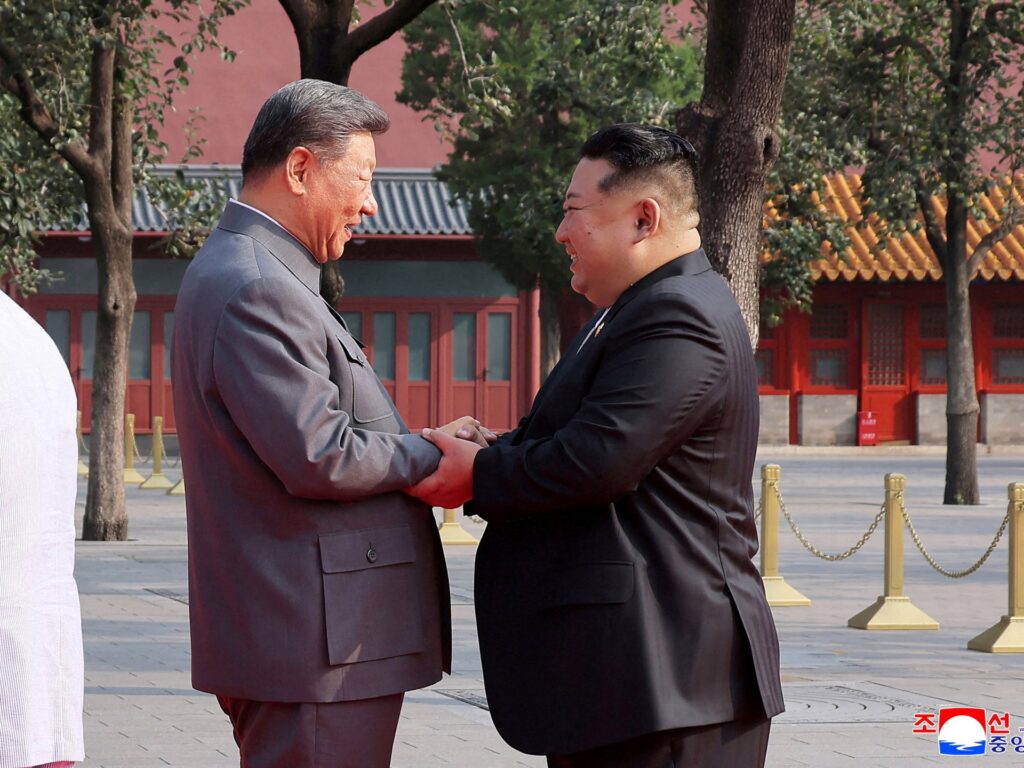
Table of Contents
The Geopolitical Weight of a Rare Flight
For the last several years, the diplomatic gravity of the East has shifted toward Beijing. President Xi Jinping has increasingly adopted a ‘home game’ strategy, with world leaders from Washington to Moscow traveling to China rather than the other way around. However, Xi’s landing in Pyongyang on Monday breaks a pattern of isolation that has persisted since 2019. While the two leaders met in Beijing a year ago for the 80th anniversary of Japan’s surrender in WWII, the act of Xi physically traveling to North Korea is a calculated signal of urgency.
Data from the Asia Society highlights a sharp decline in Xi’s international mobility: while he averaged 14 trips per year between 2013 and 2019, that number plummeted to roughly six annually between 2022 and 2025. The decision to break this trend suggests that the stability of the Korean Peninsula—and China’s role as its primary arbiter—is facing a challenge that cannot be managed via remote diplomacy.
The Moscow Pivot: A Threat to Beijing’s Hegemony
Traditionally, Pyongyang has been tethered to Beijing, with some estimates from the National Committee on North Korea suggesting that China accounted for up to 95% of North Korea’s trade. That dependency is fraying. Since the 2022 invasion of Ukraine, North Korea has emerged as a critical munitions hub for the Kremlin, providing the artillery and manpower necessary to sustain Russia’s war machine.
The cost of this alliance is not merely financial. The South Korean Institute for National Security Strategy estimates that Moscow has paid Pyongyang as much as $14.4 billion since 2023. Crucially, only a fraction of this—between $580 million and $1.5 billion—was delivered as tangible goods. This discrepancy points to a more dangerous exchange: the transfer of sensitive military technology and precision components that are invisible to satellite surveillance.
For Beijing, this is a strategic nightmare. A North Korea emboldened by Russian high-tech military transfers is a North Korea that is harder for China to control. By visiting Pyongyang, Xi is likely attempting to reassert the ‘senior partner’ dynamic, potentially offering economic incentives to lure Kim Jong Un back into a more China-centric orbit.
The Rise of AI-Guided Warfare in the DMZ
Beyond the diplomatic maneuvering, the technical evolution of the North Korean military is raising alarms. The recent unveiling of an AI-guided tactical cruise missile, reported by the US Naval Institute and North Korean state media, signals a leap in precision capabilities that could destabilize the existing balance of power.
This technological acceleration is paired with a massive expansion in raw materials. Recent state media footage showed Kim Jong Un touring a new ‘weapons-grade nuclear materials’ factory designed to scale nuclear production at an exponential rate. For China, this rapid advancement represents a double-edged sword. While a strong North Korea serves as a buffer against US influence in the region, a nuclear-armed state with AI-integrated missile systems is a volatility risk that Beijing cannot ignore.
A Fragmented Peninsula and Regional Pressure
The visit comes at a time of deep diplomatic frost. Kim Jong Un has largely severed communication channels and recently abandoned the long-term goal of Korean unification. South Korea’s Ministry of Foreign Affairs has expressed hope that Xi will play a ‘constructive role’ in easing these tensions, hinting that Seoul may have lobbied Beijing to intervene.
Further complicating the landscape is the potential for a new military-logistics support pact between South Korea and Japan, a topic of discussion at the recent Shangri-La Dialogue in Singapore. With China’s relations with Japan remaining acrimonious, the prospect of a tightened security alliance between Seoul and Tokyo may be pushing Xi to ensure that Pyongyang remains a reliable, if volatile, counterweight in East Asia.