The Orbital Breaking Point: Why Space Traffic Management is Racing Toward an ‘Equilibrium State’
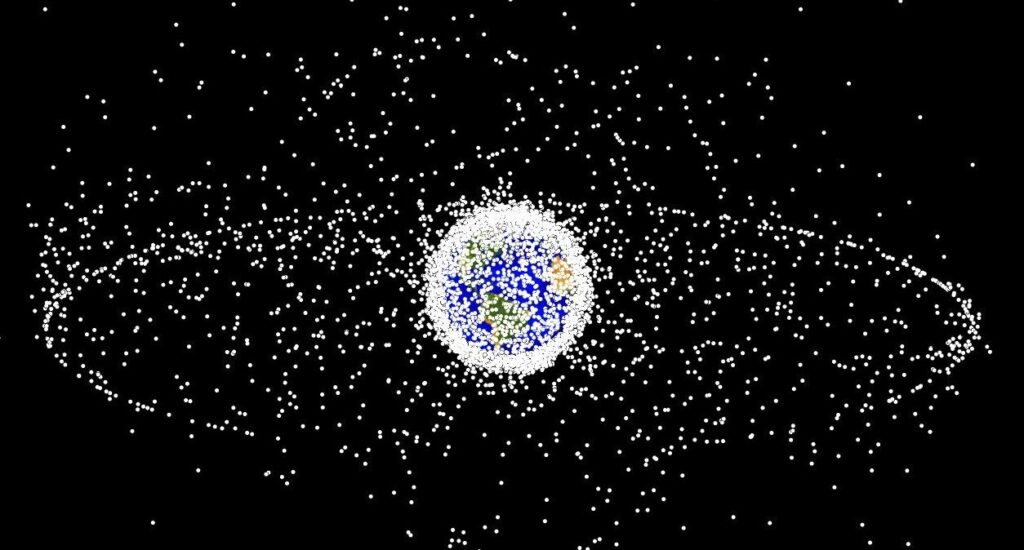
Table of Contents
The Invisible Gridlock
Low Earth Orbit (LEO) is no longer the vast, empty void it was during the Apollo era. Today, it is a congested corridor of high-speed transit, dominated by massive broadband constellations and a growing fleet of commercial satellites. But beneath the commercial gold rush lies a precarious mathematical problem: the search for an “equilibrium state.”
For space traffic management (STM) experts, equilibrium isn’t just a theoretical preference—it is a survival requirement. In orbital terms, equilibrium describes a dynamically stable environment where the rate of new launches and debris generation is balanced by the rate of atmospheric decay and active disposal. If the “source” (launches and collisions) consistently outweighs the “sink” (deorbiting and removal), the orbit enters a state of permanent degradation.
The SSO Bottleneck
Not all orbits are created equal. The most critical tension is currently playing out in Sun-synchronous orbits (SSO). These specific paths are prized by government reconnaissance and commercial imaging satellites because they allow a spacecraft to pass over a target at the same local solar time, ensuring consistent lighting for photography.
Because these orbits are concentrated between 500 and 900 kilometers, they have become the orbital equivalent of a rush-hour freeway. The danger here is compounded by physics: at these altitudes, atmospheric drag—the natural force that pulls dead satellites back to Earth to burn up—is almost nonexistent. A failed satellite in SSO doesn’t just become junk; it becomes a permanent hazard that can linger for decades, waiting for a high-speed encounter with a functioning asset.
The New Variables: Data Centers and Mega-Constellations
The risk profile of LEO is shifting rapidly. While we have long dealt with spent rocket stages, the arrival of “orbital data centers” introduces a new level of complexity. These proposed facilities require massive solar arrays and thermal radiators to manage heat in a vacuum, significantly increasing their physical footprint. When you combine these oversized structures with the thousands of satellites deployed by operators like SpaceX and Amazon, the margin for error shrinks.
The physics are unforgiving. Satellites travel at velocities exceeding seven kilometers per second. At those speeds, a fragment of paint or a millimeter-scale piece of debris carries enough kinetic energy to disable a multi-million dollar satellite or threaten the lives of astronauts on inhabited stations.
Defining Carrying Capacity
To prevent a catastrophic chain reaction—often referred to as the Kessler Syndrome—researchers are now treating Earth’s orbit as a finite environmental resource, similar to a fishery or a forest. Just as an ecosystem has a carrying capacity beyond which it collapses, orbital shells have a limit on how many objects they can support before collision probabilities become unacceptable.
Achieving equilibrium requires a shift from passive observation to active regulation. This likely means moving toward a system resembling air traffic control, where specific orbital shells have a dynamically calculated capacity. To maintain this balance, the industry must move beyond “best effort” disposal and toward mandatory post-mission disposal requirements and the deployment of active debris removal (ADR) technologies.
Currently, over 100 million pieces of debris are estimated to be in orbit, though only a fraction are large enough to be tracked by ground-based radar. The goal for the next generation of STM is to ensure that the hazardous object population remains statistically stable. Without a defined equilibrium, the very orbits that enable our modern digital world could become impassable, effectively locking humanity out of space for generations.