Switzerland’s 10 Million Population Cap: A ‘Brexit Moment’ for EU Relations and the Economy
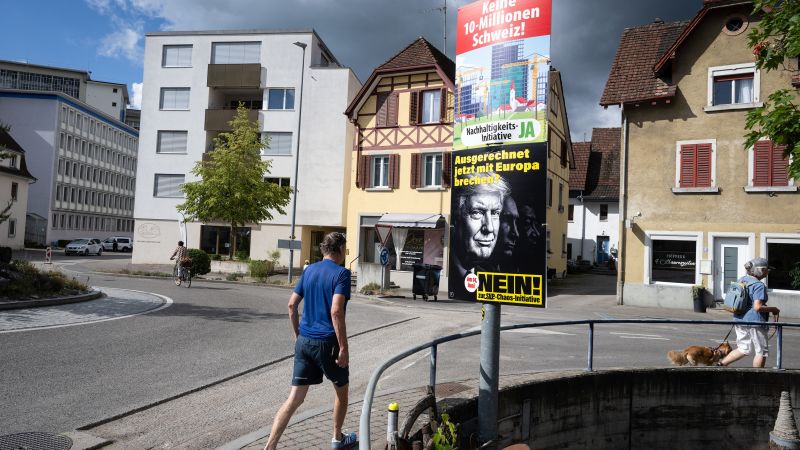
Table of Contents
The High-Stakes Gamble: Switzerland’s Population Ceiling
Switzerland is approaching a pivotal democratic crossroads. On Sunday, citizens will cast their votes on a proposal that could fundamentally alter the nation’s relationship with its neighbors and its own economic trajectory: a hard cap on the national population at 10 million residents. While the current population sits just above 9 million, the proposal represents more than a mere demographic target; it is a potential detonator for the treaties that allow Switzerland to function as a hub of European commerce.
- The Proposal: A referendum to limit Switzerland’s total population to 10 million, spearheaded by the right-wing Swiss People’s Party (SVP).
- The EU Risk: A ‘yes’ vote would likely force Switzerland to terminate the Agreement on the Free Movement of Persons (AFMP) with the European Union.
- Economic Anxiety: Business leaders warn of acute labor shortages in critical sectors, including healthcare, hospitality, and high-tech exports.
- The Trigger: If the 10-million threshold is hit, the government would be legally mandated to restrict further immigration, regardless of economic need.
The initiative, backed by the Swiss People’s Party (SVP), frames the issue as one of national sustainability. For the SVP, the rapid growth—from 8.3 million a decade ago to over 9 million today—is an uncontrolled expansion that threatens infrastructure, housing affordability, and cultural identity. However, the reality of this ‘cap’ is far more complex than a simple number. It is a direct challenge to the 2002 free-movement agreement that has fueled Swiss prosperity for over two decades.
Defining the ‘Swiss Brexit’ Scenario
A population cap is a legislative limit on the total number of residents allowed within a sovereign territory. In the Swiss context, this specifically refers to a constitutional amendment that would mandate the government to stop granting residency permits once the total population reaches 10 million. Unlike quota systems that target specific nationalities, this would be a blanket ceiling.
The term ‘Brexit moment,’ as used by Federal Council member Beat Jans, is not an exaggeration. Much like the United Kingdom’s departure from the EU, a population cap would create a legal incompatibility between Swiss domestic law and EU treaties. The EU’s free movement principle is non-negotiable; it is the bedrock of the Single Market. If Switzerland unilaterally restricts movement to maintain a population ceiling, the EU would likely respond by suspending the AFMP and potentially other bilateral agreements that govern trade, research, and security.
The Mechanism of the Referendum
Switzerland’s unique system of direct democracy allows for such high-impact changes. By gathering 100,000 signatures within 18 months, the SVP successfully moved this proposal to a national vote. This process ensures that the electorate, rather than just the Federal Council, decides the nation’s strategic direction. Current polling by gfs.bern suggests a tight race, with opposition to the cap marginally leading at 52%, though the margin of error suggests the outcome remains uncertain.
The Economic Paradox: Growth vs. Capacity
Switzerland finds itself in a classic economic paradox. Its success as a low-tax, low-regulation environment with high quality of life has made it a magnet for global talent and labor. This immigration has driven GDP growth and filled critical gaps in the workforce. However, that same growth has strained the physical and social infrastructure of the country.
Jürg Müller of the think-tank Avenir Suisse highlights that the tension is often more about ‘crowding’ than ideology. The housing market in cities like Zurich and Geneva has become prohibitively expensive, and infrastructure—from trains to lake access—is under pressure. The SVP has successfully tapped into this visceral feeling of overcrowding, transforming a logistical problem into a political mandate for a population ceiling.
Labor Market Vulnerabilities
The risk of a population cap is most acute in sectors that rely on cross-border workers (frontaliers) and EU migrants. According to government data, 27% of the population are foreign residents, with nearly half originating from Germany, France, Italy, and Portugal. If the cap is reached and the free movement agreement is severed, the following sectors would face immediate crisis:
- Healthcare: Hospitals rely heavily on EU-trained nurses and specialists. A cap would hinder the recruitment of essential medical staff.
- Hospitality: The Swiss tourism industry is heavily dependent on seasonal and permanent EU labor to maintain its global standards.
- Precision Engineering and Pharma: The export-driven sectors that define the Swiss economy require a constant influx of specialized international talent to remain competitive.
Technical Breakdown: The Free Movement Agreement (AFMP)
To understand why this vote matters, one must understand the technical nature of the 2002 Agreement on the Free Movement of Persons. This is not a simple ‘visa’ arrangement; it is a reciprocal legal framework that allows Swiss and EU citizens to live and work in each other’s territories without the need for restrictive work permits.
| Feature | Current AFMP Framework | Post-Cap Scenario (Estimated) |
|---|---|---|
| Permit Issuance | Based on labor market needs and reciprocity. | Halted entirely upon reaching 10M threshold. |
| EU Trade Relations | Stable, integrated via bilateral treaties. | High risk of sanctions or treaty suspension. |
| Labor Sourcing | Open access to EU-27 talent pool. | Restrictive, quota-based, or closed system. |
| Border Logistics | Seamless travel via Schengen Area. | Potential for increased checks and delays. |
The Cultural and Political Divide
The debate over the 10-million cap has exposed a deep rift in Swiss society. On one side, the SVP employs a narrative of ‘sustainability’ and ‘identity preservation.’ Their campaign materials suggest that uncontrolled immigration leads to a ‘loss of culture,’ occasionally leaning into anti-Muslim rhetoric and claims of ‘creeping Islamization.’ They argue that for a small nation, there is a physical limit to how many people the land and the social fabric can support.
Conversely, opponents of the cap, including Green party members like Delphine Klopfenstein, argue that the proposal is rooted in xenophobia. They contend that the SVP is using foreigners as scapegoats for systemic issues like poor urban planning and a failure to invest in housing. From this perspective, the cap is not about sustainability, but about isolationism that would leave Switzerland economically stranded in the heart of Europe.
What This Means: Practical Implications
For the average resident or business owner in Switzerland, the outcome of this vote will have tangible effects regardless of whether the 10-million mark is reached immediately.
For Business Owners
Companies should prepare for increased volatility in labor recruitment. If the cap passes, the ‘certainty’ of EU talent is gone. Businesses may need to invest more heavily in automation or internal training to reduce reliance on foreign labor. There is also the risk of reciprocal measures from the EU, which could make exporting Swiss goods to the Single Market more cumbersome.
For EU Citizens in Switzerland
While a cap at 10 million would not immediately expel current residents, it creates a climate of uncertainty. Future residency renewals or the ability for family members to join them could become subject to new, more restrictive regulations once the threshold is approached.
For the Swiss State
The government faces a diplomatic tightrope. They must balance the democratic will of the people (which may demand a cap) with the economic necessity of maintaining ties with the EU. A ‘yes’ vote would force the Federal Council to either find a loophole that satisfies the EU or risk a total collapse of the bilateral agreements.
Addressing Common Questions
Does Switzerland belong to the EU?
No, Switzerland is not a member of the European Union. However, it maintains a complex web of bilateral agreements that allow it to participate in the Single Market and the Schengen Area for border-free travel.
What happens if the population reaches 10 million?
If the referendum passes and the population hits 10 million, the Swiss government would be legally required to stop issuing new residency permits to immigrants, regardless of their nationality or skill level.
Would this affect the Schengen Area travel?
Indirectly, yes. The Schengen agreement is closely tied to the free movement of people. If Switzerland violates the core tenets of EU free movement, the EU could potentially revoke or modify Switzerland’s access to the Schengen zone.
Why is the Swiss People’s Party pushing for this?
The SVP argues that the current rate of growth is unsustainable for the country’s infrastructure and that immigration is eroding Swiss national identity and cultural norms.
Is the current population really close to 10 million?
The population is currently estimated at just over 9 million. While not at the limit yet, the growth trend over the last decade makes the 10-million mark a foreseeable reality without intervention.
Will this cause an immediate economic crash?
Not immediately, but it creates a ‘regulatory cliff.’ The danger lies in the potential reaction of the EU and the long-term inability of critical sectors (like nursing and engineering) to find workers.
Conclusion: A Question of Sovereignty vs. Stability
The upcoming vote on the Switzerland population cap is more than a demographic debate; it is a test of how Switzerland views its role in the 21st century. The nation has long prided itself on a unique blend of neutrality and integration. However, by attempting to place a hard ceiling on its growth, Switzerland risks dismantling the very mechanisms that have made it an economic powerhouse.
Whether the electorate chooses the perceived security of a capped population or the economic stability of open borders, the result will redefine the ‘Swiss Model.’ If the ‘yes’ vote prevails, Switzerland may indeed enter its own ‘Brexit’ era—one characterized by isolation, labor shortages, and a strained relationship with its most vital trading partners.