Samsung Floods Indian Market With 72 New ‘Vision AI’ TVs, Betting Big on Micro RGB
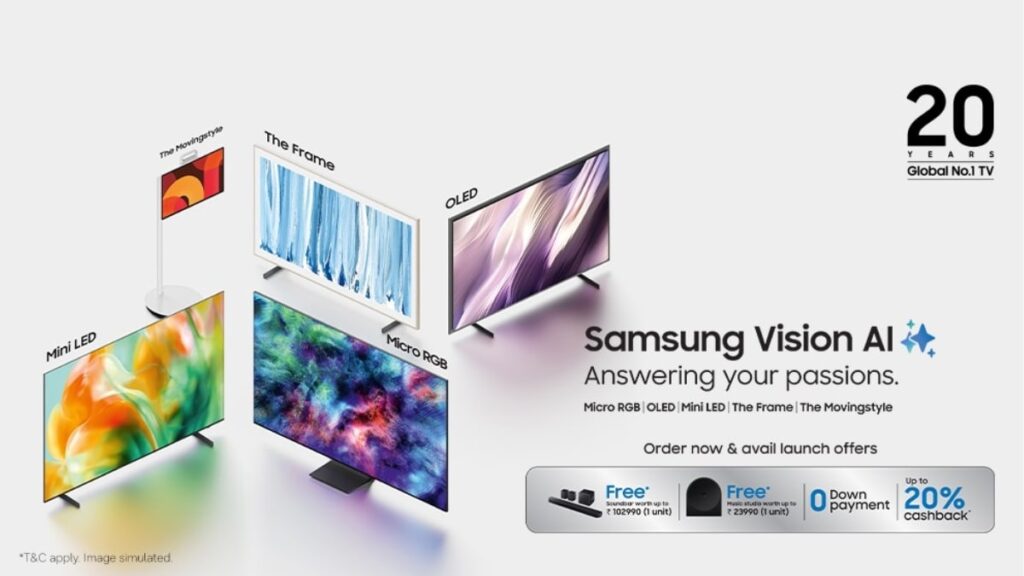
Table of Contents
A Massive Push for the Living Room
Samsung is not merely updating its catalog for the Indian market; it is attempting to redefine the television as an active AI hub. On Wednesday, the South Korean electronics giant unveiled a staggering 72 new television models, ranging from entry-level UHD sets to the cutting-edge Micro RGB displays. The sheer volume of the rollout suggests a strategic move to capture multiple price brackets simultaneously while pushing a new software layer: the Vision AI Companion (VAC).
The centerpiece of this launch is the expansion of VAC, an integrated AI suite designed to handle everything from real-time picture optimization to deep content personalization. Unlike previous iterations of AI upscaling, which primarily focused on resolution, the 2026 Vision AI lineup aims to analyze the type of content being viewed—be it a live cricket match or a cinematic drama—and adjust sound profiles and contrast levels dynamically without manual intervention.
The Micro RGB Gamble
Of particular interest to tech enthusiasts is the official introduction of Micro RGB technology to India. While MicroLED has been a high-end curiosity for years, Samsung’s Micro RGB approach attempts to bring the benefits of self-emissive pixels—perfect blacks and extreme brightness—to a more sustainable production scale. Starting at Rs. 1,24,990, the Micro RGB line positions itself as the premium alternative to traditional OLED, promising longer lifespans and a lack of burn-in risks.
However, the real volume will likely live in the OLED and Neo QLED segments. OLED models, which continue to be the gold standard for contrast, now start at Rs. 1,14,990. Meanwhile, the Neo QLED series, which utilizes Mini LED technology to bridge the gap between standard LED and OLED, begins at a much more aggressive price point of Rs. 52,990, making high-end brightness accessible to a broader demographic.
Pricing and Market Positioning
Samsung has structured its pricing to ensure there is a ‘Vision AI’ option for nearly every household budget. The strategy is clear: lock users into the Samsung ecosystem by offering AI features even in the lower-cost tiers.
| Series | Starting Price (INR) | Key Tech Focus |
|---|---|---|
| Micro RGB | 1,24,990 | Self-emissive pixels, High Brightness |
| OLED | 1,14,990 | Infinite Contrast, Precision Color |
| Neo QLED | 52,990 | Mini LED, High Peak Luminance |
| The Frame | 56,990 | Matte Display, Art Integration |
| Mini LED | 42,990 | Enhanced Backlighting |
| UHD | 36,990 | Entry-level Smart Features |
The lifestyle segment also receives a boost, with the popular ‘The Frame’ series starting at Rs. 56,990. These sets are increasingly being marketed as home decor rather than just electronics, utilizing the new AI tools to better simulate the texture and appearance of real canvas art.
Software Over Hardware
While the hardware specs are impressive, the underlying narrative of this launch is the software. By deploying the Vision AI Companion across such a wide array of models, Samsung is moving toward a model where the TV acts as a central controller for the smart home. The AI isn’t just about the image on the screen; it’s about how the TV interacts with other connected devices in the room.
This move puts Samsung in direct competition with Sony’s cognitive processing and LG’s alpha-series processors, but Samsung’s advantage in India has always been its massive distribution network and aggressive pricing tiers. By offering a UHD model starting at Rs. 36,990 that still tastes the benefits of the AI ecosystem, Samsung is effectively creating a wide funnel to bring users into its software environment.
The rollout begins immediately across major retail outlets and online platforms in India, signaling the start of a transition where ‘AI’ is no longer a premium add-on, but the baseline for the modern television experience.


