Russia’s Manpower Crisis: Why Massive Cash Bonuses Aren’t Stopping the Recruitment Slump
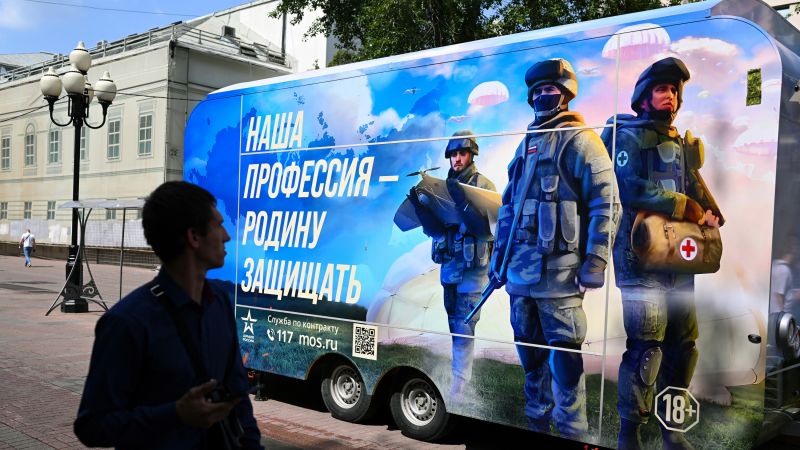
Table of Contents
The Breaking Point of Financial Incentives
For the first time in its modern history, the Russian state is attempting to buy its way through a war of attrition. In towns like Dolgoprundy and across social media feeds targeting young men, the advertisements are staggering: signing bonuses starting at 6 million rubles (approximately $80,000), a sum that dwarfs the average annual salary for many Russian citizens. For those burdened by debt, the Kremlin is offering to wipe out up to $140,000 in liabilities.
However, the data suggests a growing disconnect between the size of the check and the willingness of the population to sign. According to Russian economy expert Janis Kluge, military recruitment fell by 20% in the first quarter of this year compared to 2025. This decline indicates that the ‘financial shield’ the Kremlin hoped would protect it from the political fallout of a second forced mobilization is beginning to crack.
- The Recruitment Gap: A 20% drop in Q1 recruitment despite escalating bonuses.
- Economic Paradox: High military pay is fueling a nationwide labor shortage in the civilian sector.
- Industry Strain: Defense factories are operating at maximum capacity, limiting further scaling.
- External Sourcing: Increased reliance on North Korean troops and foreign nationals to plug gaps.
The Mechanics of an Attritional Manpower Strategy
The Kremlin’s strategic blueprint has long relied on a simple, brutal calculation: Russia has more people and a larger industrial base than Ukraine. By maintaining a slow, grinding campaign, Moscow intended to outlast Kyiv’s resolve and resources. While oil prices—bolstered by partnerships with nations like Iran—have kept the war coffers full, the human element of this equation is proving far more volatile than the financial one.
Nigel Gould-Davies, a senior fellow for Russia and Eurasia at the International Institute for Strategic Studies (IISS), argues that “rubles don’t fight wars.” The shift from conscription to a contract-based, paid force has introduced a market dynamic that the Kremlin cannot fully control. When the perceived risk of death on the front lines outweighs a life-changing sum of money, the recruitment pipeline stalls.
The Psychological Barrier to Entry
The failure of these bonuses isn’t just about the money; it’s about the reporting coming back from the trenches. Accounts of poor treatment, systemic mismanagement, and soldiers paying bribes to avoid “suicide missions” have permeated the domestic consciousness. For a potential recruit, an $80,000 bonus is irrelevant if the probability of survival is low. This creates a ceiling for voluntary recruitment that no amount of financial incentive can break.
The Industrial Collision: Defense vs. Civilian Economy
Russia is currently facing what Gould-Davies describes as the most severe labor shortage in its history. This is not merely a military problem; it is a systemic economic crisis. The defense industry is currently operating at peak capacity, with factories running 24/7 to produce shells, drones, and armored vehicles. However, this industrial surge has cannibalized the civilian workforce.
When the state offers massive bonuses to lure men into the army, it simultaneously removes productive laborers from the economy. When it expands defense factories, it pulls workers away from agriculture, healthcare, and logistics. The result is an inflationary spiral: as labor becomes scarcer, wages must rise to attract workers, which in turn drives up the cost of goods and services across the country.
| Sector | Impact of Manpower Shortage | Current State |
|---|---|---|
| Military Frontline | High casualty rates (est. 500k deaths) | Critical shortage/Reliance on foreign troops |
| Defense Industry | Maximum capacity reached | Labor bottleneck preventing output growth |
| Civilian Economy | Wage inflation due to scarcity | Severe shortage in skilled trades and services |
| Demographics | Mass emigration of fighting-age men | Irreversible loss of human capital |
Diversifying the Draft: Foreign Nationals and Prisoners
To avoid the political catastrophe of another general mobilization—which triggered a mass exodus of the tech-savvy middle class in 2022—Putin has diversified his recruitment sources. This “patchwork army” approach includes:
The Prisoner Pipeline
Tens of thousands of convicts have been offered pardons in exchange for frontline service. While effective for filling numbers, this has introduced significant security risks and operational instability within the ranks.
The North Korean Contingent
Recent reports confirm three separate waves of North Korean soldiers entering the conflict. This partnership allows Moscow to outsource the human cost of the war to Pyongyang in exchange for technology and currency.
Globalized Recruitment
The Kremlin is increasingly targeting immigrants from India and various African nations. By offering fast-tracked citizenship and high pay, Russia is attempting to replace its own missing demographic with foreign nationals who have fewer political ties to the Russian state.
What This Means for the Conflict’s Trajectory
The current manpower trend suggests that Russia is approaching a point of diminishing returns. If the state cannot recruit volunteers and refuses to mobilize the general population, it must either scale back its territorial ambitions or rely entirely on external proxies.
For the average observer, the critical metric is no longer how many tanks Russia can produce, but how many qualified operators they can find to crew them. A factory can be built, and money can be printed, but as Gould-Davies notes, the state cannot dictate the birth rate or suddenly create a new generation of soldiers.
The Risk of a Second Mobilization
The specter of another forced draft looms. To make it work this time, the Kremlin would likely need to implement draconian measures, such as restricting the movement of men of conscription age and closing borders. This would be a gamble of immense proportions, potentially alienating the remaining support base within Russia’s urban centers.
The Regional Pressure Valve
Some analysts, including Maria Snegovaya of the Center for Strategic and International Studies (CSIS), suggest the Kremlin may avoid a general draft by squeezing the periphery. By putting immense pressure on regional governors to meet quotas—targeting students and rural populations—Putin can maintain a steady trickle of recruits without triggering a national uprising in Moscow or St. Petersburg.
Frequently Asked Questions
Why are Russian military bonuses so high?
The Kremlin is using financial incentives to avoid the political backlash of forced mobilization. By offering sums like $80,000, they aim to attract volunteers through economic desperation rather than legal mandate.
Why is the labor shortage affecting the civilian economy?
The massive shift of manpower into the military and defense industries has left other sectors—like farming and manufacturing—without enough workers. This scarcity drives up wages, which contributes to overall inflation in Russia.
How many soldiers has Russia lost?
While official numbers are rarely released, Western intelligence reports estimate that nearly 500,000 Russian soldiers have died in the conflict, with hundreds of thousands more wounded or missing.
What is the role of North Korean troops in Russia?
North Korea has provided waves of soldiers to bolster Russian lines. This allows the Kremlin to maintain offensive pressure without needing to draft more of its own citizens.
Will there be another general mobilization in Russia?
It remains a possibility if voluntary recruitment continues to drop. However, President Putin has avoided this so far due to the extreme unpopularity of the 2022 partial mobilization.
Final Analysis: The Human Capital Ceiling
The Russian war effort is currently a race between industrial output and human depletion. While the defense sector’s ability to produce hardware remains robust, the capacity to field and train effective personnel is waning. The 20% drop in recruitment is a critical signal that the financial incentive model has a ceiling. As the war enters its fifth year, the Kremlin’s reliance on foreign soldiers and prisoners is not a sign of strength, but a necessary adaptation to a vanishing domestic manpower pool.