Redwire Proposes a Blueprint for Orbital Data Centers to Solve Space’s Biggest Heat Problem
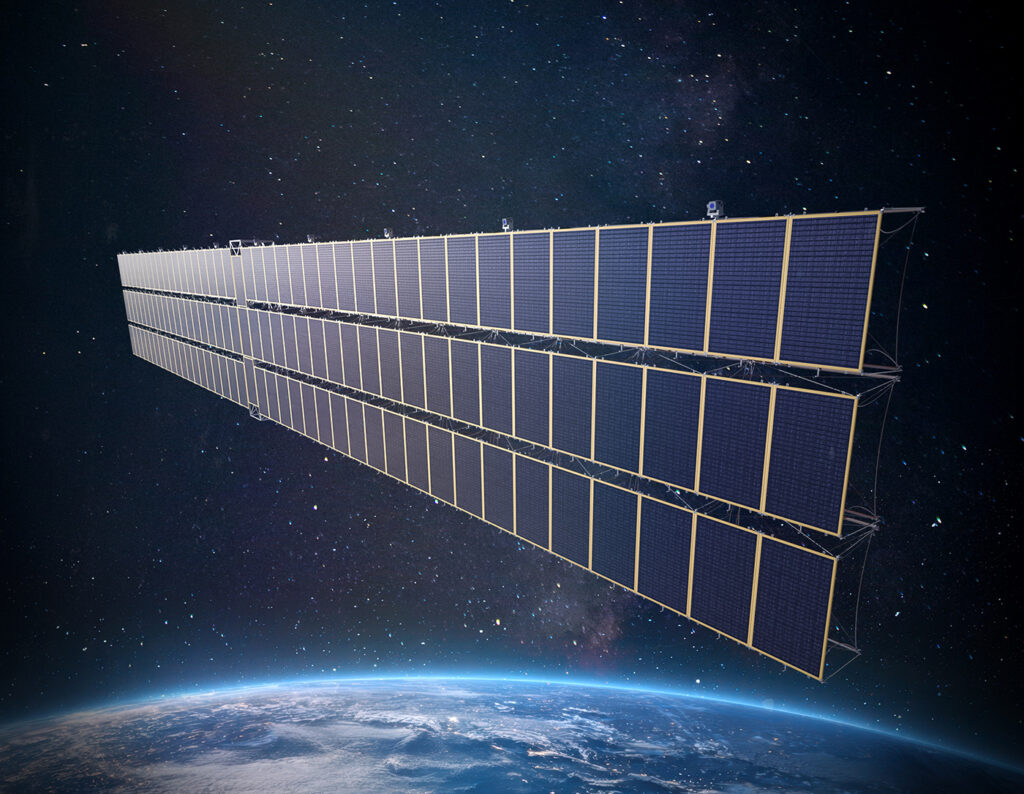
Table of Contents
The Vacuum Problem
Computing in space is fundamentally a battle against thermodynamics. On Earth, data centers rely on massive HVAC systems and chilled water loops to move heat away from processors. In the vacuum of Low Earth Orbit (LEO), there is no air to carry heat away via convection, leaving radiation as the only viable method of cooling. As the industry pushes toward putting high-performance AI chips and server racks in orbit, this physical limitation has become the primary bottleneck for scaling.
Redwire Corporation (NYSE:RDW) is attempting to solve this in a new technical whitepaper that outlines a scalable architecture for orbital data centers. Rather than treating power and cooling as secondary add-ons, Redwire argues that thermal rejection must be the primary architectural driver for any viable space-based compute platform.
Integrating Power and Heat
The core of Redwire’s proposal centers on the synergy between power generation and heat dissipation. High-performance computing (HPC) requires immense electrical loads, which in turn generate concentrated thermal energy. To address this, the company suggests a modular approach utilizing its flight-proven Roll-Out Solar Array (ROSA) technology.
ROSA arrays provide the high-density power necessary to run data center-class hardware, but the whitepaper emphasizes that power generation is only half the equation. The infrastructure must be designed as a closed-loop system where electrical distribution and thermal management are integrated. By leveraging deployable structures, Redwire proposes that orbital nodes can expand their radiator surface area dynamically, allowing the system to scale its compute capacity without overheating the hardware.
The Role of Deployable Radiators
Traditional satellites use fixed radiators, which limit the amount of heat they can shed. For a data center—where TDP (Thermal Design Power) can reach hundreds of watts per chip—fixed panels aren’t enough. Redwire’s approach utilizes deployable radiator technologies that can unfurl in orbit, significantly increasing the surface area available for infrared radiation. This allows for a higher compute-to-mass ratio, making it economically feasible to launch server-grade hardware into space.
Why Move the Cloud to Orbit?
The move toward orbital compute is not merely a novelty; it is a response to the growing volume of data being generated by Earth observation satellites. Currently, most satellites act as “bent pipes,” capturing data and beaming it back to ground stations for processing. This creates a massive latency bottleneck and consumes significant downlink bandwidth.
By implementing orbital data centers, the industry can shift toward edge computing in space. Processing data on-site allows satellites to filter noise and only send critical insights back to Earth. For example, a satellite detecting a wildfire via multispectral imaging could process the alert in orbit and notify emergency services in milliseconds, rather than waiting for a ground-station pass.
Bridging the Gap to Commercial Reality
While the concept of space-based clouds has been discussed for years, Redwire is positioning itself as the hardware enabler. By using existing, flight-proven components like ROSA, the company is moving the conversation from theoretical physics to engineering reality. The near-term goal is the deployment of individual compute nodes—essentially “space servers”—that can be clustered together to form a larger distributed network.
The success of these architectures will likely depend on the cost of launch and the longevity of the hardware in the harsh radiation environment of space. However, by solving the thermal and power constraints first, Redwire is removing the most immediate physical barrier to a scalable orbital cloud.