Commonwealth Fusion Systems Lays Out the Physics for Its 400 MW Commercial Reactor
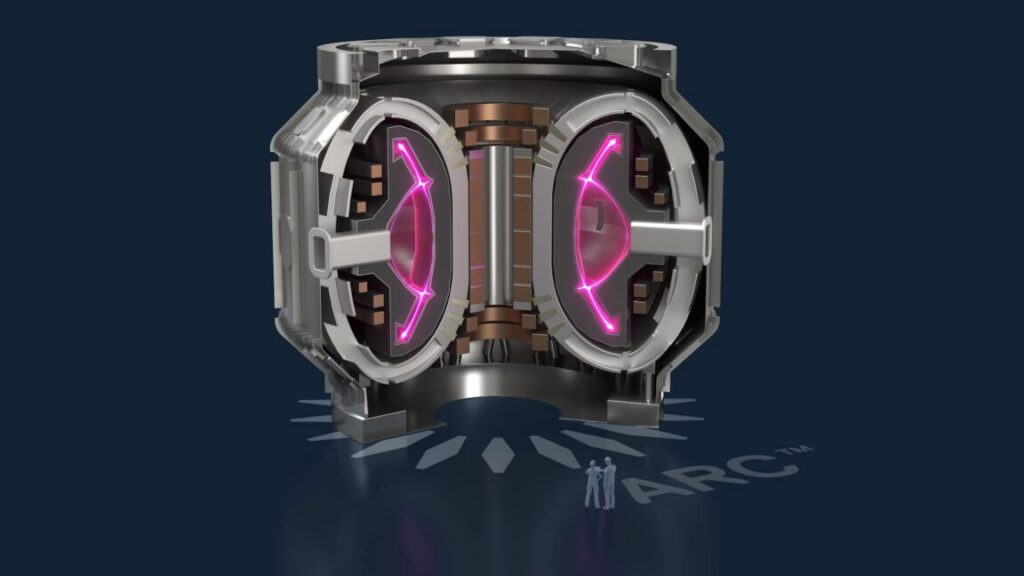
Table of Contents
A Faster Path to the Grid
For decades, the roadmap to commercial fusion energy has been dominated by the ITER project—a massive, multi-national effort to prove that a tokamak-style reactor can maintain a stable plasma. However, ITER’s timeline is glacial, with hot plasmas not expected until the mid-2030s. For many in the energy sector, that timeline is an eternity, especially as renewables like solar continue to plummet in cost.
Commonwealth Fusion Systems (CFS) is attempting to disrupt this slow-motion trajectory. Rather than waiting for the institutional momentum of ITER, CFS is betting on high-temperature superconductors (HTS) to shrink the hardware and accelerate the physics. Their immediate goal is SPARC, a compact tokamak currently over 70 percent complete and slated for operation as early as next year. But the real prize is ARC, the commercial-scale follow-on designed to deliver actual electricity to the grid.
To move ARC from a conceptual blueprint to a viable power plant, CFS recently collaborated with the academic community to release five peer-reviewed papers in the Journal of Plasma Physics. These documents serve as the “physics case” for ARC, detailing the modeling and the empirical gaps that SPARC must fill before a production plant can be finalized.
The Mechanics of the ARC Plant
The ARC design is a tokamak that utilizes a fusion reaction between deuterium and tritium, the two heavier isotopes of hydrogen. This process creates a helium nucleus and releases a high-energy neutron. While the helium (referred to as “ash”) helps maintain plasma conditions, the neutrons are the primary vehicle for energy extraction.
The reactor is surrounded by a blanket of molten salt containing lithium ions. This serves two critical purposes: the salt absorbs the neutron energy to generate heat for turbines, and the lithium reacts with those neutrons to breed more tritium, essentially creating a self-sustaining fuel cycle.
Based on current modeling, the design is projected to generate roughly 1.13 GW of fusion power. Once you account for energy lost to system inefficiencies and the 100 MW required to run the plant’s own internal systems, the net output to the grid is estimated at 400 MW. It is important to note that these figures are center-range estimates; CFS admits a variance between 900 MW and 1.3 GW, meaning the final grid output could shift depending on the actual plasma performance.
Solving the Stability Problem
Fusion is not a steady-state burn; it is a series of pulses. ARC is designed to operate in 15-minute windows, followed by one-minute resets. This “pulsed” approach is intended to prevent the system from overheating while using thermal inertia to keep power generation relatively constant.
The most significant engineering hurdles remain the “devils in the details”: magnetic instabilities and ash accumulation. If the plasma loses containment, charged particles can slam into the reactor walls. To mitigate this, CFS is using tungsten shielding on the inner walls and has designed the vacuum vessel to be replaced every one to two years. The entire tokamak is engineered to split in half, allowing for modular maintenance and design iterations.
To handle the helium ash, CFS employs a “divertor”—a specific area where magnetic field lines are shaped to exhaust waste material. According to the research, the company plans to inject radiating impurities like argon or neon to achieve “divertor detachment,” a state that prevents the plasma-facing components from eroding under extreme heat.
The path from the experimental SPARC to the commercial ARC depends on whether these theoretical models hold up under real-world conditions. While the physics case is now public and peer-reviewed, the empirical proof will only arrive once the first plasmas are ignited.


