POCO Pad C1 Debuts as a Budget-Friendly 4G Workhorse with a 2K Display
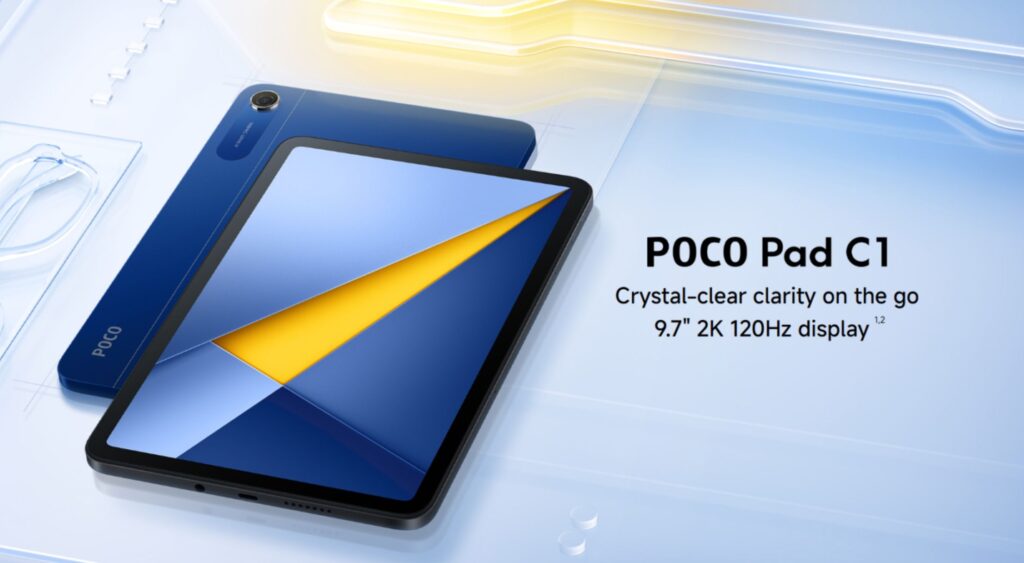
Table of Contents
Xiaomi expands budget slate portfolio with the POCO Pad C1
Xiaomi has officially broadened its ecosystem of affordable computing with the global debut of the POCO Pad C1. Positioned as a mid-to-low range alternative for students and casual media consumers, the C1 leans heavily into display quality and slim aesthetics to compete in a crowded budget Android tablet market.
The device is designed around a slim 7.4 mm metal chassis, weighing in at 406 grams. While the build quality is aimed at providing a premium feel, the internals are strictly utilitarian, focusing on efficiency over raw power. The most striking feature is the 9.7-inch IPS panel, which boasts a 2K resolution and a 120Hz refresh rate—specs that are surprisingly competitive for a device expected to retail under the $300 mark.
To handle outdoor visibility, Xiaomi has tuned the display to reach 500 nits of typical brightness, peaking at 600 nits in direct sunlight. Given the trend toward eye-health certifications in modern hardware, the C1 arrives with TUV Rheinland certification, targeting low blue light emissions and flicker reduction to make it more viable for long reading sessions.
Performance and the 4G Trade-off
Under the hood, the POCO Pad C1 utilizes the Qualcomm Snapdragon 6s 4G Gen 2 chipset. While the industry has largely pivoted to 5G, the choice of a 4G-only processor allows POCO to keep the cost down while maintaining stable connectivity for those who don’t require ultra-high-speed cellular data on a tablet.
The hardware configuration consists of 6 GB of RAM paired with 128 GB of internal storage. For users dealing with large media libraries or offline academic archives, the inclusion of a microSD slot supporting up to 2 TB of expansion is a critical addition. The tablet runs on HyperOS 3.0, Xiaomi’s latest software layer that attempts to unify the experience across its phones, tablets, and IoT devices.
Interestingly, Xiaomi is pushing its AI integration down to the budget tier. The C1 supports features like Circle to Search and Google Gemini, suggesting that the device is intended to be more than just a video player, serving instead as a lightweight productivity tool for those accustomed to AI-assisted workflows.
Battery Life and Connectivity
Powering the experience is a 7,600 mAh battery. While the capacity is respectable, the charging speed remains a bottleneck; the device supports 18W wired charging, which is slow by modern smartphone standards but typical for budget tablets of this size. Xiaomi claims this setup will yield approximately 15 hours of continuous video playback or nearly two days of moderate daily use.
In a move that will please audio enthusiasts and students, POCO has retained the 3.5 mm headphone jack, avoiding the dongle-dependency found in more expensive flagship slates. This is complemented by dual speakers designed for front-facing audio delivery during streaming.
The camera array is purely functional. An 8 MP sensor handles the rear, while a 5 MP shooter is embedded in the front for video calls. Given the device’s primary use case as a consumption tool, these specifications are adequate, though they won’t satisfy those looking for a creative tool.
Market Positioning
While comprehensive regional pricing has not been fully detailed across all markets, industry indicators suggest the POCO Pad C1 will sit comfortably below $300. This puts it in direct competition with the Samsung Galaxy Tab A series and Lenovo’s budget offerings.
By combining a high-resolution 120Hz screen with a slim metal build and the flexibility of 4G connectivity, the POCO Pad C1 avoids the “plastic feel” of many budget tablets, offering a polished, if modest, experience for the entry-level consumer.


