OPPO Pad 6 Debuts with Slim Design and Dimensity 9500s Power
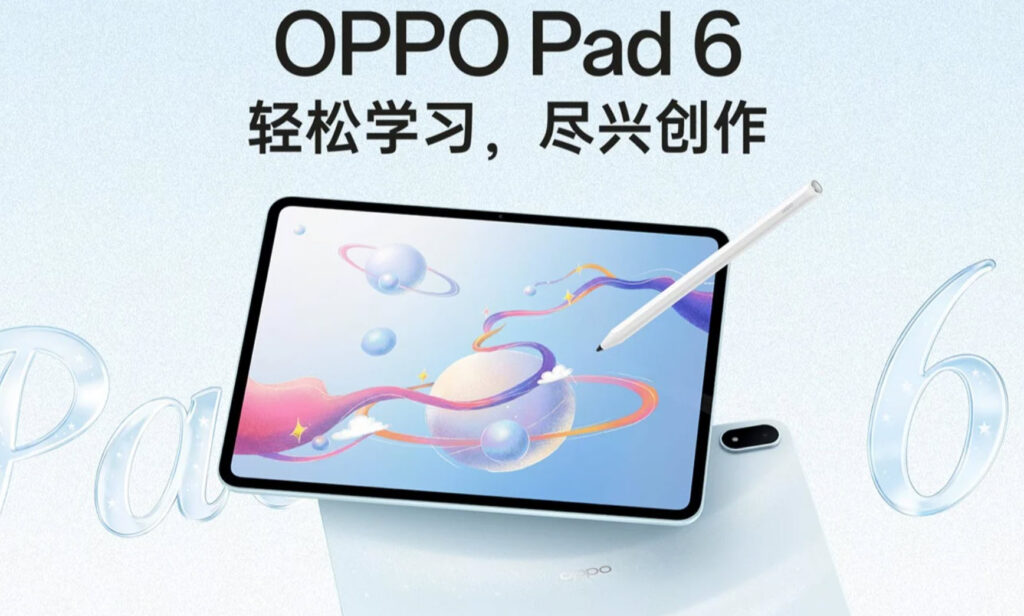
Table of Contents
A Thin Profile for a Productivity Push
OPPO has officially expanded its tablet portfolio with the launch of the Pad 6 in China. While the company has spent the last few months diversifying its slate offerings—including the high-end Pad 5 Pro and the more compact Pad Mini—the Pad 6 arrives as a refined attempt to balance portability with high-end processing power.
The most immediate takeaway from the hardware reveal is the device’s physical footprint. At just 5.99 mm thick and weighing 577 grams, the Pad 6 is aggressively thin, positioning it as a direct competitor to the iPad Air and Samsung’s Galaxy Tab S series in terms of mobility. The device is launching in three distinct finishes: Starlight Blue, Galaxy Silver, and Deep Space Gray.
Display Technology and ‘Soft Light’ Integration
Center stage is a 12.1-inch 3K LCD panel. While OLED has become the gold standard for high-end tablets, OPPO is sticking with LCD here, opting instead to push the refresh rate to 144Hz. This high frequency ensures fluid navigation and smoother performance for gaming and creative work.
Of particular interest is the inclusion of a “Soft Light” screen design. Rather than a simple matte coating, this technology is designed to diffuse light and significantly reduce glare and reflections. For users who utilize tablets as primary document readers or digital notebooks, this approach mitigates the eye strain often associated with high-gloss glass panels under harsh office lighting.
Performance: The Dimensity 9500s Edge
Under the hood, the Pad 6 is powered by the MediaTek Dimensity 9500s. This chipset has recently gained attention for its appearance in the POCO X8 Pro Max, and its transition to the tablet form factor suggests a focus on sustained performance and thermal efficiency. According to internal benchmarks, the chip is capable of exceeding 3 million points on AnTuTu, placing it firmly in the upper echelon of Android productivity devices.
To sustain this performance, OPPO has equipped the slate with a substantial 10,420 mAh battery. While the capacity is generous, the 67W fast charging is the more critical spec, allowing users to top up the massive cell without the hours-long wait typical of older large-format tablets.
Software Ecosystem and Convergence
Hardware specs aside, the Pad 6 is designed to function as more than just a consumption device. OPPO is leaning heavily into “PC-style” productivity, introducing a revamped file management system and floating windows that mimic a desktop environment. Stylus support is integrated, catering to the creative and professional demographic.
One of the more practical additions is the enhanced ecosystem connectivity. The Pad 6 can share a nearby OPPO phone’s 5G connection directly, reducing the friction of setting up mobile hotspots and allowing for a more seamless transition between mobile and tablet workflows.
While the jump from the Pad 5 to the Pad 6 may seem incremental in terms of raw numbers, the combination of the 144Hz display, the Dimensity 9500s, and the ultra-slim chassis suggests a device optimized for the modern “prosumer” who needs a portable workstation without the bulk of a traditional laptop.


