Plastic over Petals: Urban Bowerbirds are Trading Nature for Human Trash to Win Mates
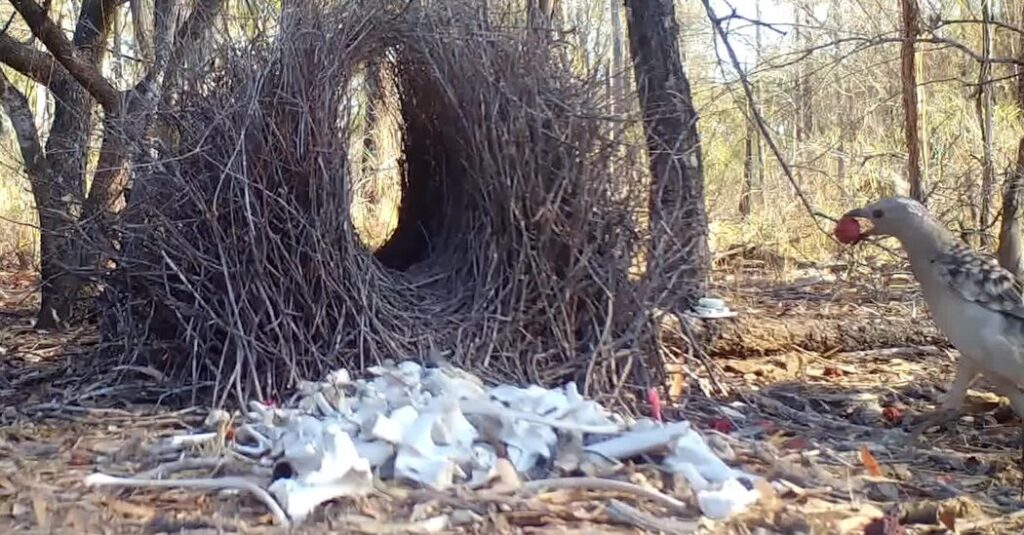
Table of Contents
The High Cost of Urban Fashion
In the dense forests of northern Australia, the great bowerbird is renowned for its architectural precision. Male birds spend months constructing intricate tunnels—known as bowers—which serve as ornate stages for mating displays. Historically, these structures were adorned with the spoils of the forest: bleached bones, vibrant petals, seeds, and carefully selected grasses. However, as these birds migrate into human settlements, the definition of ‘luxury’ is shifting from the organic to the synthetic.
A recent study published in Royal Society Open Science suggests that the urban environment isn’t just changing where these birds live; it is fundamentally altering their aesthetic preferences. Researchers found that great bowerbirds inhabiting cities and towns are increasingly abandoning natural materials in favor of brightly colored, man-made debris.
The Plastic Pivot in Queensland
The research, led by Caitlin Evans, a Ph.D. student at the University of Exeter, involved a comprehensive cataloging of 61 bowers across Queensland, Australia. By comparing nests located within the city limits of Townsville against those on the outskirts of rural cattle ranches, the team identified a stark divergence in decorating trends.
While rural bowerbirds stuck to a palette of green leaves and seeds, their urban counterparts leaned heavily into the ‘neon’ offerings of human waste. The study noted a particular affinity for red wire and green glass, but the most striking discoveries were the “statement pieces.” In several urban bowers, researchers documented the use of plastic packaging, homegrown hot peppers, and even discarded cash—items that provide a level of visual saturation and contrast that natural forest materials simply cannot match.
Preferring the Artificial
The most significant finding of the study is not merely that urban birds use plastic because it is available, but that they actively prefer it. When presented with a choice between natural organic materials and artificial accouterments, the birds consistently opted for the synthetic versions.
This shift suggests a behavioral adaptation to the “visual noise” of the city. In a gray, concrete landscape, a piece of bright red plastic is far more visible to a potential mate than a brown seed or a green leaf. By integrating anthropogenic materials, male bowerbirds may be evolving their courtship strategies to ensure they stand out in a crowded, human-dominated environment.
The Ecological Trade-off
While this adaptation showcases the impressive plasticity of the species, it raises questions about the long-term impact of living in a plastic-saturated habitat. The transition to synthetic decor is a clear signal of how human waste is integrating into the reproductive cycles of wildlife. As these birds prioritize high-visibility plastic over biological indicators of health (like the ability to find rare natural items), the criteria for “fitness” in the eyes of female bowerbirds may be permanently rewritten.
The research highlights a broader trend seen across various avian and mammalian species in urban hubs: the transition from utilizing natural resources to exploiting human leftovers. In the case of the great bowerbird, the result is a surreal gallery of urban detritus that serves as a testament to the bird’s resilience—and the pervasive reach of human pollution.