Nvidia Taps Unitree for ‘Physical AI’ Push as Chinese Robotics Startup Eyes $620 Million IPO
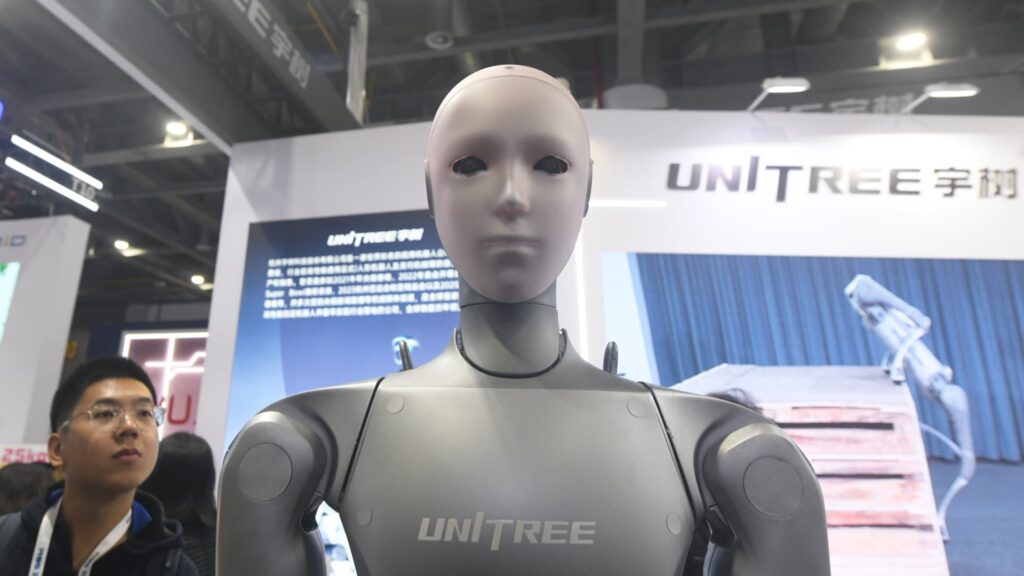
Table of Contents
A Strategic Pivot Toward ‘Physical AI’
Nvidia is moving aggressively to bridge the gap between generative AI and the physical world. In a significant strategic partnership, the chip giant has selected Chinese humanoid robot manufacturer Unitree to serve as the primary hardware vehicle for its latest robotics research system. The collaboration aims to democratize high-end humanoid development, moving it out of the exclusive domain of trillion-dollar tech firms and into university laboratories.
The centerpiece of this initiative is a sophisticated integration of Unitree’s nearly 6-foot-tall H2 humanoid robot with Nvidia’s Jetson Thor hardware. By embedding the Blackwell GPU architecture directly onto the robot, Nvidia is essentially creating a mobile supercomputer capable of processing complex AI workloads on-device, reducing the latency that has long plagued real-time robotic interaction.
The Hardware Stack: From Blackwell to Dexterous Hands
The technical synergy here is deep. The platform isn’t just a robot with a chip; it’s a full-stack implementation of Nvidia’s vision for “Physical AI.” According to CEO Jensen Huang, the system is designed to be a reference humanoid, combining 31 degrees of freedom in the body with highly complex mechanical hands provided by Singapore-based Sharpa, which offer 25 degrees of freedom each.
Running the entire operation is the Nvidia Isaac GR00T model—a general-purpose foundation model for humanoid robots. By pairing this software with a comprehensive data generation and simulation stack, researchers can train robots in virtual environments before deploying the learned behaviors to the physical H2 hardware. This “sim-to-real” pipeline is critical for scaling robotics without the risk of damaging expensive hardware during the trial-and-error phase of machine learning.
Democratizing the Humanoid Lab
For years, the development of humanoid robots has been gated by immense capital requirements and proprietary hardware. Nvidia is attempting to break this bottleneck by targeting higher education and independent research centers. Rev Lebaredian, Vice President of Physical AI Simulation at Nvidia, stated that the goal is to put frontier research “in reach of every lab.”
The strategy is already gaining traction. Four prestigious institutions have already committed to the platform: the Stanford Robotics Center, ETH Zurich, UC San Diego’s Advanced Robotics and Controls Laboratory, and the Seattle-based Ai2. Notably, the current list of early adopters excludes China-based research arms, a detail that may reflect the complex geopolitical landscape surrounding high-end GPU exports and AI collaboration.
The Financial Stakes: Unitree’s Path to Public Markets
While Nvidia seeks a reliable hardware partner to showcase its software prowess, Unitree is leveraging the partnership to fuel a massive expansion. The startup is currently pursuing a listing on Shanghai’s STAR board, seeking to raise approximately 4.2 billion yuan (roughly $620 million).
The timing of the IPO is calculated. By securing a high-profile endorsement from Jensen Huang and integrating with the Blackwell ecosystem, Unitree signals to investors that it is more than just a hardware assembler—it is a key player in the global AI infrastructure. The company’s growth is already global; more than 40% of its revenue is now generated outside of China, suggesting a successful pivot toward the international research and commercial markets.
The next milestone comes in October with the release of the H2 Plus, an upgraded version of the humanoid robot that Nvidia confirms will be available for general purchase. This transition from a closed research tool to a commercial product marks a pivotal moment in the industry: the era of the “off-the-shelf” humanoid is arriving, powered by the same silicon that fueled the LLM revolution.