Lenovo’s ThinkStation P4 Targets AI Workflows with Ryzen 9000 and Blackwell GPUs
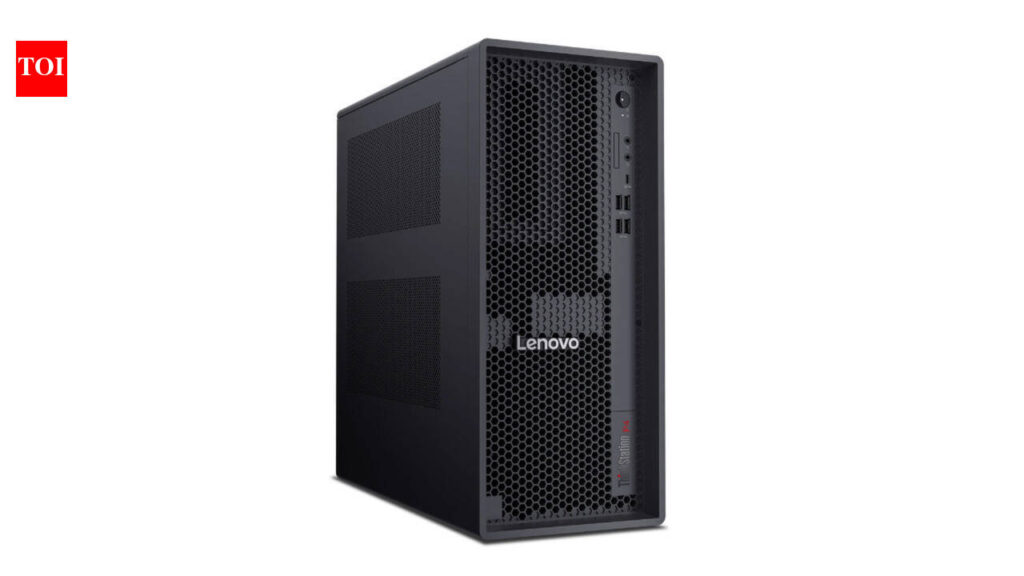
Table of Contents
A New Baseline for Local AI Compute
Lenovo has officially expanded its professional desktop lineup with the launch of the ThinkStation P4. While the workstation market has traditionally focused on raw CPU clock speeds and massive RAM pools for CAD and 3D rendering, the P4 represents a pivot toward local AI development and heavy-duty data processing. By pairing AMD’s newest silicon with Nvidia’s Blackwell architecture, Lenovo is positioning the P4 as a bridge between a standard desktop and a full-scale server rack.
At the heart of the P4 is the AMD Ryzen PRO 9000 Series. The inclusion of 3D V-Cache technology is the standout technical detail here; by stacking L3 cache vertically on the processor die, Lenovo is targeting the specific latency bottlenecks that often plague complex simulation software and large-scale dataset compilation. For engineers and data scientists, this means a significant reduction in the time it takes for the CPU to access critical data, which typically results in smoother performance during high-iteration AI training tasks.
The Blackwell Advantage
The most aggressive specification in the ThinkStation P4 is the integration of the Nvidia RTX PRO 6000, powered by the Blackwell architecture. While the consumer-facing RTX 40-series is capable, the Blackwell-based PRO 6000 is built for stability and massive memory throughput. This GPU is designed specifically to handle Large Language Models (LLMs) and generative AI workflows that would typically crash a standard consumer workstation due to VRAM limitations.
By moving the compute power to the desktop, Lenovo is catering to a growing trend of “edge AI,” where companies prefer to run sensitive models locally rather than relying on cloud providers like AWS or Azure. This provides not only a layer of cybersecurity for proprietary data but also removes the latency associated with API calls to remote servers.
Thermal Management and Chassis Design
High-performance components like the Ryzen 9000 and Blackwell GPUs generate immense heat, a problem Lenovo has attempted to solve through a redesigned thermal architecture in the P4. The chassis utilizes a high-airflow configuration that isolates the GPU heat from the CPU, preventing the thermal throttling that often plagues compact workstations. This ensures that the P4 can maintain peak clock speeds during multi-hour rendering or training sessions without the fans sounding like a jet engine—though the noise levels will still be higher than a standard office PC.
The P4 also emphasizes modularity. Given how quickly AI hardware evolves, Lenovo has designed the internal layout to allow for relatively easy upgrades to storage and memory, ensuring the machine doesn’t become obsolete as soon as the next generation of GPUs arrives.
Positioning in a Crowded Market
The ThinkStation P4 enters a market where Dell’s Precision series and HP’s Z-workstations hold significant sway. However, by leaning heavily into the AMD/Nvidia synergy, Lenovo is making a play for the “prosumer” and mid-market enterprise segment. The focus isn’t just on the hardware, but on the ecosystem—ensuring that the drivers and BIOS are optimized for the specific demands of AI libraries and professional software suites.
While pricing for the top-tier configurations has not been fully detailed, the P4 is expected to sit at a premium, reflecting the cost of the Blackwell silicon and the specialized cooling required to keep the system stable under load.


