Lenovo Pushes Rollable Limits at CES 2026 with Expanding ThinkPad and Ultra-Wide Legion Concepts
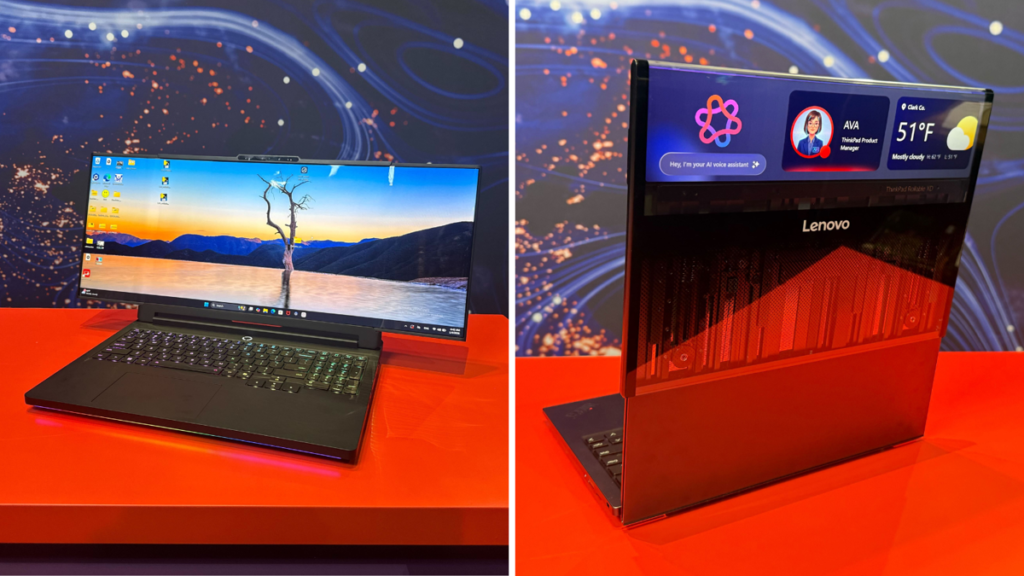
Table of Contents
Beyond the Fold: Lenovo’s New Bet on Rollable Silicon
While the industry has spent the last few years trying to perfect the fold, Lenovo is doubling down on the roll. At CES 2026, the company unveiled two distinct prototypes that move away from the crease and toward a more fluid, mechanical approach to screen real estate: the ThinkPad Rollable XD Concept and the Legion Pro Rollable Concept.
These aren’t just iterative updates to the ThinkBook Plus Gen 6 Rollable AI that hit the market last year. Instead, they represent two wildly different philosophies of how a laptop screen should grow. One focuses on vertical productivity and multi-surface utility, while the other aims to replace the need for a dedicated gaming monitor entirely.
The ThinkPad Rollable XD: A Vertical Powerhouse
The ThinkPad Rollable XD Concept targets the enterprise market with a display that expands vertically. In its base state, the device operates as a standard 13.3-inch laptop, but with a button press or a swipe along the lid’s edge, the OLED panel unfurls to nearly 16 inches. This 50 percent increase in vertical space is a clear nod to coders and analysts who spend their days scrolling through long spreadsheets or lines of script.
The most striking engineering feat, however, is the “world-facing” display. In a partnership with Corning, Lenovo has developed a transparent glass cover that allows the OLED panel to wrap 180 degrees over the top edge of the lid. This creates a secondary screen on the back of the laptop, but it also serves as a window into the machine’s guts. Because the glass is clear, users can see the fiber cables and motors that drive the rolling mechanism—which has been relocated from the base to the lid for a more streamlined chassis.
Control is handled via a fully touch-sensitive lid, though the current prototype lacks the voice and gesture controls found in earlier iterations. Given the fragile nature of the prototype—a point Lenovo emphasized before allowing demos—the current hardware is more of a proof-of-concept for the glass-wrapping technology than a retail-ready product.
Legion Pro Rollable: The Desktop Replacement
If the ThinkPad is about productivity, the Legion Pro Rollable is about raw immersion. This device eschews vertical growth for a horizontal expansion that is frankly staggering. The 240Hz OLED display features three distinct configurations:
- Focus Mode: A standard 16-inch layout for portable gaming.
- Tactical Mode: An expanded 21.5-inch screen for wider peripheral vision.
- Arena Mode: A full two-foot expansion that essentially transforms the laptop into a wide-format desktop monitor.
For gamers, this is a more intuitive alternative to dual-screen designs like the Asus ROG Zephyrus Duo, providing a continuous canvas without the need for a bridge or a physical gap. Under the hood, the prototype is specced to match the high-end Legion Pro 7i, featuring an Nvidia GeForce RTX 5090 GPU and the latest Intel Core processors.
However, the ambition comes with a cost. The device is visibly chunky and suffers from significant thermal output; during demos, the rear fan vents were blasting hot air even without a demanding game running. There were also minor superficial marks on the screen during the unfurling process, suggesting that while the 25,000-cycle durability rating is impressive on paper, the real-world friction of the internal mechanism still needs polishing.
The Cost of Innovation
The transition from concept to consumer is a long road at Lenovo. The original rollable concept took two years to reach the market. If these prototypes follow a similar trajectory, we may not see them in stores until 2028. Furthermore, the price point will likely be prohibitive for most. The ThinkBook Plus Gen 6 launched at $3,499.99; given the complexity of the Legion’s triple-mode expansion and the RTX 5090 hardware, the gaming variant could easily push toward the $5,000 mark.
Despite the bulk and the price, Lenovo’s willingness to experiment with OLED flexibility keeps them ahead of the curve. While competitors are refining the hinge, Lenovo is perfecting the roll.


