Lenovo MWC 2026: Foldable Gaming Handhelds, Modular PCs, and the Push for Repairable Hardware
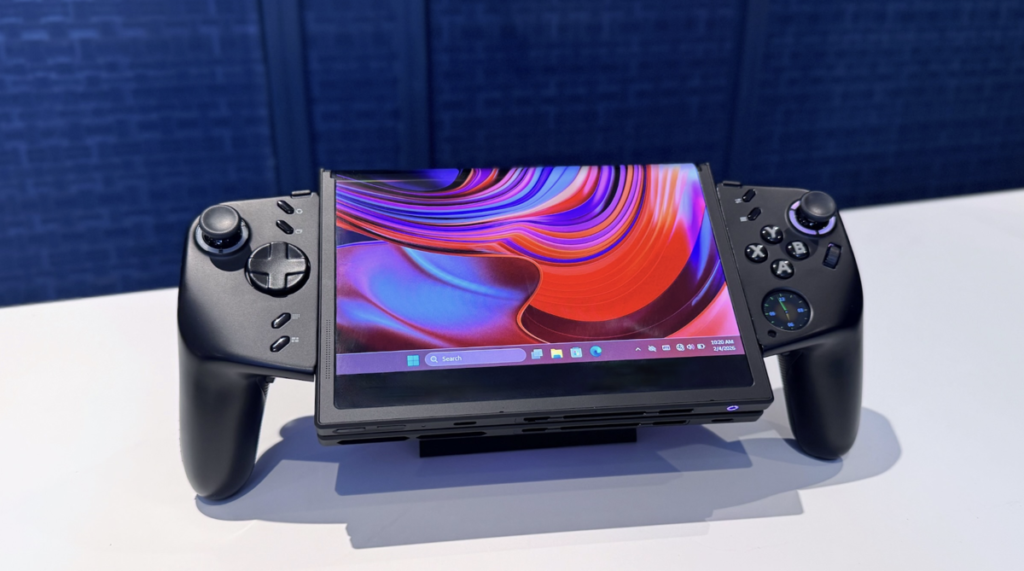
Table of Contents
A Pivot Toward Versatility and Sustainability
Lenovo has traditionally dominated the PC market through sheer scale and iterative refinement. However, at Mobile World Congress (MWC) 2026, the company shifted its narrative from ‘more of the same’ to ‘radical reconfiguration.’ The showcase wasn’t just about new SKUs; it was a concentrated effort to address two of the biggest pain points in modern computing: the rigid form factor of the laptop and the environmental toll of disposable electronics.
While the headlines will inevitably gravitate toward the flashy Legion Go Fold, the more significant story lies in Lenovo’s sudden, aggressive pivot toward modularity and repairability. From the ThinkBook Modular AI PC to the revamped T-Series design, Lenovo is signaling a departure from the sealed-shut era of ultra-portables, moving instead toward a philosophy that mirrors the success of companies like Framework.
- The Legion Go Fold: A gaming handheld that transforms into a tablet and a clamshell laptop.
- ThinkBook Modular AI PC: A prototype focusing on user-swappable ports and detachable displays.
- Yoga 9i Aura Edition: The new flagship 2-in-1 featuring Intel Core Ultra Series 3.
- AI Desktop Companions: The ‘Work Companion’ and ‘Workmate’ exploring localized AI interaction.
The Legion Go Fold: Redefining the Handheld Experience
The most discussed prototype at the event is undoubtedly the Legion Go Fold Concept. For those unfamiliar with the current handheld landscape, the transition from a 7.7-inch screen to an 11.6-inch POLED display represents more than just more screen real estate—it changes the device’s fundamental utility. In our hands-on time, the transition between handheld and tablet modes felt fluid, but the real innovation is the detachable wireless keyboard.
By pairing the unfolded screen with the keyboard, the device effectively becomes a compact Windows laptop. This isn’t just a gimmick; it’s a direct challenge to the ‘tablet-as-a-laptop’ struggle seen in the iPad Pro ecosystem. By utilizing Intel Lunar Lake architecture and 32GB of RAM, Lenovo is targeting a performance tier that can handle AAA gaming and productivity tasks without the thermal throttling typical of smaller handhelds.
Technical Specifications: Legion Go Fold Concept
| Feature | Specification |
|---|---|
| Display | 7.7″ (folded) to 11.6″ (unfolded) POLED |
| Processor | Intel Lunar Lake |
| Memory | 32GB RAM |
| Form Factor | Foldable Handheld / Detachable Laptop |
| Input | Wireless Keyboard + Detachable Controllers |
The Modular Shift: ThinkBook and Repairability
If the Legion Go Fold is the ‘flash,’ the ThinkBook Modular AI PC Concept is the ‘substance.’ The industry has long been criticized for ‘planned obsolescence,’ where a single failed port or a dead battery necessitates a full motherboard replacement. Lenovo’s new modular approach allows users to swap ports in and out, a feature that drastically extends the hardware’s lifecycle.
The integration of pogo-pin connectors for power and data transfer ensures that these modules aren’t just loosely attached but are electronically stable. Furthermore, the detachable secondary display and keyboard allow users to reconfigure their workspace on the fly. This level of flexibility is critical for the ‘hybrid’ workforce, where a device may need to function as a focused writing tool one hour and a multi-monitor data station the next.
This commitment to repairability isn’t limited to concepts. The ThinkPad X1 Carbon Gen 14 Aura Edition, which earned a Best of CES award earlier this year, utilizes a ‘Space Frame’ design. By making internals easily replaceable, Lenovo is acknowledging that the enterprise market—where T-Series laptops are staples—demands longer-lasting, more maintainable hardware.
Yoga 9i Aura Edition: The Refined Flagship
While concepts steal the spotlight, the Yoga 9i 2-in-1 Aura Edition is the product users will actually be buying this May. Priced at $1,949, it represents the pinnacle of Lenovo’s current consumer engineering. The inclusion of the Intel Core Ultra Series 3 chip provides a measurable bump in NPU (Neural Processing Unit) performance, which is essential for the local execution of the new Qira AI agent.
One of the most praised updates is the return of the headphone jack—a small but vital win for professionals who cannot rely on Bluetooth latency. The addition of a magnetic stylus case that enables ‘Canvas mode’ transforms the 2-in-1 from a consumption device into a genuine creative tool, bridging the gap between a traditional laptop and a digital easel.
AI Beyond the Screen: The Desk Companions
Lenovo is attempting to move AI out of the operating system and into the physical environment. The AI Work Companion and AI Workmate are experiments in ambient computing. The former acts as a productivity hub, using its ‘Thought Bubble’ to sync schedules and monitor screen time to prevent burnout—a nod to the growing corporate focus on mental health and productivity optimization.
The AI Workmate, resembling a robotic arm with an emoji-driven screen, is more ambitious. By processing inputs locally (on-device AI), it avoids the privacy pitfalls associated with constant cloud uploading. Its ability to scan documents and project content onto physical surfaces suggests a future where the ‘monitor’ is no longer a fixed rectangle but a dynamic projection across a workspace.
What This Means for the Consumer
The convergence of these announcements reveals a clear strategy: diversification of form. For years, the ‘laptop’ was a clamshell. Now, Lenovo is proposing that a computer can be a foldable handheld, a modular workstation, or an ambient desk lamp.
For the average user, this means more choice in how they interact with AI. Whether it’s through the Qira agent rolling out to 20+ devices or the hardware-level modularity of the ThinkBook, the goal is to reduce friction. For the environmentally conscious, the move toward ‘Space Frame’ designs and modular ports is a welcome shift toward a circular economy in tech, where we upgrade components rather than replacing entire machines.
Frequently Asked Questions
When will the Legion Go Fold be available for purchase?
The Legion Go Fold is currently a concept product. While Lenovo has shared internal specs (Intel Lunar Lake, 32GB RAM), they have not provided an official release date or pricing. Concepts are prototypes used to gauge interest and test viability.
What is the Yoga 9i Aura Edition and how much does it cost?
The Yoga 9i 2-in-1 Aura Edition is a premium convertible laptop featuring an Intel Core Ultra Series 3 chip and an improved port selection. It is scheduled for release in May 2026 with a retail price of $1,949.
How does the ThinkBook Modular AI PC improve repairability?
The ThinkBook Modular AI PC utilizes pogo-pin connectors and a modular chassis that allows users to swap out ports and peripherals (like keyboards and displays) without replacing the entire motherboard, significantly extending the device’s lifespan.
What is Qira, and which devices will support it?
Qira is Lenovo’s personal AI agent designed to assist with productivity and system management. Lenovo has announced that Qira will be integrated into more than 20 devices, with the rollout beginning in the weeks following MWC 2026.
Is the Yoga Book Pro 3D Concept useful for non-creators?
The Yoga Book Pro 3D is specifically targeted at 3D creators, utilizing eye-tracking technology to render 3D objects without glasses. While a novelty for general users, it provides a critical tool for architects, 3D artists, and engineers.