Ex-SpaceX VP’s New Venture Observable Space Secures $90M and Massive Space Force Contract
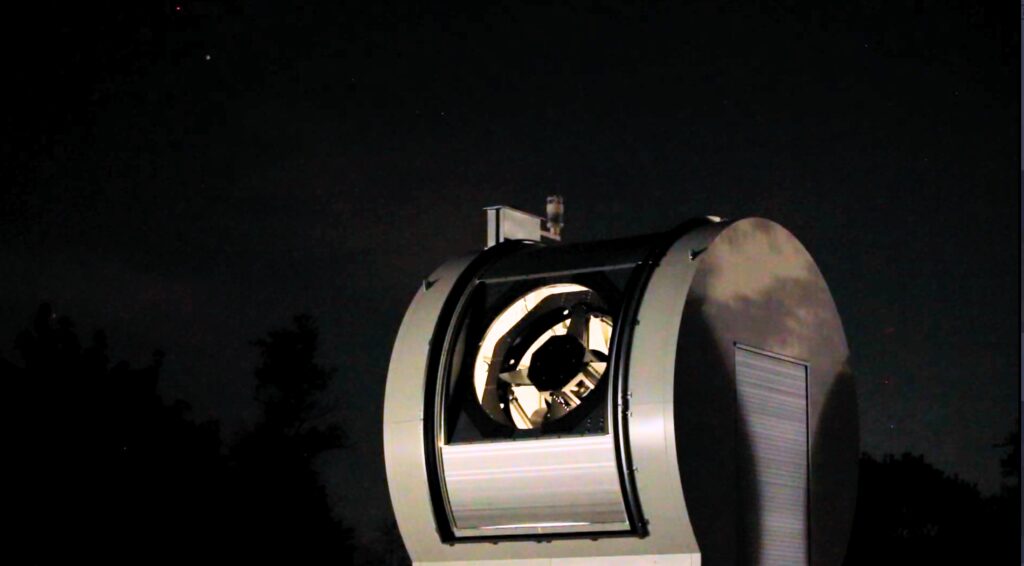
Table of Contents
The Race for Orbital Light
In the current arms race for orbital superiority, the ability to move data and track objects with precision is becoming as critical as the rockets that get them there. Observable Space, a firm specializing in high-end optical systems, is positioning itself at the center of this shift. The company recently announced a $90 million Series A funding round and a strategic contract with the U.S. Space Force, signaling a concerted push to move laser communications from experimental prototypes to scalable infrastructure.
The funding round was led by Lux Capital and co-led by Upfront Ventures, Detroit Venture Partners, Island Green Capital, and RTX Ventures, with additional participation from BRV Capital and Fathom Fund. For the investors, the play is clear: as AI compute demands skyrocket and satellite constellations grow more crowded, the traditional radio frequency (RF) spectrum is becoming a bottleneck. Free-space optics—essentially fiber optics without the cables—offer a path to terabit-per-second speeds that RF simply cannot match.
Military Grade Awareness
While the venture capital provides the runway, the U.S. Space Force is providing the immediate market validation. Observable Space has secured an indefinite-delivery, indefinite-quantity (IDIQ) contract with a maximum value of $94 million. The Pentagon has already committed $22 million in initial task orders to kickstart the production of Deployable, Attritable Optical Systems.
These are not traditional, static observatories. The Space Force is targeting “mobile, off-grid robotic telescopes” that can be rapidly deployed to track orbital objects. According to Jeremy Verbout, assistant secretary of defense for mission capabilities, these systems are designed to give the joint force high-fidelity space domain awareness—essentially a more precise, real-time map of what is happening in orbit and who is moving what.
The strategic shift toward “attritable” systems—hardware that is inexpensive enough to be considered expendable if lost or destroyed—reflects a broader Pentagon trend of prioritizing mass and agility over a few overly expensive, monolithic assets.
From the Moon to Michigan
The technical pedigree of the company is anchored by co-founder and CEO Dan Roelker, a former SpaceX vice president. Roelker’s vision centers on the idea that controlling light equates to controlling space. This isn’t just theoretical; Observable Space has already begun demonstrating its capabilities on a galactic scale.
During the Artemis 2 mission in April, the company deployed an optical communications ground station in Australia, working alongside the Australian National University. The system successfully locked onto laser transmissions from the Orion spacecraft as it navigated its lunar trajectory, hitting data rates of 260 megabits per second. While that speed is modest compared to terrestrial fiber, achieving it over the vast distances between Earth and the Moon is a significant engineering feat.
The company is also moving beyond ground stations. Its “Iguana” 200-millimeter multispectral imager is slated to fly on a spacecraft from Apex later this year, pushing the company’s optical stack directly into the vacuum of space.
Industrializing the Optical Stack
To meet these demands, Observable Space is expanding its physical footprint. Currently operating out of Adrian, Michigan, the company is scaling up with a new facility in Detroit, while maintaining engineering and design labs in Los Angeles. This hybrid of Midwestern manufacturing and Californian design is intended to solve the “scale problem” that has historically plagued high-end optical instruments.
This scalability is also being applied to civilian science. Through a partnership with Schmidt Sciences, Observable Space is producing the telescopes for the Argus Array, a massive project comprising 1,200 small telescopes. By treating telescope production more like a hardware assembly line than a boutique laboratory, Observable Space is attempting to commoditize high-precision optics for both the military and the scientific community.