DJI Osmo Pocket 4 Review: Can a 1-Inch Sensor Finally Kill the Vlogging Smartphone?
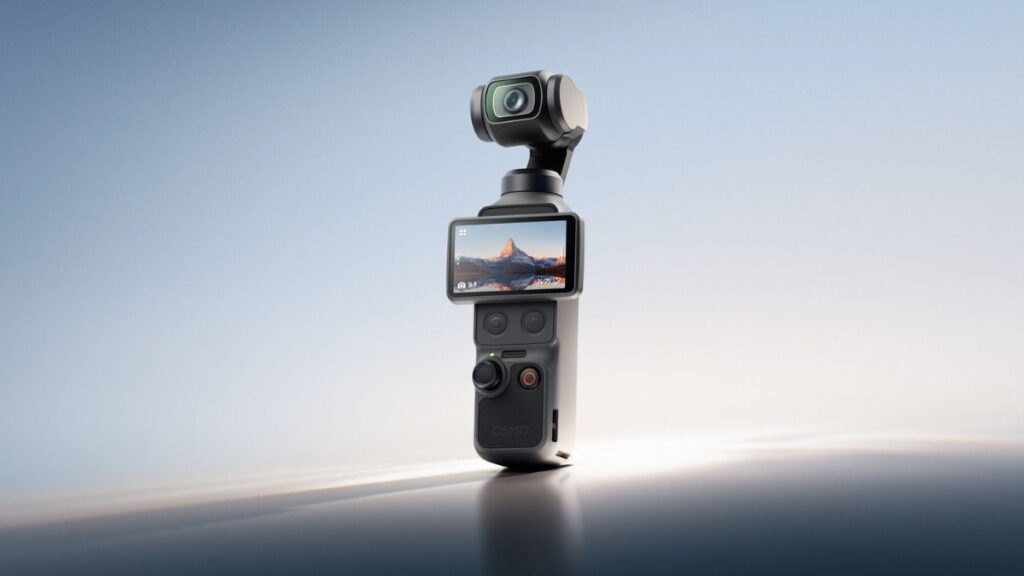
Table of Contents
The Pivot to Large-Format Imaging in Your Pocket
DJI has officially expanded its handheld imaging ecosystem with the global launch of the DJI Osmo Pocket 4. While the industry has largely moved toward computational photography via smartphones, DJI is doubling down on physical hardware. The centerpiece of this iteration is the transition to a larger 1-inch CMOS sensor, a move that fundamentally alters how this device handles low light and dynamic range compared to the smaller sensors found in typical action cams.
For creators, the friction point has always been the trade-off between stability and image quality. A smartphone on a gimbal is bulky; a dedicated action cam often struggles in dim environments. The Osmo Pocket 4 attempts to bridge this gap by housing a professional-grade sensor within a chassis that still fits in a jacket pocket. This isn’t just a marginal bump in resolution; it is a strategic shift in light gathering capability that targets the ‘prosumer’ vlogger who requires cinematic depth of field without carrying a full-frame mirrorless rig.
- Sensor Leap: The 1-inch CMOS sensor significantly reduces noise in low-light scenarios.
- Stabilization: Enhanced 3-axis mechanical gimbal combined with electronic horizons.
- Pricing: Standard Combo starts at €499; Creator Combo at €619.
- AI Integration: New AI-driven subject tracking for solo creators.
Breaking Down the 1-Inch Sensor Advantage
To understand why the 1-inch CMOS sensor is the headline feature, we have to look at the physics of light. In the world of digital imaging, sensor size is often more critical than megapixel count. A 1-inch sensor has a significantly larger surface area than the sensors found in the DJI Action series or most mid-range smartphones. This means each individual pixel (photosite) can capture more photons, resulting in a higher signal-to-noise ratio.
In practical terms, this means the Osmo Pocket 4 can maintain a clean image in a dimly lit cafe or during a sunset shoot without the ‘grainy’ artifacts typical of smaller sensors. Furthermore, the larger sensor allows for a shallower depth of field. While we aren’t talking about the extreme bokeh of a 50mm f/1.8 lens, there is a noticeable, natural blur to the background that separates the subject from the environment—a key requirement for high-production-value vlogs.
Technical Specifications Comparison
| Feature | Osmo Pocket 3 | Osmo Pocket 4 |
|---|---|---|
| Sensor Size | 1-Inch CMOS | Enhanced 1-Inch CMOS (Gen 2) |
| Max Resolution | 4K / 60fps | 4K / 120fps (High Bitrate) |
| Stabilization | 3-Axis Mechanical | 3-Axis + AI Adaptive Dampening |
| Tracking | ActiveTrack 5.0 | ActiveTrack 6.0 (Neural Processing) |
| Battery Life | ~160 mins | ~180 mins (Optimized) |
The Creator Combo: More Than Just Accessories
DJI is pushing the Creator Combo at €619, and for the first time, the bundle feels essential rather than optional. The inclusion of the DJI Mic 3 Transmitter is the most critical update here. Audio is historically the weakest link in vlogging; internal microphones often pick up wind noise or sound ‘tinny.’ By integrating the Mic 3, DJI is treating the Pocket 4 as a complete production studio.
The addition of the fill light is particularly useful for the 1-inch sensor. While the sensor handles low light better, a controlled light source allows for professional skin tones in harsh environments. The wide-angle lens attachment further extends the versatility, allowing creators to capture expansive landscapes or tight interior shots without needing to move the camera physically backward.
AI Tracking and the ‘Solo Operator’ Workflow
One of the most frustrating aspects of solo vlogging is the ‘frame drift’—where you move slightly out of center and the camera doesn’t keep up. The Osmo Pocket 4 introduces what DJI calls ActiveTrack 6.0. Unlike previous versions that relied heavily on contrast detection, the new system utilizes a neural processing unit (NPU) to better understand human silhouettes and facial features.
This means that if you walk behind a pillar or another person momentarily obscures the view, the gimbal is far more likely to ‘remember’ your position and snap back to you instantly. This reduction in ‘lost targets’ significantly lowers the amount of time spent in post-production cropping and stabilizing footage.
What This Means for the Market
The launch of the Osmo Pocket 4 puts a spotlight on the stagnation of the ‘vlog-camera’ market. For years, creators used the Sony ZV-1 or Canon G7X series. However, those cameras require external tripods or bulky gimbals to achieve smooth motion. DJI is effectively arguing that a dedicated, integrated gimbal system is superior to a static camera on a handle.
For the average user, this means the barrier to entry for ‘high-end’ looking video has dropped. You no longer need a cinematographer to get a smooth tracking shot; you simply set the AI to follow you and walk. For professional creators, the Pocket 4 serves as a perfect ‘B-cam’—a device that can be deployed quickly for candid moments without the setup time of a cinema camera.
Frequently Asked Questions
Is the Osmo Pocket 4 waterproof?
No, the Osmo Pocket 4 is not natively waterproof. Unlike the DJI Action series, the mechanical gimbal is exposed. For underwater use, users must use a dedicated waterproof diving case sold separately.
How does the battery life hold up during 4K recording?
Based on initial data, the device lasts approximately 180 minutes under standard conditions. However, recording in 4K/120fps increases power draw significantly, potentially reducing that time by 20-30%.
Can I use the Pocket 4 for professional photography?
While the 1-inch sensor produces excellent stills, the device is optimized for video. It lacks a physical zoom lens and a traditional shutter button, making it a secondary tool for photography rather than a primary one.
Does the Creator Combo include a carrying case?
Yes, the Creator Combo comes with a custom-fitted hard case designed to protect the gimbal head and organize the Mic 3 and tripod accessories.
Is the 1-inch sensor significantly better than a smartphone?
Yes. While iPhones and Pixels use ‘pixel binning’ and AI to fake low-light performance, the Pocket 4 captures more raw light data, leading to more natural textures and less ‘smearing’ in shadows.
Final Verdict on Value
At €499, the Standard Combo is a competitive entry point for anyone moving up from a smartphone. The leap to the Creator Combo is justified for those who intend to produce content for YouTube or TikTok, as the audio improvements alone are worth the price difference. While the hardware is impressive, the true value of the Osmo Pocket 4 lies in the efficiency it grants the creator—less time stabilizing, less time editing, and more time capturing.