Beluga Whales May Be Self-Aware: New Analysis of Mirror Test Footage Offers Clues
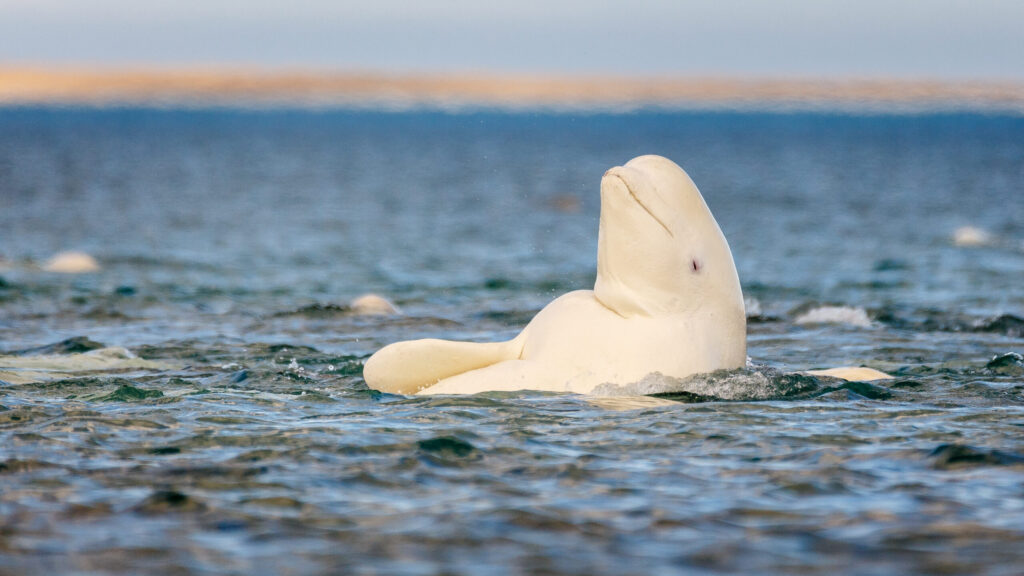
Table of Contents
The Glass Barrier to Consciousness
In a series of underwater recordings from a New York aquarium, a beluga whale named Natasha performs a series of deliberate movements: she stretches her neck, pirouettes, and tilts her head while facing a two-way mirror. Beside her, her daughter Maris mirrors the behavior. For years, these tapes sat in storage, but a new study published in PLOS One suggests these movements aren’t just random play—they are the hallmarks of mirror self-recognition (MSR).
If the findings hold, belugas join an incredibly exclusive biological club. The MSR test is widely regarded as the gold standard for identifying self-awareness in non-human species. To date, the list of confirmed or likely passers is remarkably short: humans, a few species of great apes, Asian elephants, bottlenose dolphins, and potentially magpies and orcas. Notably, common pets like dogs and cats have consistently failed the test.
Decoding the Mark Test
The logic behind the MSR test, pioneered by psychologist Gordon Gallup in 1970, is straightforward but rigorous. Researchers place a mark—usually a bit of dye or a sticker—on a part of the animal’s body that it cannot see without a reflection. If the animal uses the mirror as a tool to investigate the mark on its own body, it demonstrates that it understands the reflection is ‘me’ and not another individual.
For the beluga study, the process involved applying waterproof lipstick to the whales during feeding sessions. To ensure the results weren’t just a reaction to the sensation of being touched, the team used ‘sham-mark’ controls—performing the same application process without the pigment. The whales only exhibited the specific, self-directed behaviors when the mark was actually present.
The Challenge of Old Data
The study isn’t without its hurdles. Much of the evidence relies on footage that is over two decades old. Senior author Diana Reiss noted that while more studies were planned years ago, they weren’t feasible at the time. This led the team to digitize and re-analyze the original tapes, though some data was lost due to tape degradation.
The behavioral evidence is suggestive but not definitive. Belugas are known for ‘bubble bite play’ and barrel rolls, activities they often perform alone without any mirrors present. However, the most compelling evidence came from Natasha, who repeatedly pressed the marked area behind her right ear against the glass. Lacking arms to point or scratch, this tactile interaction with the mirror is the strongest indicator that she recognized the mark as belonging to her own body.
Does ‘Failure’ Mean a Lack of Soul?
The broader debate isn’t just about whether belugas pass, but what the test actually proves. Some neuroscientists argue that the MSR test is overly centered on human visual perception. Anil Seth, a neuroscientist at the University of Sussex, suggests that failing the mirror test doesn’t necessarily imply a lack of consciousness.
For many species, visual self-recognition may simply be irrelevant. An animal might possess a complex internal sense of self but have no biological or social reason to care about a silvered piece of glass. In this view, consciousness exists in degrees and forms, and the inability to recognize oneself in a mirror is a limitation of the test’s design, not necessarily a limitation of the animal’s mind.
Whether Natasha and Maris are truly ‘self-aware’ in the philosophical sense remains a point of contention, but their curiosity in the glass suggests a cognitive complexity that continues to challenge our understanding of non-human intelligence.