Beluga Whales Join the Exclusive ‘Mirror Test’ Club, Challenging Our Understanding of Cetacean Consciousness
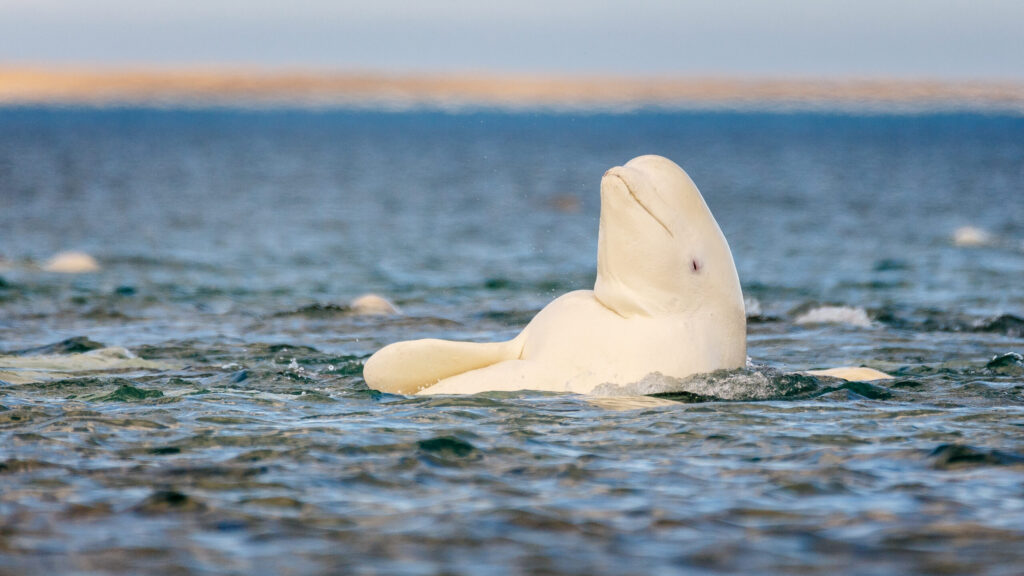
Table of Contents
A rare kind of recognition
In a series of underwater recordings from a New York aquarium, a beluga whale named Natasha exhibits a curious set of behaviors: she stretches her neck, performs rhythmic pirouettes, and repeatedly shakes her head while facing a two-way mirror. Beside her, her daughter Maris follows suit. To a casual observer, it looks like play. To cognitive scientists, it looks like a breakthrough.
According to a study recently published in PLOS One, these behaviors are the hallmarks of mirror self-recognition (MSR)—a cognitive milestone that suggests an animal understands the image in the glass is not another creature, but itself. If the findings hold, belugas join an incredibly short list of species capable of this feat, a group that currently includes humans, great apes, Asian elephants, bottlenose dolphins, and a few outliers like magpies and the cleaner wrasse.
The mechanics of the mark
The MSR test, pioneered by psychologist Gordon Gallup in 1970, is deceptively simple. Researchers place a mark—often a spot of pigment—on a part of the animal’s body that it cannot see without a mirror. If the animal spends time inspecting or attempting to touch the mark while looking at the reflection, it demonstrates a mental representation of itself as a distinct entity.
For the belugas, the process involved waterproof lipstick applied during feeding sessions. To ensure the animals weren’t simply reacting to the sensation of the lipstick being applied, researchers used “sham-mark” controls—going through the motions without actually leaving a pigment. The result was telling: the whales only exhibited these self-directed behaviors when the mark was actually present.
Working with fragmented data
The road to this publication was not linear. The footage being analyzed is more than two decades old, and the research team had to contend with the realities of aging media. Senior author Diana Reiss noted that while they had hoped to conduct more extensive studies with additional belugas over the years, it proved impossible. This led the team to revisit and digitize original videotapes, though some data had been lost to tape degradation over time.
The sample size was small. Out of four belugas exposed to the mirror, only Natasha and Maris showed sustained interest. While skeptics might argue that a sample of two is statistically insignificant, cognitive researchers often argue that if even one member of a species can perform a task, the species is biologically capable of it.
The consciousness debate
Even with the data, the interpretation remains contentious. Gordon Gallup, the test’s creator, is known for being a rigorous grader. He argues that unless an animal shows clear, active efforts to remove or examine the mark, the test is a failure. Since belugas lack arms, their “mark-directed” behavior is more subtle. Natasha, for instance, repeatedly pressed the area behind her right ear—where the mark was located—against the mirror surface.
This limitation highlights a broader critique of the MSR test: it is designed by humans, for humans. Anil Seth, a neuroscientist at the University of Sussex, suggests that failing the mirror test doesn’t necessarily mean an animal lacks consciousness. It may simply mean that visual self-recognition is irrelevant to their perceptual world. For an animal that relies on echolocation or scent, a silvered piece of glass might be an alien concept, regardless of their level of intelligence.
As we move toward a more nuanced understanding of consciousness—viewing it as a spectrum rather than a binary ‘yes or no’—the beluga study serves as another piece of evidence that the inner lives of cetaceans are far more complex than we once assumed.