Beluga Whales Join an Exclusive Club of Self-Aware Species
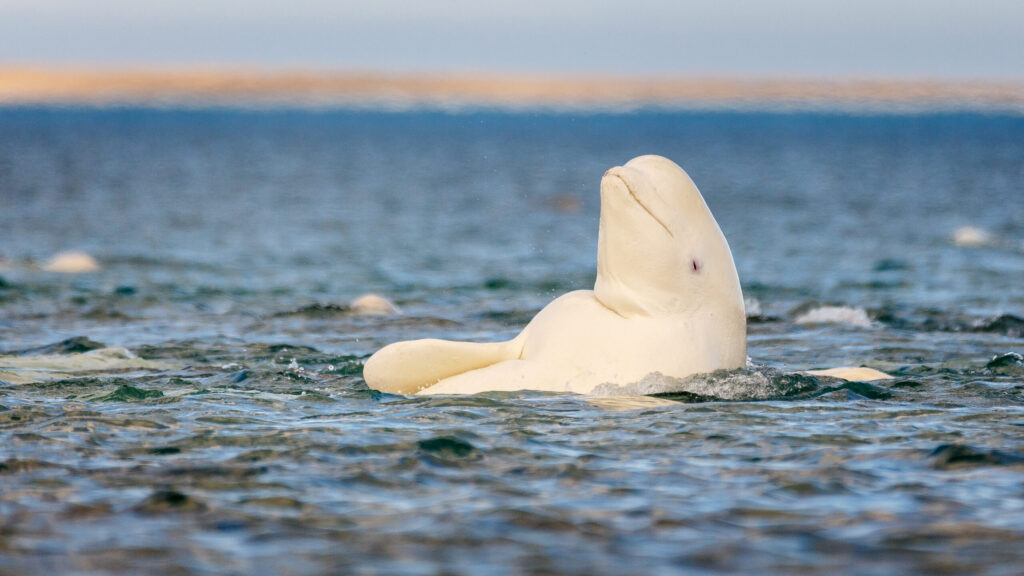
Table of Contents
In a series of underwater videos recorded at a New York aquarium, a beluga whale named Natasha exhibits a curious set of behaviors. She pirouettes, nods, and meticulously shakes her head while staring into a two-way mirror. Her daughter, Maris, displays nearly identical patterns. While it might look like simple play, researchers suggest it is something far more profound: the cognitive ability to recognize oneself.
According to a study recently published in PLOS One, both whales demonstrated the behavioral hallmarks of mirror self-recognition (MSR). This ability, which involves understanding that a reflection is a representation of one’s own body rather than another animal, has long been regarded as a primary indicator of self-awareness. Until now, such behavior had never been formally documented in beluga whales.
An Exclusive Cognitive Circle
The list of species that can pass the MSR test is remarkably short. Humans typically acquire this ability around age two, and it has been observed in a select few great apes—including chimpanzees, bonobos, and orangutans. The club also includes Asian elephants, bottlenose dolphins, and potentially orcas and magpies. Even the cleaner wrasse, a small fish, has reportedly passed, though such claims remain debated.
Notably absent from this list are dogs, cats, and most monkeys. Despite their high intelligence, many species that we intuitively assume are self-aware have consistently failed the mirror test, suggesting that the gap between instinct and self-concept is wider than many assume.
How the Test Works
The MSR procedure is deceptively simple. While an animal is not looking, researchers place a mark—often a bit of pigment—on a part of the body that the animal cannot see without a reflection. When a mirror is introduced, researchers observe whether the animal attempts to examine or touch the mark. If they do, it implies the animal comprehends that the figure in the mirror is itself.
The logic, pioneered by psychologist Gordon Gallup in 1970, is that using a mirror as a tool for self-inspection requires a mental representation of the self as a distinct entity. It is a cognitive leap that separates basic reaction from true self-awareness.
The Challenge of Old Data
The beluga study faced a unique hurdle: the footage used was more than two decades old. Senior author Diana Reiss noted in an email that while the team hoped to conduct more expansive studies with additional belugas, it wasn’t feasible at the time. The team eventually decided to digitize and rigorously analyze the original tapes, despite some degradation of the data over the years.
The experiment originally involved four belugas in social housing, but only Natasha and Maris showed the sustained interest required for the experimental phase. To ensure the results weren’t fluke reactions, researchers used “sham-mark” controls—applying a colorless substance using the same procedure. The whales only exhibited self-recognition behaviors when the actual pigment was present.
“The two beluga whales showed the same progression of behavioral stages reported for other species that show evidence of MSR,” first author Alexander Mildener explained. One of the most compelling moments occurred when Natasha repeatedly pressed the marked area—located behind her right ear—directly against the mirror. Since belugas lack arms to point, this physical contact served as the strongest evidence of mark-directed behavior.
Questioning the Definition of Consciousness
Despite the positive results, some critics argue that the MSR test is limited by its human-centric design. Anil Seth, a neuroscientist at the University of Sussex, suggests that failing the mirror test doesn’t necessarily mean an animal lacks a sense of self.
Seth argues that the test measures a specific type of recognition—visual body recognition. For many species, vision may not be the primary way they perceive their environment or themselves. An animal might be fully conscious and self-aware but simply indifferent to a mirror, or perhaps uncomfortable with the eye contact it requires.
Ultimately, the beluga findings add another piece to the complex puzzle of cetacean intelligence. Whether the mirror test is the gold standard or a narrow window, the behavior of Natasha and Maris suggests a level of mental complexity that continues to challenge our understanding of the non-human mind.