Beluga Whales Pass the Mirror Test, Joining an Exclusive Circle of Self-Aware Species
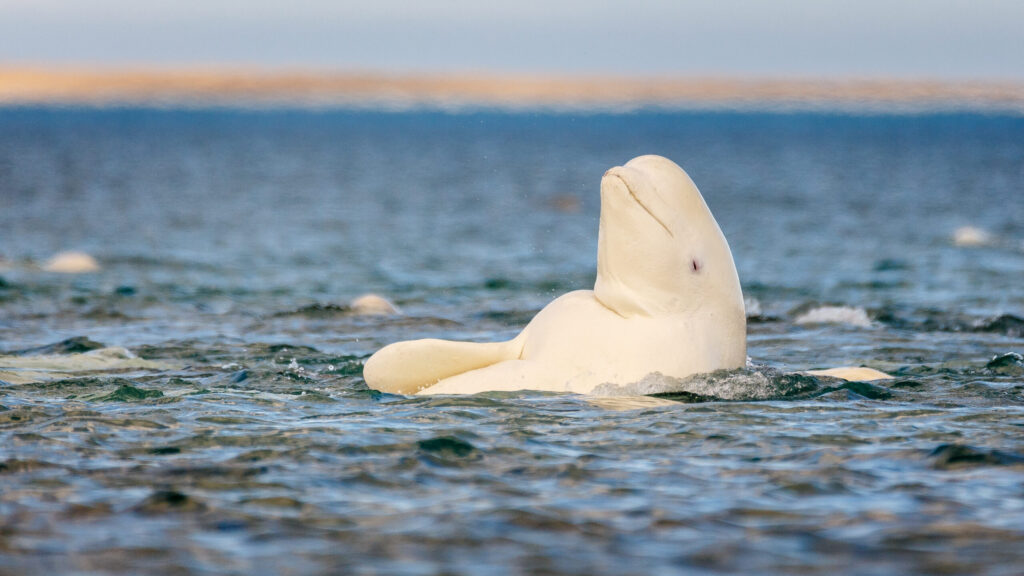
Table of Contents
A Rare Cognitive Milestone
In the quiet corridors of a New York aquarium, recorded on video footage spanning two decades, a beluga whale named Natasha performed a series of deliberate movements: stretching her neck, nodding, and pirouetting in front of a two-way mirror. Beside her, her daughter, Maris, mirrored the behavior. While these actions might seem like simple curiosity, a new study published in PLOS One suggests they are evidence of something far more complex: mirror self-recognition (MSR).
The ability to recognize one’s own reflection is widely regarded by cognitive scientists as a benchmark for self-awareness. If the study’s findings hold, belugas now join an incredibly short list of species capable of this feat. The club currently includes humans, a few great apes—such as chimpanzees and orangutans—Asian elephants, bottlenose dolphins, magpies, and the cleaner wrasse. Notably, most common domestic animals, including dogs and cats, have consistently failed the test.
The Mechanics of the Mark Test
The MSR protocol, developed by psychologist Gordon Gallup in 1970, relies on a simple but rigorous premise. Researchers place a mark on a part of the animal’s body that is invisible to them unless they are looking into a mirror. If the animal uses the mirror as a tool to investigate or touch the mark, it demonstrates that they understand the image in the glass is not another animal, but themselves.
The beluga study was an exercise in digital archaeology. Senior author Diana Reiss explained that while original studies were conducted years ago, the team recently revisited and digitized the original videotapes to conduct a more rigorous, modern analysis. Despite some degradation of the tapes and lost data, the patterns remained clear.
The experiment began with four belugas in their social housing, but only Natasha and Maris displayed the sustained interest required to move into the experimental phase. To ensure the results weren’t coincidental, researchers used “sham-marks”—applying the same pressure and procedure without the pigment. The whales only exhibited self-directed behaviors when the actual waterproof lipstick mark was present.
Interpreting the Evidence
The data is compelling, though not without its critics. First author Alexander Mildener noted that the whales followed the same behavioral progression seen in other MSR-positive species. The most striking evidence came from Natasha, who repeatedly pressed the area behind her right ear—where the mark was located—directly against the mirror. Lacking arms to point, this physical contact represents the strongest indicator that she was attempting to interact with the mark on her own body.
However, some behaviors, such as “bubble bite play” or barrel rolls, are common solo activities for belugas and could be interpreted as reactions to a novel stimulus rather than a realization of self. Because the sample size is small, the results sit on the edge of what some researchers call “hard evidence.”
The Question of Consciousness
The broader debate isn’t just about whether belugas pass the test, but what the test actually measures. Many scientists argue that failing the mirror test doesn’t necessarily mean an animal lacks a sense of self.
Anil Seth, a neuroscientist at the University of Sussex, suggests that the MSR is a test of a specific visual ability rather than consciousness itself. For many species, visual feedback is not the primary way they experience the world. A dog may not recognize itself in a mirror, but it possesses a powerful olfactory sense of self. To force a species to define its existence through a piece of silvered glass may be a human-centric bias.
Regardless of the philosophical implications, the study reinforces the idea that consciousness exists in degrees and forms across the animal kingdom. For the beluga, the mirror was more than just a reflection—it was a window into a complex internal world.