AMD Challenges Nvidia’s AI Dominance with the $3,999 Ryzen AI Halo Workstation
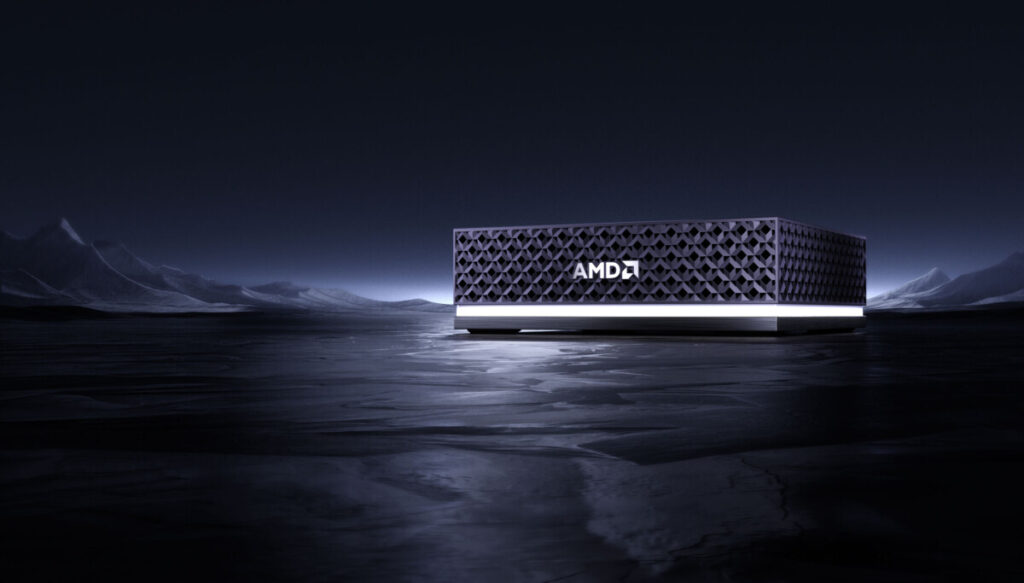
Table of Contents
The Pitch: Local Compute vs. Cloud Subscriptions
AMD is making a bold claim: for the dedicated developer, owning the hardware is cheaper than renting the cloud. The company’s latest foray into the high-end developer market is the Ryzen AI Halo, a compact AI workstation priced at $3,999. While the price tag is steep for a mini PC, AMD is framing it as a strategic investment. According to the company, developers spending eight hours a day ‘vibe coding’—the emerging trend of high-level, iterative AI-assisted programming—could save roughly $750 a month by shifting their workloads from expensive cloud APIs to local silicon.
This isn’t just about saving a few bucks on a subscription; it’s a direct shot at Nvidia’s DGX Spark, which has long held the territory for curated, small-form-factor AI development environments. While the DGX Spark has seen its price climb to $4,699, AMD is positioning the Halo as a more accessible, yet potent, alternative for those running local models and agentic AI frameworks.
The Silicon Under the Hood
At the heart of the Ryzen AI Halo is the Ryzen AI Max+ 395 APU, better known by its codename, Strix Halo. This 120-watt beast is designed to bridge the gap between consumer laptops and massive server racks. The system is packed with 128 GB of LPDDR5x memory clocked at 8000 MT/s, providing a massive 256 GB/s of bandwidth. To put that in perspective, this exceeds the bandwidth found in some non-Pro Ryzen 9000 Threadripper configurations.
For the AI enthusiast, this memory overhead is the critical metric. It allows the Halo to run models with up to 200 billion parameters at 4-bit precision locally. The compute is driven by 16 Zen 5 cores and 40 RDNA 3.5 GPU compute units, capable of delivering roughly 56 teraFLOPS at 16-bit precision. While this is a formidable feat for integrated graphics, it still trails Nvidia’s Blackwell-based GB10 APU in raw floating-point performance, particularly since Strix Halo lacks hardware support for FP8 or FP4 data types.
Performance Realities: Tokens vs. Tensors
On paper, the Nvidia Spark is faster, boasting significantly higher teraFLOPS in FP8 and FP4. However, real-world LLM (Large Language Model) inference is often more dependent on memory bandwidth than raw compute. AMD claims that in specific inference tasks, the AI Halo can actually generate tokens 4% to 14% faster than the Spark.
The trade-off appears in prompt processing. In internal testing, Nvidia’s tensor cores provided a 2x to 3x lead in the time it takes to ‘digest’ a prompt before generating a response. For a developer working with short snippets, the difference is negligible—measured in milliseconds. For those feeding the machine entire libraries of documentation, the Spark’s lead becomes apparent.
An Open Ecosystem Approach
Where AMD genuinely differentiates itself is in the OS and flexibility. The Ryzen AI Halo is a standard x86 machine, meaning users can install Windows or any preferred Linux distribution. In contrast, the DGX Spark largely locks users into a customized version of Ubuntu 24.04. For developers building within the Microsoft NPU-accelerated ecosystem, the Halo is the obvious choice.
AMD has also integrated an XDNA 2-based NPU delivering 50 TOPS. While the industry is still figuring out the best way to utilize NPUs for generative AI, the inclusion ensures the Halo is ready for the next wave of software updates in content creation and productivity apps.
The Networking Gap
The one area where AMD falls short is connectivity. Nvidia’s workstation features a 200 Gbps ConnectX-7 NIC, allowing multiple units to be clustered into a larger supercomputing node. AMD has opted for a single 10 Gbps NIC. While sufficient for downloading large model weights, it lacks the enterprise-grade clustering capabilities of the Spark. There is a possibility of achieving higher speeds via USB-4, but AMD has not yet officially validated this as a primary use case.
Solving the ‘Dependency Hell’
Beyond the hardware, AMD is selling a ‘validated environment.’ The most frustrating part of AI development isn’t the coding; it’s the installation of ROCm, HIP, PyTorch, and various CUDA-alternatives. To combat this, the AI Halo ships with five preinstalled ‘playbooks’—essentially curated software stacks for tools like vLLM, Llama.cpp, and Ollama—to ensure developers spend more time building and less time debugging drivers.
The 128 GB model will be available for pre-order next month starting at $3,999, marking a significant shift in how AMD intends to capture the local AI developer market.