AMD Targets Developers with $3,999 Ryzen AI Halo Workstation
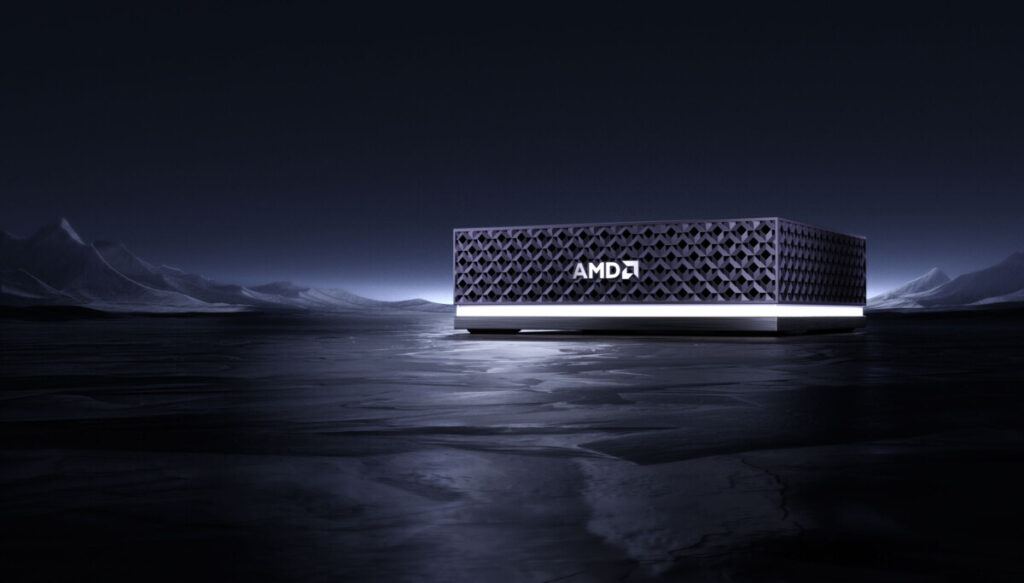
Table of Contents
The High Cost of Local Intelligence
AMD is making a bold claim: if you spend eight hours a day ‘vibe coding,’ a $3,999 piece of hardware can actually save you money. The company is positioning its upcoming Ryzen AI Halo workstation not just as a piece of silicon, but as a financial hedge against the recurring costs of cloud AI APIs. According to AMD, the system could potentially save power users roughly $750 a month in API fees by shifting heavy workloads to local hardware.
Available for pre-order next month, the Ryzen AI Halo is AMD’s direct answer to Nvidia’s DGX Spark. While the price tag is steep—especially considering similar hardware configurations were available for significantly less a year ago—the industry is currently grappling with a ‘RAMpocalypse,’ where the soaring cost of high-bandwidth memory has pushed prices up across the board. Even Nvidia has adjusted, with the DGX Spark now retailing for $4,699, up from its initial $3,999 launch price.
Silicon and Scale: The Strix Halo Engine
At the heart of the diminutive 5.9 x 5.9 x 1.7-inch chassis is the 120-watt Ryzen AI Max+ 395 APU, better known by its codename, Strix Halo. This chip is a powerhouse designed for a specific purpose: bridging the gap between consumer PCs and enterprise AI servers. It features 16 Zen 5 cores and 40 RDNA 3.5 GPU compute units, all fed by 128 GB of LPDDR5x 8000 MT/s memory.
For the local AI enthusiast, the 256 GB/s of bandwidth is the critical metric. This allows the AI Halo to run models with up to 200 billion parameters at 4-bit precision. In a surprising twist of performance, AMD claims the AI Halo can generate tokens 4 to 14 percent faster than the Nvidia Spark in certain LLM inference workloads. This is largely because token generation is often gated by memory bandwidth rather than raw floating-point calculations.
The Performance Trade-off
However, raw speed in tokens doesn’t tell the whole story. In prompt processing—the initial phase where the AI digests your input—Nvidia’s Blackwell-based architecture retains a commanding lead. In internal testing, the Spark’s tensor cores provided a 2x to 3x advantage in processing speed. While this difference is negligible for short prompts, it becomes a significant bottleneck for developers working with massive datasets or complex context windows.
Furthermore, the Ryzen AI Halo lacks hardware support for FP8 or FP4 data types, which the Spark leverages to hit massive teraFLOP numbers. AMD’s GPU delivers roughly 56 teraFLOPS at 16-bit precision, which is impressive for integrated graphics but still trails the raw compute throughput of Nvidia’s specialized AI silicon.
Software as the Product
AMD is betting that developers will value flexibility and ecosystem support over raw teraFLOPS. Unlike the DGX Spark, which locks users into a customized version of Ubuntu 24.04, the AI Halo is a standard x86 machine. Users can run Windows or any Linux distribution, making it an ideal target for those developing within Microsoft’s NPU-accelerated AI PC ecosystem.
The machine also includes an XDNA 2-based NPU rated for 50 TOPS. While the industry is still figuring out how to fully utilize NPUs for generative AI inference, they are increasingly supported in mainstream content creation apps.
Perhaps the most important part of the package isn’t the hardware, but the “playbooks.” To solve the perennial headache of mismatched drivers, ROCm versions, and PyTorch dependencies, AMD is shipping the AI Halo with five preinstalled environment playbooks, with more available online. By providing a validated software stack for tools like vLLM, Llama.cpp, and Ollama, AMD hopes to move developers away from debugging installation errors and back toward actual coding.
Connectivity Gaps
The one area where AMD falls short is networking. While the DGX Spark features a 200 Gbps ConnectX-7 NIC for clustering multiple systems, the AI Halo offers a single 10 Gbps NIC. While high-speed networking may be possible via USB-4, AMD has not yet explicitly detailed a supported RDMA playbook to match Nvidia’s clustering capabilities.