Zeiss Horizon Anamorphic: The End of the External Lens Motor?
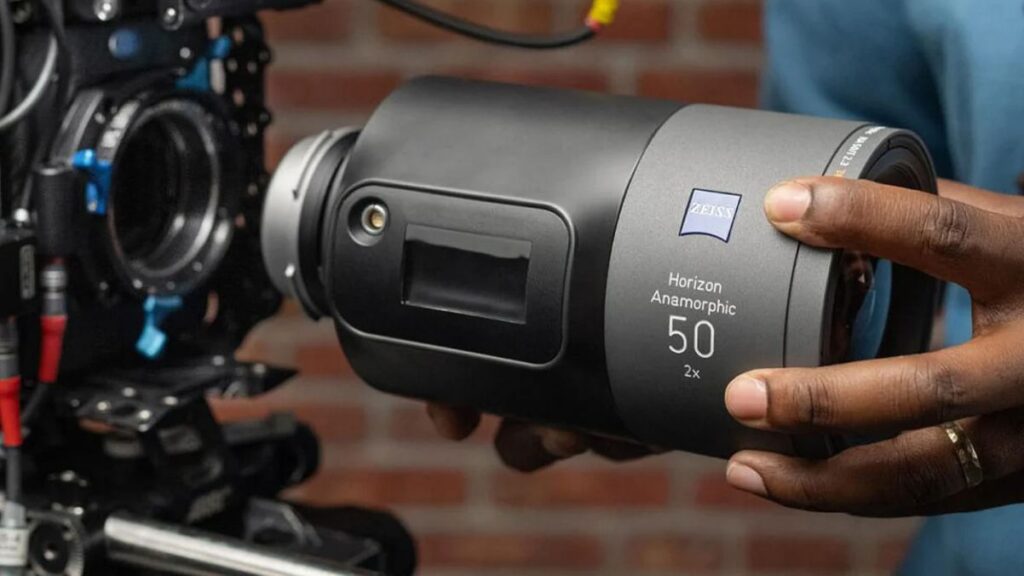
Table of Contents
A Shift in Cinema Rigging
For decades, the high-end cinema set has been defined by a certain kind of mechanical clutter. Between the matte box, the follow-focus rings, and the external motors required to pull focus or adjust the iris remotely, the lens mount often becomes a crowded hub of cables and clamps. Zeiss is attempting to dismantle this complexity with the unveiling of the Horizon Anamorphic series, a full-frame prime lineup that moves the machinery inside the glass.
The Horizon Anamorphic series isn’t just another set of primes; it’s a fundamental rethink of how a lens interacts with a camera system. By integrating focus and iris motors directly into the lens barrel, Zeiss effectively removes the need for external motor rigging. For a first assistant camera (AC), this means a cleaner build and a significant reduction in the time spent calibrating external gear. These built-in motors are designed to interface directly with industry-standard lens control systems, promising a level of repeatability and precision that is often lost when mounting third-party motors to a lens gear.
Tunable Aesthetics and Digital Control
Beyond the mechanical integration, Zeiss is addressing a long-standing tension in cinematography: the balance between technical perfection and artistic ‘character.’ Traditionally, if a director wanted a softer, more organic look from a lens, the cinematographer had to rely on external filtration or choose a lens with a specific, unchangeable vintage personality.
The Horizon series introduces an interchangeable look-tuning back element. This allows operators to modify the lens’s rendering—adjusting contrast, sharpness, and overall character—without compromising the scale accuracy or the 2x squeeze factor. It allows the Horizon primes to start as a neutral, sharp baseline and be dialed back into a more stylized aesthetic on the fly.
This shift toward digitization extends to the lens barrel itself. Eschewing the traditional static scale, Zeiss has equipped these lenses with dual displays and touch panels. These interfaces provide real-time readouts of focus distance and t-stop values, allowing the operator to make adjustments directly on the lens. By storing factory calibration and lens scales internally, the system eliminates the tedious process of re-mapping scales when swapping between different focal lengths.
The Technical Footprint
The lineup consists of seven primes: 35mm, 40mm, 50mm, 75mm, 110mm, 150mm, and 200mm. To maintain consistency across the set, Zeiss has standardized a 114mm front diameter for all seven lenses. This is a critical detail for production designers and ACs, as it means a single matte box configuration can serve the entire range, drastically speeding up lens changes during a shoot.
Physical Specifications
| Focal Length | Aperture | Length | Weight |
|---|---|---|---|
| 35mm to 75mm | T2.3 | 199mm | 2.42kg – 3.25kg |
| 110mm to 200mm | T2.3 / T2.9 | 262mm | 2.42kg – 3.25kg |
While the weight remains substantial—peaking at 3.25kg (approximately 7.17 lbs)—it remains comparable to the existing Zeiss Master Anamorphic 2x series. The trade-off for the added weight is a significant gain in metadata accuracy and rigging efficiency.
Market Positioning and Availability
Zeiss has not yet released official pricing, but given the integration of electronic motors and a digital interface, these are positioned firmly at the top of the professional market. They aren’t designed for the prosumer or the independent YouTuber, but for large-scale productions where the cost of time on set far outweighs the cost of the hardware.
The rollout will be staggered. The 40mm, 50mm, and 75mm primes are expected to begin shipping this fall. The remaining focal lengths—35mm, 110mm, 150mm, and 200mm—will follow later this year, with some extending into 2027.


