Valve’s Steam Machine is a High-Stakes Bet on the ‘Living Room PC’
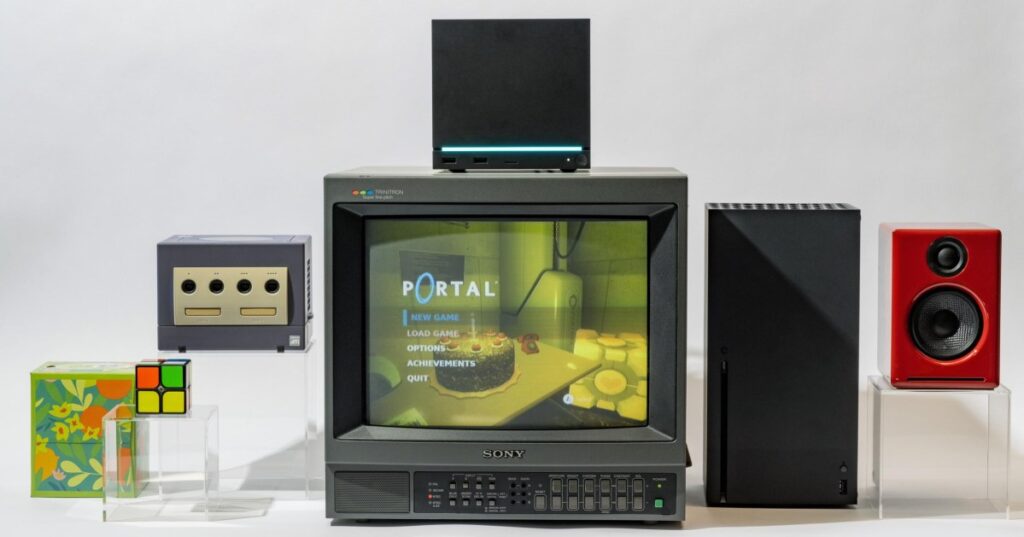
Table of Contents
The Ambition of the ‘PC-Plus’
For over half a century, the gaming console blueprint has remained virtually unchanged: buy a proprietary box, plug it into a television, and launch a game. From the Magnavox Odyssey to the PlayStation 5, the value proposition has always been simplicity over flexibility. Valve is now attempting to dismantle that binary with the Steam Machine, a device that positions itself not as a traditional console, but as a ‘PC-plus’ designed specifically for the living room.
The Steam Machine is an ambitious, albeit expensive, experiment in removing the friction between a high-end PC library and the comfort of a couch. Starting at $1,049—and climbing to $1,128 when bundled with a gamepad—the device enters a market where it is significantly more expensive than its primary competitors, yet doesn’t necessarily offer a raw performance leap over the aging Sony PS5. In side-by-side testing with titles like Cyberpunk 2077 and Horizon Zero Dawn Remastered, a standard $650 PS5 often delivers sharper image quality, raising a critical question: why pay a premium for the Steam Machine?
The answer lies in the intersection of hardware engineering and software ecosystem. Valve has managed to shrink a capable PC into a form factor that is smaller, quieter, and more aesthetically integrated than a traditional gaming rig. More importantly, it is fully navigable via gamepad. The goal is to eliminate the need for a mouse and keyboard entirely, allowing users to download, launch, and manage their libraries using nothing but joysticks.
The Friction of First-Gen Hardware
Despite the vision, the initial user experience reveals the typical growing pains of first-generation hardware. Setup is far from the ‘plug-and-play’ promise of the console world. Initial deployment involved several hurdles, including HDMI handshake issues with Denon receivers and the need to manually enable Game Mode on Samsung OLED displays to achieve HDR and VRR functionality.
Software stability remains the most significant hurdle. In early testing, critical dependencies like Proton—the compatibility layer that allows Windows games to run on Linux—were not pre-installed, necessitating manual downloads before gaming could begin. Furthermore, the system exhibited sporadic instability, including spontaneous reboots and graphical glitches when pushing the video memory limits. There were also instances of failed downloads leaving hundreds of gigabytes of incomplete installs on the internal drive.
However, Valve has a proven track record of iterative improvement. Much like the evolution of the Steam Deck, the company has shown an ability to push rapid patches. Within 24 hours of identifying specific stability bugs, Valve delivered fixes, suggesting that the current rough edges are a temporary state rather than a fundamental flaw.
Performance and Versatility
When the system stabilizes, the Steam Machine performs admirably as a mid-range gaming hub. While it lacks the raw muscle of a full-sized desktop, it leverages AMD’s FSR (FidelityFX Super Resolution) to upscale 1080p content to 4K, maintaining stable frame rates that pair well with Variable Refresh Rate (VRR) televisions. In titles like Indiana Jones or Returnal, the machine comfortably handles 1440p at medium specs.
The true ‘secret weapon’ of the Steam Machine is its dual identity. Because it is a full PC running a Linux desktop, it can be repurposed as a workstation. By plugging in a keyboard, mouse, and external monitors, the device transforms into a functional desktop computer, capable of running a variety of non-gaming applications. This versatility makes the $1,049 price tag more palatable for users who don’t already own a dedicated PC.
Valve’s strategy is a gamble on the ‘open’ living room. By selling components at cost and negotiating directly with suppliers during a global memory crisis, Valve is attempting to offer a hardware package that would be nearly impossible for a consumer to build manually at this price point and size. If Valve can smooth out the software friction, the Steam Machine could redefine what we expect from a home entertainment center, shifting the conversation from ‘which console’ to ‘which ecosystem.’