The Physical AI Pivot: Why Investors are Betting on a $200 Billion Humanoid Market by 2035
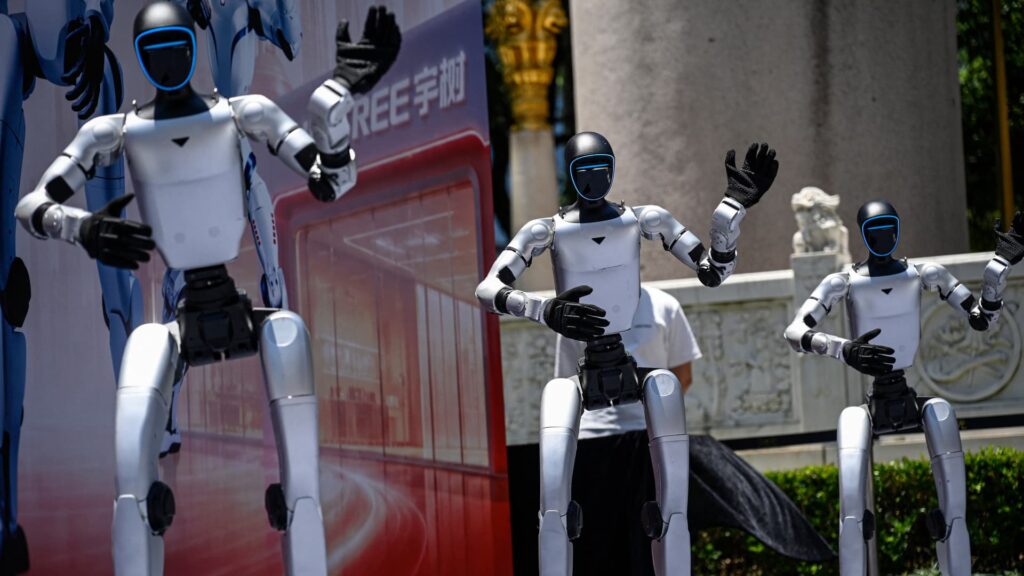
Table of Contents
The Migration from Digital to Physical Intelligence
For the last few years, the AI gold rush has been largely invisible, confined to the cloud, large language models, and the screens of our smartphones. But a strategic shift is underway. Top-tier investors and analysts are now pivoting toward what is being termed “Physical AI”—the integration of advanced intelligence into humanoid forms capable of navigating and manipulating the real world.
Softbank CEO Masayoshi Son has been vocal about this transition, suggesting to CNBC that the next trillion-dollar company will likely emerge from the intersection of robotics and AI. This isn’t just about industrial arms on assembly lines; it’s about general-purpose humanoids that can mimic human movement to fill systemic labor gaps.
The ‘Automation 3.0’ Framework
According to a recent “AI Gets Physical” report from Barclays, we are entering the era of “Automation 3.0.” While previous waves of automation focused on repetitive, fixed tasks, humanoid robots are designed to handle the “dirty, dull, and dangerous” roles that have historically required a human presence. Zornitza Todorova, head of thematic FICC research at Barclays, notes that the market is currently in its infancy—valued at roughly $2 to $3 billion—but is projected to skyrocket to $200 billion by 2035.
The rollout is expected to happen in two distinct waves. The first, currently underway and lasting through 2030, focuses on the industrial backbone: manufacturing, logistics, agriculture, and construction. These machines are already beginning to handle basic tasks like sorting boxes or assisting on assembly lines.
The second wave, arriving after 2030, aims for the “services-oriented” economy. This represents the high-value target for Western markets, where robots will move into healthcare, elderly care, education, and hospitality—sectors that drive a significant portion of economic growth in developed nations.
China’s Infrastructure Advantage
While the U.S. captures the headlines with high-profile projects like Tesla’s Optimus, the actual boots-on-the-ground (or servos-on-the-ground) dominance belongs to China. Data from the Barclays report highlights a staggering disparity in robot density: China has installed nearly 300,000 industrial robots compared to just 34,000 in the United States.
This infrastructure allows China to act as a global innovation lab. Last year, China accounted for 85% of humanoid installations, largely because they can produce these machines at a fraction of the cost of Western competitors—often hovering around the $50,000 mark. This price point makes the transition from prototype to fleet deployment a mathematical reality rather than a laboratory experiment.
Following the Money: Hardware and Ecosystems
Investors are adjusting their portfolios to reflect this shift. Jason Pidcock, who manages the £2.75 billion Asian Income fund at Jupiter, argues that the value won’t just be in the robot companies themselves, but in the hardware and software ecosystems that enable them. His fund’s heavy lean into companies like TSMC, Samsung, and Foxconn underscores the belief that the “picks and shovels” of the robotics era will be the primary drivers of immediate returns.
Dan Ives of Wedbush Securities echoes this sentiment, calling humanoid robots the “golden goose” for physical AI. While many of the most promising firms remain private, the influence of public giants is undeniable. Ives notes that the U.S. is currently in “catch-up mode,” but the potential for a massive production boost remains the primary catalyst for the AI Revolution ETF.
The transition won’t be without friction. The leap from a factory floor to a private home involves immense regulatory and safety hurdles. However, for those betting on the decade of the robot, the trajectory is clear: AI is finally getting a body.


