The Last-Mile Lifeline: How MIT-Born Tricycle Ambulances are Slashing Maternal Mortality in Rural Ghana
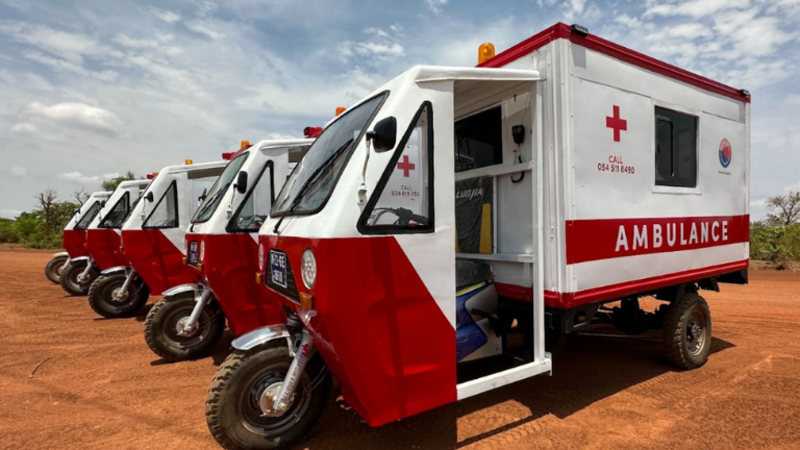
Table of Contents
Bridging the Last-Mile Gap
In the remote farming communities of Northern Ghana, the distance between a medical emergency and a hospital bed is often measured not in miles, but in survival rates. For women facing complicated labors or miscarriages, the absence of reliable transport transforms a manageable medical crisis into a life-threatening event. Billeh Rosemount, a 24-year-old from Du West, experienced this terror firsthand in October 2024 during a complicated miscarriage. With severe bleeding that her local midwife could not control, Rosemount faced a choice: wait hours for a conventional ambulance that might never arrive, or attempt the journey on the back of a neighbor’s motorbike.
Instead, Rosemount was transported via a specialized tricycle ambulance—a low-cost, high-impact vehicle designed to navigate the narrow, unpaved arteries of rural Ghana where standard emergency vehicles are either impractical or nonexistent. The intervention worked; Rosemount received emergency care and recovered, avoiding a fate that too many women in her region share.
Engineering for the Terrain
The vehicles are the product of Moving Health, a nonprofit that transitioned from an MIT engineering project in 2016 to a permanent operational entity in Ghana by 2019. Founded by CEO Emily Young and a team of mechanical engineering students, the project identifies a specific failure in healthcare infrastructure: the “last-mile” problem. While hospitals may exist, the inability to reach them within the “golden hour” of an emergency remains the primary barrier to survival.
Unlike traditional ambulances, which are prohibitively expensive and often too heavy for the region’s rough terrain, these tricycle units are powered by motorcycle engines. They are manufactured at roughly one-tenth the cost of a standard ambulance—approximately $7,000 per unit. Despite their small footprint, they are meticulously outfitted for maternal crises. Each vehicle includes a full-length stretcher, an oxygen concentrator, basic life support equipment, and emergency birthing kits. Crucially, the design includes a dedicated seat for a midwife or community health worker, ensuring that clinical care begins the moment the patient is loaded, rather than upon arrival at a facility.
Scaling Impact in the Upper West Region
The logistical challenge in Ghana is staggering. In 2020, reports indicated that only 55 ambulances served the entire nation. While the National Ambulance Service has since grown to 356 vehicles for a population of roughly 35 million, the distribution remains heavily skewed toward urban centers. In rural districts, the gap remains wide.
Moving Health has filled this void by deploying a fleet of 31 ambulances across five districts in the Upper West Region, extending a critical safety net to more than 230,000 people. The impact is measurable: the nonprofit reports a 64% decrease in transport time from rural communities to hospitals. By integrating with local health agencies and training community drivers and health workers to manage emergency dispatches, Moving Health has created a sustainable ecosystem of care rather than just providing hardware.
The Maternal Mortality Crisis
The urgency of this technology is underscored by grim statistics. In 2023, maternal mortality in Ghana stood at 234 deaths per 100,000 live births. While this is lower than the broader Sub-Saharan African average, it remains 14 times higher than the rate in the United States. The World Health Organization notes that Sub-Saharan Africa accounted for roughly 70% of all global maternal deaths in 2023, with the vast majority of these occurring in rural areas due to poverty and transport failures.
As Emily Young notes, the crisis is rarely about a total lack of medical knowledge or facilities, but about the physical impossibility of reaching them. By optimizing the vehicle for the specific geography of Northern Ghana, Moving Health is proving that high-tech solutions aren’t always about complex software or expensive robotics, but about appropriate engineering tailored to the environment.