The Hidden Easter Egg in the Commodore 64’s ‘Dead Test’ Diagnostic Font
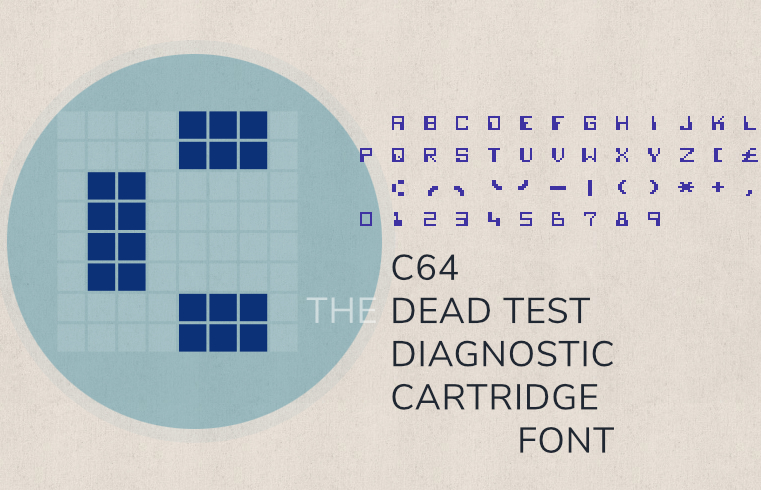
Table of Contents
The Forgotten Typography of Hardware Diagnostics
In the world of retro-computing, certain pieces of hardware achieve a legendary status not because of their consumer appeal, but because of their utility in the hands of technicians. The Commodore 64 ‘Dead Test’ diagnostic cartridge (Rev. 718220, part number 314139-03) is one such artifact. While most users remember the C64 for its iconic PETSCII character set, the Dead Test cartridge operates on a completely different visual language—one that has remained largely undocumented until now.
The cartridge earned its name through a brutal piece of engineering: it is designed to diagnose a C64 even when the machine’s own internal ROMs are completely non-functional. To achieve this, the cartridge doesn’t rely on the C64’s built-in Character ROM. Instead, it carries its own embedded font within its own ROM, allowing it to output a readable display regardless of the state of the motherboard’s chips.
A Departure from PETSCII
For those familiar with the standard C64 output, the Dead Test font is instantly recognizable—and jarring. It eschews the soft curves of the standard Commodore set for a blocky, industrial aesthetic. The implementation is lean, utilizing only 58 characters (screen codes $00 to $39). This stripped-down set focuses exclusively on uppercase letters, digits, and a handful of mathematical operators and punctuation marks.
Interestingly, the developers opted for a pragmatic approach to layout. The standard ‘at’ symbol (@) at position $00 was replaced with an extra blank space, and the range from $22 to $27—usually reserved for characters like # and $—was repurposed to house box border characters. This allowed the diagnostic tool to draw clean, structured frames around its test results, essential for a technician scanning through memory dumps and register values.
The MICR Connection and the Hidden Symbol
The visual style of the Dead Test font isn’t accidental. It draws heavy inspiration from the MICR (Magnetic Ink Character Recognition) E-13B character set. Developed in the 1950s, MICR is the standard used by the banking industry to process checks, characterized by its distinct, rectangular glyphs designed for high-accuracy machine reading.
The proximity to the MICR set reveals a subtle, hidden detail: an Easter egg embedded in the ROM. At screen code $21—where an exclamation mark would normally reside—there is a mysterious, C-shaped character. This glyph is never referenced anywhere in the cartridge’s executable code; it is never called as an operand and never appears in any data section. It is, for all intents and purposes, invisible to the end user.
A closer look reveals that this character is actually the ‘transit symbol’ from the MICR set, used globally as a delimiter for bank routing codes. The inclusion of this symbol is a clear, intentional nod to the banking fonts that inspired the cartridge’s look, tucked away in a memory address that will never be triggered during a standard diagnostic run.
The ‘Two Machines in One’ Architecture
The ability of the Dead Test cartridge to override the system’s internal ROMs is rooted in a fascinating quirk of C64 architecture. The machine was essentially designed to be two different computers in one: the standard Commodore 64 and the short-lived Commodore Max (known as the Ultimax in the US). The Max was a budget-friendly, cartridge-based system released in 1982 that lacked internal ROMs entirely.
To facilitate this, the C64 expansion port features two critical signals: _GAME and _XROM. When the _GAME signal is low and _XROM is high, the C64 enters ‘Ultimax mode.’ This shifts the memory map, banking out the built-in C64 ROMs—including the character set—and allocating space for external ROM banks at $8000-$9FFF and $E000-$FFFF.
By leveraging this mode, the Dead Test cartridge effectively transforms the C64 into a Max Machine, bypassing the system’s damaged internal components to provide a clean, standalone diagnostic environment. It is a masterclass in hardware fallback design, ensuring that as long as the CPU and VIC II chip are breathing, the technician can find out exactly what went wrong.


