The Geometry of the Grid: Why Manhattanhenge is More Than Just a Viral Photo Op
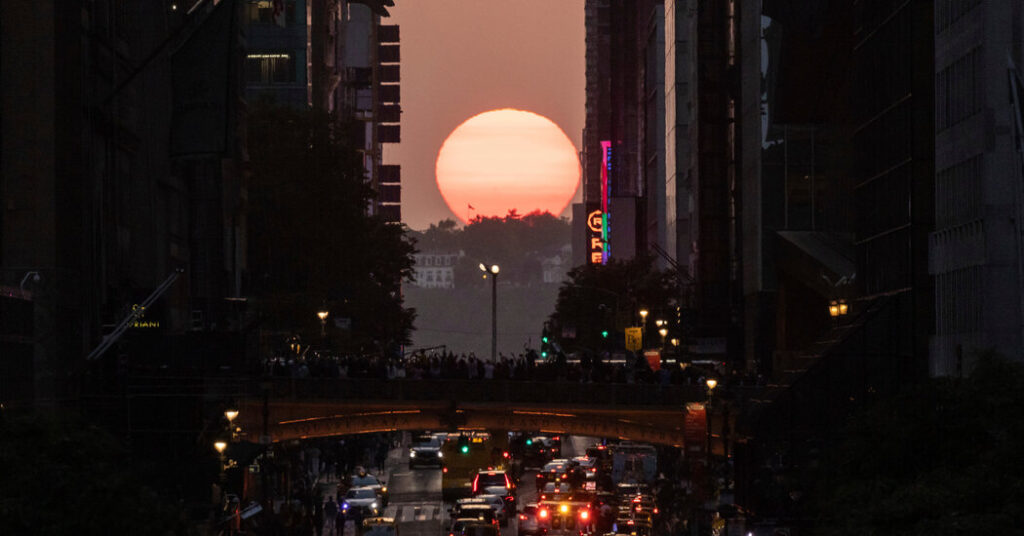
Table of Contents
For most New Yorkers, the intersection of the city’s rigid grid and the solar system’s orbit is usually a matter of academic curiosity. But on Thursday and Friday, that curiosity manifests as thousands of people standing shoulder-to-shoulder in the middle of the street, cameras poised, waiting for the sun to precisely align with the east-west corridors of Manhattan.
The phenomenon, colloquially known as “Manhattanhenge,” isn’t a coincidence of nature so much as a collision between celestial mechanics and 19th-century urban planning. While the city’s Commissioners’ Plan of 1811 established the grid that defines the island, it didn’t account for the specific tilt of the Earth’s axis relative to those streets. The result is a twice-yearly event where the sun sets perfectly between the towering skyscrapers, creating a corridor of light that feels, for a few moments, like a cinematic set piece.
The Math Behind the Moment
To understand why this happens, one has to look at the specific orientation of the Manhattan grid. The city’s streets don’t run exactly east-west; they are offset by about 29 degrees from true east. This misalignment is what makes the event possible. If the streets were perfectly aligned with the cardinal directions, the sun would set directly at the end of the street only on the equinoxes.
Instead, the offset means the alignment occurs around May 30 and July 12. This precision is why the window for the “perfect shot” is so narrow. A difference of a few minutes or a few blocks can mean the difference between a sun-drenched canyon and a street cast in deep purple shadows.
The Role of Modern Imaging
While the event has occurred since the first skyscrapers rose, its popularity has exploded alongside the rise of mobile photography and algorithmic discovery. What used to be a niche observation for astronomers has become a massive digital event. The visual symmetry of the sun centered perfectly within a concrete frame is a textbook example of the “satisfying” aesthetic that drives engagement on platforms like Instagram and TikTok.
However, the event also highlights a technical challenge for photographers: extreme dynamic range. Capturing the blinding brilliance of the setting sun while maintaining the detail of the dark, shadowed skyscrapers requires a level of exposure control that tests the limits of most smartphone HDR (High Dynamic Range) processing. This has turned Manhattanhenge into an informal annual benchmark for mobile sensor capabilities.
Urban Friction and Public Space
As the crowds swell on Thursday and Friday, the event transforms from an astronomical curiosity into a logistical challenge. The New York City Department of Transportation often faces the reality that a few viral social media posts can turn a standard commuter artery into a pedestrian plaza. This tension underscores a broader trend in “internet-driven tourism,” where specific, time-sensitive geographic coordinates become hotspots for thousands of people simultaneously.
For the residents of these corridors, the event is less about the geometry of the sun and more about the geometry of the crowd. But for the brief window when the sun hits the horizon, the noise of the traffic seems to fade behind the sheer visual impact of the light. It is a rare moment where the massive, imposing scale of the city’s architecture is momentarily humbled by the clockwork precision of the solar system.