The 18K Quest: How Christopher Nolan’s ‘The Odyssey’ Is Forcing a Return to Analog IMAX
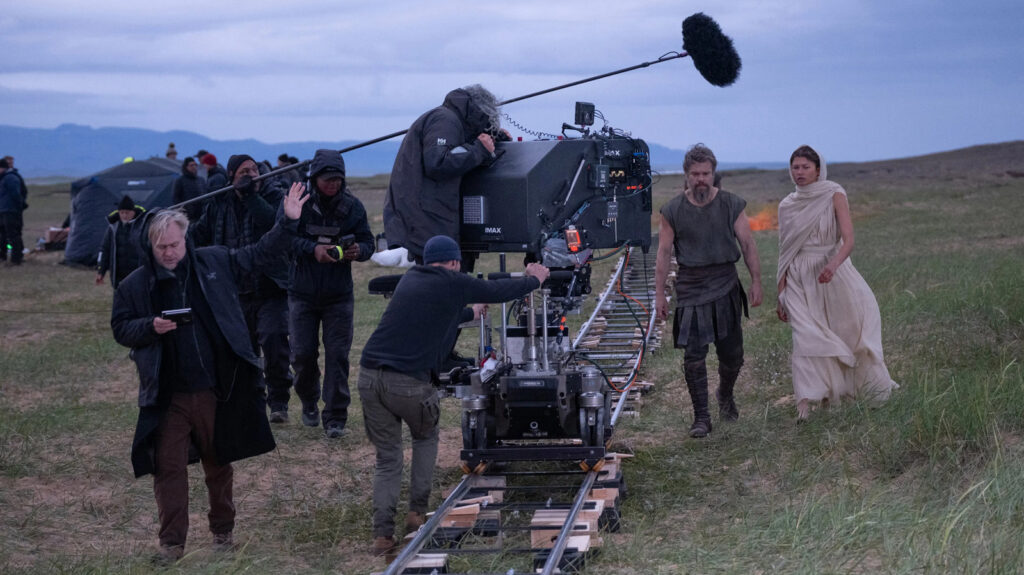
Table of Contents
The Analog Peak in a Digital Era
For decades, the 15-perf 70mm IMAX format has been the ‘holy grail’ of cinema—a technical behemoth capable of delivering an image quality that digital sensors still struggle to replicate. While Christopher Nolan has long been the industry’s most vocal proponent of celluloid, his upcoming film The Odyssey, arriving July 17, represents a first in cinematic history: a feature-length production shot entirely in the 15/70 IMAX format.
To understand why this matters, one must look at the physics of the film. Unlike standard 35mm or even the vertical 65mm prints used in smaller prestige theaters, 15/70 film runs horizontally through the projector. This allows for a massive frame size of 70mm x 48.5mm, providing nearly nine times the surface area of traditional cinema film. In digital terms, this translates to a perceived resolution of roughly 16K to 18K, creating a level of clarity and depth that makes 4K digital projection look compressed by comparison.
Solving the ‘Noise’ Problem
Until now, the 15/70 format was reserved for spectacle—broad vistas and action sequences—because the cameras are notoriously loud. The mechanical roar of the film transport makes it virtually impossible to record usable dialogue on set, forcing directors to use hybrid formats or extensive ADR (Automated Dialogue Replacement). In Oppenheimer and Sinners, Nolan utilized standard 65mm film for intimate scenes to avoid this issue.
For The Odyssey, Nolan reportedly bypassed this limitation using a specialized acoustic enclosure dubbed ‘Keighly.’ While these enclosures add nearly 400 pounds to the rig, they effectively isolate the microphone from the camera’s mechanical noise, allowing Nolan to capture intimate dialogue without sacrificing the IMAX frame. To maintain the purity of the image, Nolan avoided the ‘digital intermediate’ process entirely, opting for chemical color correction using filters and striking the final prints directly from the negative.
“[IMAX 15/70] is the highest quality imaging format that’s ever been devised,” Nolan told CBS’s 60 Minutes. “There’s nothing that competes with it… there’s an image quality there that you can’t get anywhere else.”
The Logistics of the ‘True’ Experience
Finding a theater capable of screening The Odyssey in its native format is a challenge of geography. There are only 30 such theaters in the United States and nine in Canada. These screens are characterized by their colossal size (typically 59 by 79 feet) and a nearly square 1.43:1 aspect ratio that fills the viewer’s entire peripheral vision.
Because of the scarcity of these projectors and the high cost of striking chemical prints, tickets for these venues often sell out instantly. While the official premiere is July 17, several locations are hosting early screenings on July 16.
Navigating the Digital Alternatives
For those outside the reach of 15/70 film, the experience degrades in tiers of technical fidelity. The closest digital approximation is IMAX with Laser 4K, specifically those using the GT Laser dual projector system. These theaters can still maintain the full 1.43:1 aspect ratio, meaning you get the full image, even if the resolution is capped at 4K rather than the analog 18K.
Below that is the 5/70mm projection. This is still film, but the celluloid runs vertically, resulting in a 2.2:1 aspect ratio and half the frame size of the IMAX 15/70. While it lacks the scale of the giant screens, it still offers a resolution significantly higher than 35mm film.
The final tier is the standard IMAX 4K Laser at a 1.90:1 ratio. While visually impressive and bright, this version crops a significant portion of the image that Nolan specifically composed for the square IMAX frame, effectively removing the ‘immersive’ intent of the cinematography.


