Spotify Introduces Podcast Clipping to Combat the ‘Long-Form’ Discovery Problem
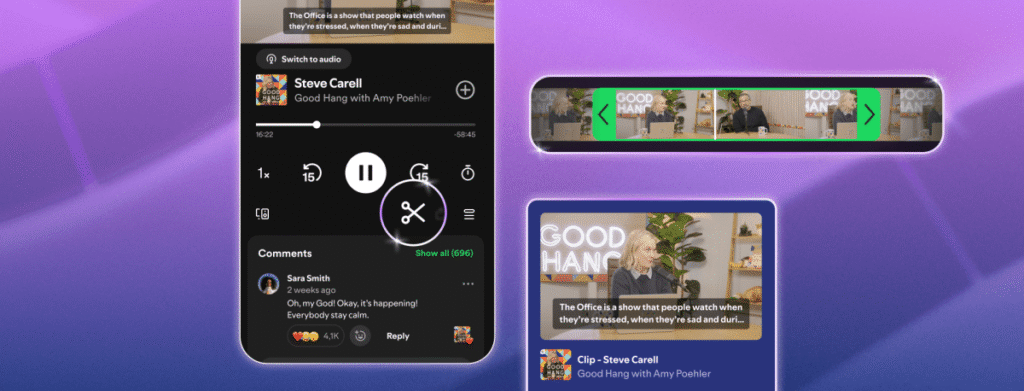
Table of Contents
The end of the ‘timestamp’ struggle
For years, sharing a specific insight from a three-hour podcast has been a clumsy process. Users were forced to manually note a timestamp, share a link to the full episode, and hope the recipient had the patience to scrub through the audio to find the relevant minute. Spotify is attempting to solve this friction with the rollout of a native ‘clipping’ tool, designed to turn long-form audio into snackable, shareable content.
Starting this week, users will see a scissors icon integrated into the “Now Playing” view. This interface allows listeners to isolate a specific segment of an episode, trim the start and end points via a visual timeline, and preview the audio before exporting it. Once finalized, the clip can be shared as a standalone audio snippet or linked back to the full episode, creating a more seamless bridge between social media discovery and deep-dive listening.
Strategic timing in the ‘CEO Podcast’ era
The introduction of this feature arrives at a pivot point for how news is broken in the tech industry. We have seen a marked shift where executives from companies like OpenAI, NVIDIA, and Meta increasingly bypass traditional press junkets and critical journalistic interviews in favor of long-form podcast appearances. These environments often allow guests to control the narrative over several hours, making it difficult for the general public to parse a single, critical admission or a new product reveal without listening to the entire recording.
By democratizing the ability to clip audio, Spotify is effectively giving the audience the tools to act as curators. When a high-profile executive drops a piece of news in the 112th minute of a conversation, the community can now isolate that specific claim and propagate it across X (formerly Twitter), Threads, or LinkedIn without requiring the rest of the internet to commit three hours to a single stream.
Scaling the ‘Chapter’ momentum
This move isn’t a shot in the dark; it’s a response to existing user behavior. Earlier this year, Spotify expanded its support for “Chapters,” which allow creators to break episodes into titled segments. According to internal data shared by the company, these chapters have seen significant adoption, with users saving and adding them to playlists over 2 million times per month.
The clipping tool is the logical evolution of the chapter system. While chapters provide a map of the episode, clips provide the destination. By allowing these snippets to be stored directly in a user’s Spotify Library, the platform is attempting to turn podcasts into a searchable archive of highlights rather than just a linear stream of audio.
The marketing ripple effect
Beyond the user experience, there is a clear growth play here for podcast creators. The “viral loop” for audio has always been weaker than for video; a 15-second TikTok clip can drive millions of views to a YouTube channel, but audio has historically lacked a similarly potent discovery mechanism. Native clipping allows podcasters and their fans to create “trailers” on the fly, potentially increasing the conversion rate of casual social media browsers into dedicated subscribers.
The feature is currently deploying globally to both Free and Premium users on mobile devices. While the rollout is wide, Spotify noted that availability will expand to a broader range of shows over time as the system integrates with various hosting platforms and RSS feeds.