Sony’s Bravia Theater Trio Attempts to Solve the ‘Soundbar Dilemma’ with a Hybrid 3-Piece Array
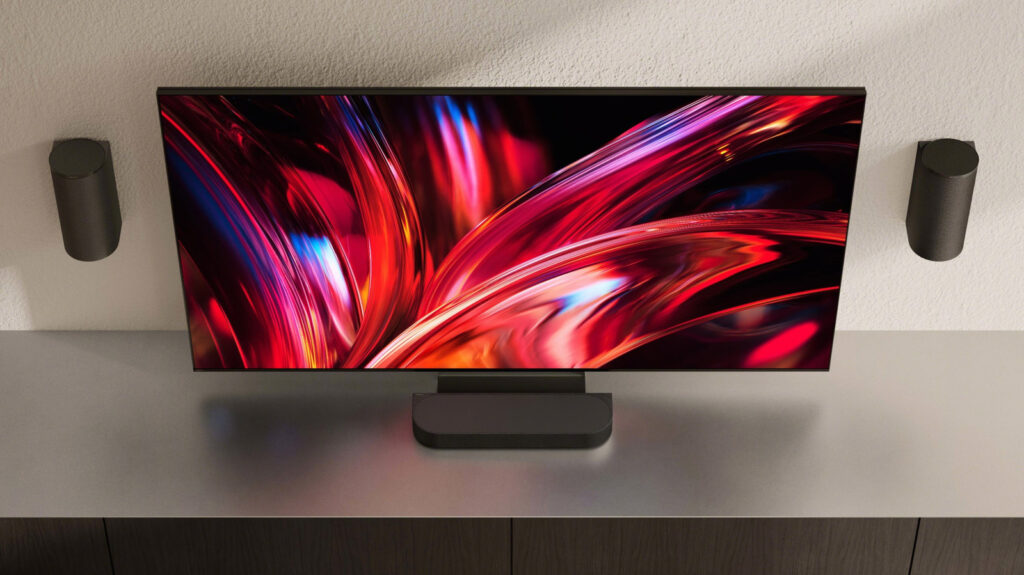
Table of Contents
A Middle Ground Between Soundbars and Stereo
For years, home cinema consumers have been forced into a binary choice: the convenience of a single, monolithic soundbar or the cumbersome installation of a traditional multi-channel receiver and wired speakers. Sony is attempting to break this deadlock with the introduction of the Bravia Theater Trio, a wireless audio configuration that seeks to offer the immersion of a full surround system without the cable management nightmare.
The Theater Trio isn’t a soundbar in the traditional sense, nor is it a standard stereo pair. Instead, it is a three-piece modular system consisting of two standalone speakers and a compact center-channel bar. By decoupling the left and right channels from the center, Sony allows users to create a wider, more natural soundstage that isn’t limited by the physical width of a single piece of plastic sitting on a TV stand.
The Hardware Breakdown
Under the hood, Sony has shifted toward high-frequency clarity with the introduction of new aluminum speaker diaphragms. Each of the two main speakers is equipped with a 100mm woofer, a 20mm high-resolution tweeter, and an 80mm up-firing driver—the latter being critical for the ‘height’ effects required by modern Atmos tracks. The accompanying mini soundbar focuses on dialogue and center-channel precision, featuring a 25mm high-resolution tweeter flanked by two 45x108mm pill-shaped woofers.
The inclusion of up-firing drivers across the array suggests that Sony is leaning heavily into spatial audio. Rather than relying on a physical ceiling speaker, the Trio bounces sound off the room’s architecture to simulate overhead movement, a necessity for content labeled as Dolby Atmos, DTS:X, or IMAX Enhanced.
The Software Secret: Spatial Sound Mapping
The hardware is only half the story. The Trio utilizes Sony’s 360 Spatial Sound Mapping, a technology developed in collaboration with Sony Pictures to translate cinematic mixing into a domestic environment. According to Sony, the system can simulate up to 24 virtual speakers, effectively filling the ‘sonic gaps’ that occur when speakers are placed in non-ideal positions, such as against a wall or tucked into a corner.
To make this work, the system relies on Sound Field Optimization. Rather than using a proprietary calibration mic, users can employ a USB-C microphone connected to a smartphone to map the room’s acoustics. This ensures that the virtual speakers are placed accurately relative to the listener’s position, regardless of the room’s dimensions.
Direct Connect: A New Ecosystem Shift
Perhaps the most significant strategic move accompanying the Trio is the announcement of ‘Direct Connect.’ Traditionally, rear speakers and subwoofers required a soundbar to act as the central hub or ‘brain’ of the operation. Direct Connect bypasses this requirement, allowing Bravia TVs to communicate wirelessly and directly with rear speakers and subwoofers.
This is a clear nod to the growing trend of ‘invisible’ audio. By removing the need for a central soundbar hub, Sony is enabling users to build modular systems that grow over time. A user could start with the Theater Trio and later add Theater Rear 8 or 9 speakers, or integrate a Theater Sub 7, 8, or 9, without needing to overhaul their entire connectivity chain.
The Bravia Theater Trio is positioned as a premium offering, retailing at $2,200. Pre-orders are open now, targeting the enthusiast who wants a cinematic experience but refuses to run HDMI cables through their living room walls.


