Shuttle Veterans Tom Akers and Joe Tanner Inducted Into Astronaut Hall of Fame
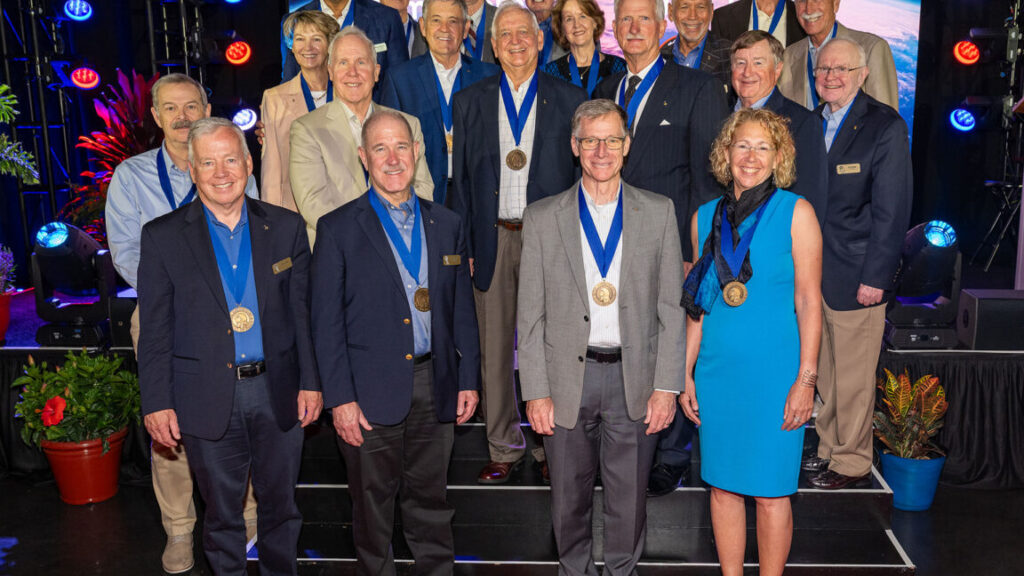
Table of Contents
A Delayed Reunion
For Tom Akers and Joe Tanner, the path to the U.S. Astronaut Hall of Fame was a long game of patience and professional persistence. On May 16, the two Space Shuttle-era veterans were officially inducted together at the Kennedy Space Center Visitor Complex, finally sharing the same stage after decades of overlapping careers that almost began in unison.
The irony of their joint induction wasn’t lost on the duo. In 1984, both men were vying for a spot in the same NASA astronaut selection group. While Akers secured his place in the class of 1987, Tanner—who was serving as an instructor pilot at the Johnson Space Center at the time—was passed over. He wouldn’t officially join the astronaut corps until 1992.
“Tom came in with the class of 1987, which, interestingly enough, I interviewed for. He made it, and I didn’t,” Tanner recalled in a recent interview with collectSPACE. Akers, leaning into their long-standing friendship, joked that he had been “leading the way ever since,” though he admitted he never quite understood why NASA waited so long to recruit Tanner.
The Engineering of the Void
While they never shared a launch pad on the same mission, their careers were defined by the same grueling physical demands of Extravehicular Activity (EVA). Both men were instrumental in the high-stakes maintenance of the Hubble Space Telescope (HST), a task that required extreme manual dexterity and precision while floating in the vacuum of space.
Tanner, who logged 43 days in space and over 46 hours of EVA time, noted the distinct technical differences between working on Hubble and the International Space Station (ISS). While the ISS required the “hauling of big, heavy objects” and navigating vast structural distances, the Hubble missions were an exercise in fine-motor skills, manipulating delicate optical instruments within confined areas.
Akers’ career is highlighted by a particular historical anomaly: the only three-person spacewalk in NASA history. On May 16, 1992—the exact anniversary of the induction ceremony—Akers and crewmates Rick Hieb and Pierre Thuot struggled to secure the Intelsat VI communications satellite. When the standard capture bar failed, ground controllers and the crew improvised a three-person maneuver to secure the satellite.
“All of our spacewalks are designed really for two people,” Akers explained. “That was a unique situation… With the teamwork and great ground team support, it worked slick.” In total, Akers spent nearly 30 hours of his 34 days in space conducting these complex walks.
Legacy Beneath the Atlantis
The induction ceremony took place under the shadow of the Space Shuttle Atlantis, a vehicle that served as a ride for both men during their careers. The event was managed by the Astronaut Scholarship Foundation, which oversees the rigorous nomination and selection process for the Hall of Fame.
Curt Brown, board chairman of the foundation and a fellow astronaut who flew with Tanner on Atlantis, emphasized that the induction was less about the flight hours and more about the enduring impact of their leadership. “Their lasting contributions to NASA, and their ongoing work as educators and mentors, reflect the very best of the US space program,” Brown stated.
The ceremony included the unveiling of etched-glass portraits and mission patch displays, which now join the ranks of 111 other inductees. The U.S. Astronaut Hall of Fame, established in 1990, has been a centerpiece of the Heroes & Legends attraction since 2016, serving as a permanent record of the humans who pushed the boundaries of low-Earth orbit.
The event was attended by roughly 20 veteran astronauts, including Brian Duffy and Chris Ferguson, the latter of whom served as the pilot on Tanner’s final mission, STS-115. For Akers and Tanner, the honor marks a definitive closing of a professional circle that began with a shared dream and a few decades of orbiting the Earth.