Shuttle Era Veterans Tom Akers and Joe Tanner Inducted into Astronaut Hall of Fame
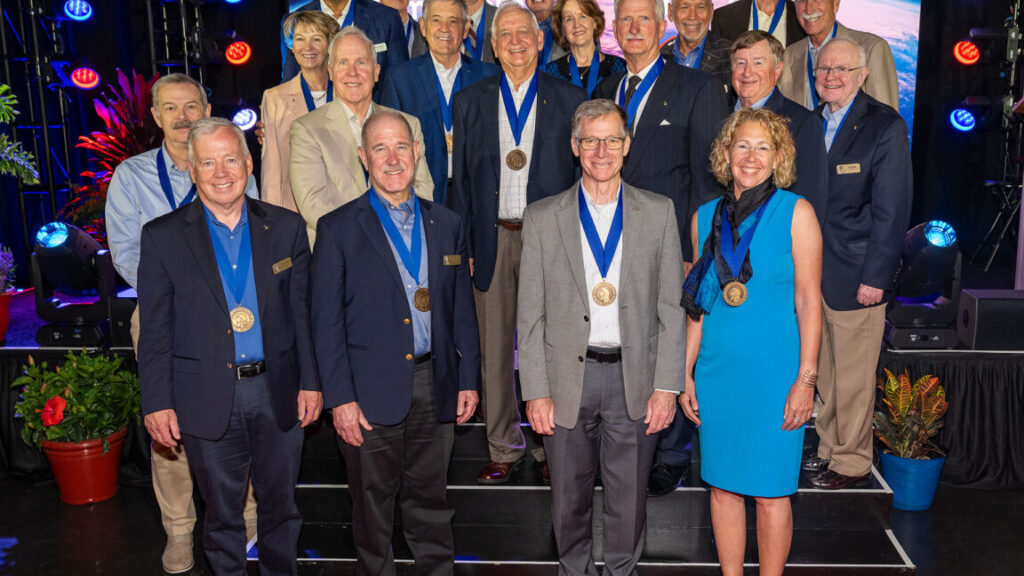
Table of Contents
A Long-Overdue Partnership
For Tom Akers and Joe Tanner, the path to the U.S. Astronaut Hall of Fame was as winding as the orbits they once traversed. On May 16, the two veteran space shuttle crew members were finally inducted into the Hall of Fame together—a synchronization that almost happened decades earlier.
The irony of their shared induction wasn’t lost on the men. In 1984, Tanner arrived at the Johnson Space Center (JSC) as an instructor pilot and applied for the next astronaut candidate class. While Akers made the cut for the class of 1987, Tanner did not. “Tom came in with the class of 1987, which, interestingly enough, I interviewed for. He made it, and I didn’t,” Tanner recalled during a joint interview with collectSPACE.com.
The banter between the two remained sharp even after retirement. When Tanner noted the gap in their selection, Akers quickly interjected, “And I’ve been leading the way ever since.” He joked that he had never quite understood why NASA took so long to recruit Tanner, who eventually became an astronaut in 1992.
The Technical Rigors of the Spacewalk
While Akers and Tanner never shared a launch pad for a mission to orbit, their careers were deeply intertwined. Beyond their T-38 jet training and a close personal friendship rooted in their shared community and church, both men became specialists in the most dangerous aspect of spaceflight: extravehicular activity (EVA).
Akers is perhaps best remembered for a milestone in NASA history. On May 16, 1992—exactly 34 years before his induction ceremony—he landed aboard the space shuttle Endeavour after participating in the only three-person spacewalk ever conducted. The mission was a response to a technical failure; the crew was unable to secure the capture bar on the Intelsat VI communications satellite.
“All of our spacewalks are designed really for two people; the system really isn’t made where it’s easy for three people,” Akers explained. He noted that the ground controllers and the crew had to pivot mid-mission to coordinate a three-person effort to secure the satellite, a maneuver he described as working “slick” due to intense teamwork.
Tanner’s contributions were equally critical, particularly in the assembly of the International Space Station (ISS) and the maintenance of the Hubble Space Telescope (HST). When discussing the difference between these two types of EVAs, Tanner pointed to the physical toll. While HST missions required extreme manual dexterity to manipulate delicate optical instruments in cramped quarters, ISS work involved the “heavy lifting” of hauling massive structural components and solar array wings across long distances.
A Legacy Etched in Glass
The induction ceremony took place at the Kennedy Space Center Visitor Complex, positioned beneath the retired space shuttle Atlantis—a vehicle that served as a ride for both men during their careers. The event was presided over by news correspondent John Zarella and featured remarks from Curt Brown, board chairman of the Astronaut Scholarship Foundation.
Brown, a fellow NASA astronaut who flew with Tanner on Atlantis, emphasized that the induction was not just a nod to their flight hours, but to their ongoing roles as mentors and educators. “Their lasting contributions to NASA… reflect the very best of the US space program,” Brown stated.
The ceremony was a gathering of the “old guard,” with roughly 20 veteran astronauts in attendance. Brian Duffy (Class of 2016) presented Akers with his medal, while Chris Ferguson, who piloted Tanner’s final mission on STS-115, honored Tanner. The induction concluded with the unveiling of etched-glass portraits and mission patches, which now join 111 other plaques in the Heroes & Legends attraction.
In total, Akers logged nearly 30 hours of EVA time across 34 days in space. Tanner’s record was even more extensive, with 46.5 hours of spacewalks during 43 days in orbit. Their inclusion in the Hall of Fame serves as a final chapter in a professional relationship that spanned the golden age of the Space Shuttle program.