Samsung Pushes Resolution Ceiling with 6K Odyssey G8 and Thunderbolt 5 Integration
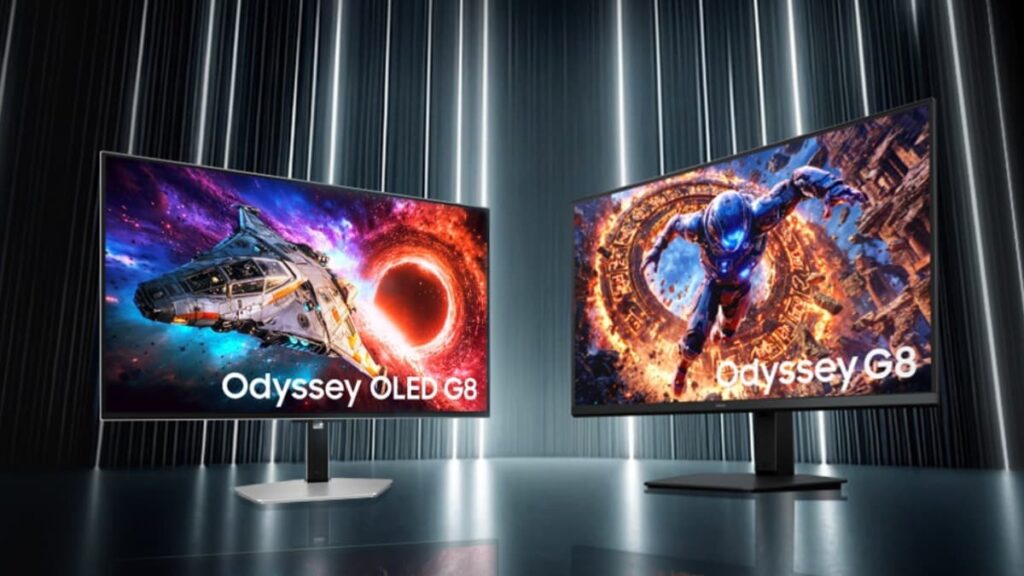
Table of Contents
Scaling Beyond 4K: The 6K Odyssey Experiment
Samsung is making a decisive bet on extreme pixel density with the introduction of its 2026 Odyssey lineup, headlined by the Odyssey G8 G80HS. Moving beyond the industry-standard 4K, the G80HS pushes into 6K territory, pairing that massive resolution with a 165Hz refresh rate. It is a clear attempt to bridge the gap between professional-grade clarity and high-performance gaming, targeting users who find 4K too limiting but aren’t yet ready for the extreme proportions of ultra-wide panels.
The hardware shift is most evident in the connectivity. To handle the sheer bandwidth required for 6K at high refresh rates, Samsung has integrated DisplayPort 2.1 and Thunderbolt 5. The inclusion of Thunderbolt 5 is particularly significant; it allows for significantly higher data throughput than its predecessor, reducing the need for multiple cables and ensuring that the signal doesn’t bottleneck during intense gaming or high-bitrate video editing.
Diversifying the Odyssey Portfolio
While the 6K model grabs the headlines, Samsung is also filling the gaps in its mid-to-high-end range to better compete with LG’s OLED dominance. The new Odyssey OLED G8 (G80SH) maintains a 4K resolution but pushes the speed to 240Hz, catering to the competitive esports crowd that demands near-instantaneous response times. Below that, the Odyssey OLED G7 (G73SH) provides a more accessible entry point with 4K resolution and a 165Hz refresh rate.
Interestingly, Samsung has also introduced the G80HF, a 5K 180Hz variant. This suggests a strategic pivot to offer a granular ladder of resolutions—5K, 6K, and 4K OLED—allowing users to choose based on whether they prioritize raw pixel count or the infinite contrast ratios provided by OLED technology.
The Professional Pivot: ViewFinity S8
Parallel to the gaming push, the ViewFinity S8 series has been refreshed. While the Odyssey line focuses on speed and immersion, the S8 remains anchored in color accuracy and productivity. These monitors are designed to operate as the centerpiece of a creative workstation, likely leveraging the same Thunderbolt 5 infrastructure to serve as a one-cable docking solution for Mac and PC users.
Market Positioning and Pricing
The pricing structure, currently confirmed for the South Korean market, reveals how Samsung views these tiers. The 6K Odyssey G8 (LS32HG806) is the premium flagship, priced at KRW 1,757,700 (approximately $1,300 USD). The OLED G8 follows closely at KRW 1,627,000, suggesting that Samsung views the 6K LCD technology as having a similar value proposition to high-end OLED panels.
| Model | Resolution | Refresh Rate | Price (KRW) |
|---|---|---|---|
| Odyssey G8 G80HS | 6K | 165Hz | 1,757,700 |
| Odyssey OLED G8 G80SH | 4K | 240Hz | 1,627,000 |
| Odyssey OLED G7 G73SH | 4K | 165Hz | 1,292,000 |
| Odyssey G8 G80HF | 5K | 180Hz | 1,130,000 |
The real-world success of the 6K G8 will likely depend on GPU adoption. Currently, few consumer GPUs can drive 6K at 165Hz without significant scaling or DLSS intervention. However, by shipping these panels now, Samsung is positioning itself for the next generation of graphics cards that will inevitably prioritize the bandwidth provided by DisplayPort 2.1.