Russian Missile Strike Hits Kyiv Pechersk Lavra: UNESCO World Heritage Site in Flames
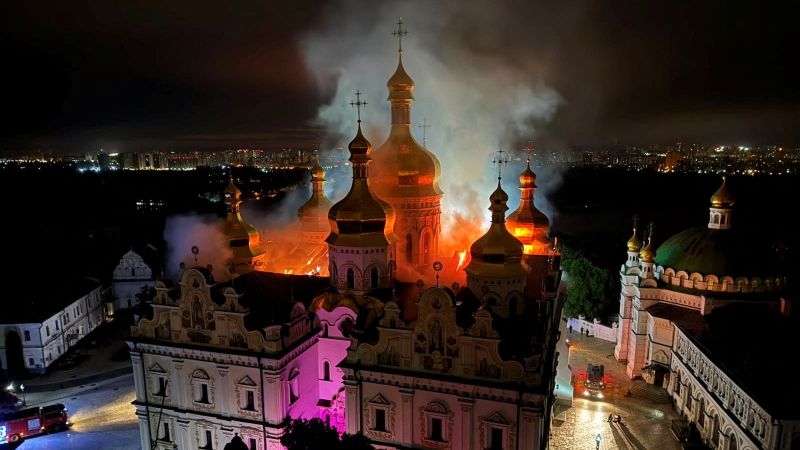
Table of Contents
The Siege of Heritage: Fire at the Kyiv Pechersk Lavra
In a coordinated escalation of aerial warfare, a massive Russian strike on Monday, June 15, 2026, resulted in the ignition of the Kyiv Pechersk Lavra, one of Eastern Europe’s most significant spiritual and architectural landmarks. The complex, a UNESCO World Heritage site, suffered severe damage to the Dormition Cathedral, marking a critical blow to Ukrainian cultural identity and the global preservation of historic religious architecture.
- Scale of Attack: Russia deployed 611 long-range strike drones and 70 missiles, totaling 681 projectiles targeting Kyiv and other urban centers.
- Architectural Damage: Roughly 800 square meters of the Dormition Cathedral’s roof were incinerated; an additional 1,000 square meters were destroyed at the National Cultural, Art and Museum Complex.
- Human Cost: At least five deaths and 30 injuries were reported in Kyiv alone, with a total of 11 casualties across Ukraine.
- Infrastructure Impact: Approximately 140,000 households in northern Kyiv lost power due to the bombardment.
The attack occurred amidst a high-stakes diplomatic window, following conversations between Ukrainian President Volodymyr Zelensky and US President Donald Trump regarding potential peace frameworks. The timing and precision of the strikes on a site already listed by UNESCO as being “in danger” suggest a strategic effort to exert psychological pressure on the Ukrainian population and international observers.
Anatomy of the Assault: Drone Saturation and Missile Strikes
The technical nature of the Monday attack reflects a “saturation tactic” designed to overwhelm Ukrainian air defense systems. According to the Ukrainian Air Force, the deployment of 611 long-range strike drones served as a primary layer of interference, forcing interceptors to engage high-volume, low-cost targets while 70 high-velocity missiles were launched to penetrate the city’s defensive perimeter.
This hybrid approach is a known Russian doctrine: using “swarm” drones to deplete ammunition and distract radar operators, creating windows of opportunity for cruise missiles to strike high-value targets. The resulting fire at the Dormition Cathedral was not merely a byproduct of proximity but a direct result of the kinetic energy and thermal impact of the munitions.
Damage Assessment of the Dormition Cathedral
The Dormition Cathedral, the heart of the Lavra complex, bore the brunt of the fire. Emergency services reported that the blaze consumed 800 square meters of the roofing system. While the structural integrity of the main walls remains under assessment, the thermal stress from the fire poses long-term risks to the internal frescoes and gold-leaf ornamentation characteristic of the 11th-century foundation.
In a race against time, officials confirmed that sacred relics and irreplaceable liturgical items were evacuated from the cathedral before the fire reached the interior. This rapid response likely saved centuries of ecclesiastical history from total incineration.
The Cultural Stakes: Why the Lavra Matters
To understand the gravity of this attack, one must look at the Kyiv Pechersk Lavra not just as a building, but as a spiritual epicenter. Founded in 1051, the monastery is renowned for its complex system of caves (the “Pechery”) and its influence on the development of Orthodox Christianity in the region.
UNESCO has designated the site as a “masterpiece of Ukrainian art.” The complex integrates diverse architectural styles, from the Byzantine-inspired depths of the caves to the Baroque splendor of the surface churches. By targeting this site, the strike affects the collective memory of millions of pilgrims and historians.
“Another Russian crime against humanity, against history, against Christianity,” stated Metropolitan Epiphanius of Kyiv and All Ukraine, emphasizing that the attack transcends military objectives to target the very soul of Ukrainian culture.
Quantifying the Destruction of Civilian Infrastructure
The fire at the Lavra is not an isolated incident but part of a broader trend of systematic destruction. Data provided by Deputy Chief of Staff Olena Kovalska highlights a staggering level of attrition across Ukraine’s civilian landscape since February 2022.
| Infrastructure Type | Approximate Number of Sites Affected | Impact Level |
|---|---|---|
| Total Civilian Sites | 338,294 | Critical/Severe |
| Cultural Buildings | ~1,000 | Irreplaceable Loss |
| Places of Worship | Hundreds | Community Displacement |
| Hospitals & Schools | Thousands | Social Service Collapse |
These statistics, corroborated by the United Nations Human Rights Monitoring Mission in Ukraine, suggest a deliberate pattern of targeting non-military assets. The recent spike in casualties, which reached a post-April 2022 peak last month, indicates that the conflict is entering a phase of increased intensity regardless of ongoing diplomatic discussions.
What This Means: Practical and Geopolitical Implications
The attack on the Kyiv Pechersk Lavra has implications that extend far beyond the charred roof of a cathedral. For the international community, it serves as a litmus test for the G7’s resolve.
For the G7 and NATO: President Zelensky has explicitly linked this attack to the G7 summit in Évian, France. He is arguing that diplomatic talks without accompanying military support—specifically advanced air defense systems—are insufficient. The strike proves that Russia is willing to target UNESCO sites to signal its disregard for international norms.
For the Diplomatic Process: The timing is particularly pointed. With Donald Trump and Vladimir Putin reportedly in communication, the strike acts as a “hard-line” signal from the Kremlin, asserting that they maintain the initiative on the ground and in the air, regardless of who holds power in Washington.
For Cultural Preservation: The addition of the Lavra to the “World Heritage in Danger” list in 2023 was a warning. This attack transforms that theoretical risk into a physical reality, necessitating a global effort for digital archiving and physical reconstruction of Ukrainian heritage sites.
The Technical Challenge of Restoration
Restoring a 1,000-year-old monastery is not as simple as replacing a roof. The use of traditional materials (lime mortars, specific wood types, and gold leaf) means that any restoration must be historically accurate to maintain its UNESCO status. Furthermore, the presence of active munitions and the risk of subsequent strikes make the site a hazardous environment for conservationists.
Comparing the Strategic Narrative
There is a stark disconnect between the reporting from the Russian Defense Ministry and the reality on the ground. Russia claims its strikes targeted the “defense-industrial complex” in Kyiv, Kharkiv, and Dnipropetrovsk. However, the physical evidence—firefighters battling blazes at a monastery and a national museum—contradicts the claim of precision military targeting.
This discrepancy is common in modern hybrid warfare, where the “information front” is used to mask the targeting of civilian and cultural landmarks. By labeling a spiritual center as a “defense target,” the aggressor attempts to avoid the legal repercussions of war crimes under the 1954 Hague Convention for the Protection of Cultural Property in the Event of Armed Conflict.
Frequently Asked Questions
What is the Kyiv Pechersk Lavra?
The Kyiv Pechersk Lavra is a historic Orthodox monastery complex in Kyiv, Ukraine, founded in 1051. It is a UNESCO World Heritage site known for its stunning architecture and the extensive cave systems where saints’ relics are preserved.
Was the monastery targeted intentionally?
While the Russian Defense Ministry claims to target industrial complexes, the impact on the Dormition Cathedral and the National Cultural, Art and Museum Complex suggests that high-value cultural sites were either direct targets or collateral damage in a wide-area saturation strike.
What is the current status of the damage?
The fire was extinguished by midday Monday. Approximately 800 square meters of the Dormition Cathedral’s roof were destroyed. Religious relics were successfully evacuated, though the full structural damage is still being evaluated.
How does UNESCO classify this site?
The site is a UNESCO World Heritage site and was officially added to the “World Heritage in Danger” list in 2023 due to the existential threat posed by the ongoing Russian offensive.
What was the scale of the overall attack on Kyiv?
The attack involved 611 long-range drones and 70 missiles. It resulted in at least five deaths in the capital, 30 injuries, and a massive power outage affecting 140,000 households.
The Path Toward Recovery
As the smoke clears from the Dormition Cathedral, the focus shifts to a precarious balance of military survival and cultural salvage. The call from Ukrainian Foreign Minister Andrii Sybiha for an emergency UN Security Council meeting emphasizes that the battle for the Lavra is as much a legal and political fight as it is a physical one.
The international community’s response at the G7 summit in Évian will likely determine whether Ukraine receives the necessary air defense upgrades to prevent further heritage sites from becoming casualties of war. Until such protections are in place, the masterpieces of Ukrainian art remain vulnerable to the volatility of the front lines.