Redwire Proposes Blueprint for Massive Orbital Data Centers Using Roll-Out Solar Tech
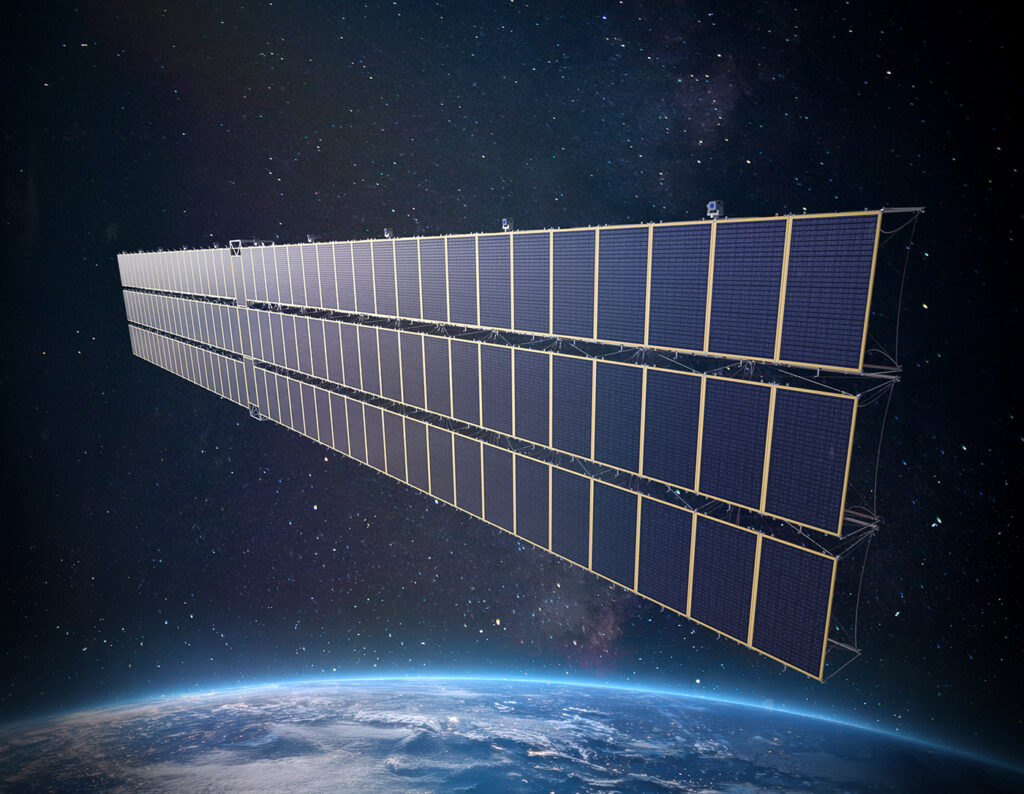
Table of Contents
Moving the Cloud to Low Earth Orbit
For years, the concept of an ‘orbital data center’ has lived primarily in the realm of science fiction and theoretical whitepapers. While the idea of processing data in space to reduce latency for satellite constellations is appealing, the physical reality of the vacuum of space makes traditional server architecture impossible. Specifically, two existential threats stand in the way: power scarcity and the inability to dump heat.
Redwire Corporation (NYSE:RDW) is attempting to bridge this gap. In a recently released technical whitepaper, the space infrastructure firm outlines a scalable architecture for orbital compute nodes, arguing that the transition from conceptual to operational is now possible by leveraging existing flight-proven technologies.
The Heat Sink Problem in a Vacuum
On Earth, data centers rely on massive HVAC systems and water-cooling loops to prevent CPUs from melting. In space, there is no air to carry heat away via convection. Thermal management becomes the primary bottleneck for compute density; without a way to reject heat, a high-performance server in orbit would quickly overheat and shut down.
Redwire’s approach focuses on deployable radiator technologies. Rather than relying on static panels, the company proposes modular, deployable thermal systems that can expand to increase the surface area available for radiative cooling. This allows the compute node to scale its processing power in tandem with its ability to shed heat, preventing the ‘thermal throttling’ that typically plagues small-satellite payloads.
Powering the Orbital Cloud
Computing is an energy-intensive endeavor. To support data center-class capabilities, an orbital node requires a power profile far beyond what standard satellite bus panels can provide. Redwire points to its Roll-Out Solar Array (ROSA) architecture as the foundational power source for these installations.
ROSA technology, which has already seen successful deployment on the International Space Station (ISS), allows for high-power generation in a compact, storable form factor that expands once in orbit. By integrating ROSA with advanced electrical distribution systems, Redwire suggests that orbital nodes can maintain the consistent, high-wattage power draw required by modern GPUs and AI accelerators.
Architectural Integration and the Near-Term Node
The core thesis of the Redwire paper is that orbital computing cannot be treated as a ‘server in a box’ launched into space. Instead, it must be an integrated system where the compute performance is mathematically tied to the power generation and thermal rejection capabilities from day one.
To illustrate this, Redwire presents a representative near-term compute node concept. This prototype architecture leverages the company’s existing heritage in deployable structures to create a modular platform. By using a modular design, operators could theoretically ‘plug in’ additional compute blades as needed, provided they also deploy additional ROSA wings and radiator panels to balance the energy and thermal budget.
This shift toward scalable orbital infrastructure arrives at a critical moment. As the number of LEO (Low Earth Orbit) satellites grows, the volume of raw data being beamed back to Earth is creating a massive bandwidth bottleneck. Shifting the ‘compute’ to the ‘edge’—literally the edge of the atmosphere—would allow satellites to process data locally and only send back high-value insights, drastically reducing the load on ground-station networks.
While the whitepaper provides a technical roadmap, the economic viability of such systems will depend on the cost of launch and the longevity of the hardware in the harsh radiation environment of space. However, by grounding their proposal in flight-proven tech like ROSA, Redwire is moving the conversation from “if” orbital data centers are possible to “how” they will be scaled.