POCO Pad C1 Hits Global Markets: A Pragmatic Budget Tablet for the HyperOS Ecosystem
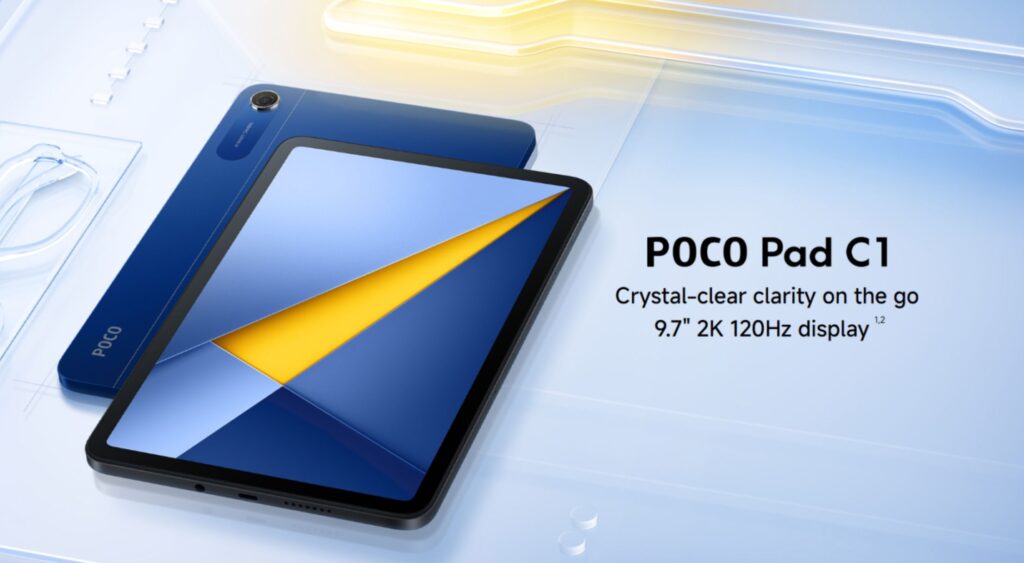
Table of Contents
Xiaomi’s Budget Strategy Shifts to the Slate
Xiaomi is expanding its aggressive pricing strategy into the tablet market with the official global rollout of the POCO Pad C1. While the industry has seen a surge in high-end OLED tablets, the C1 is positioned as a pragmatic utility device, targeting users who need a portable media consumption hub without the flagship price tag. The device arrives at a time when budget tablets are increasingly becoming satellites for smartphone ecosystems, and the C1 is designed to fit squarely into that niche.
The hardware profile of the POCO Pad C1 emphasizes visibility and portability. It features a 9.7-inch IPS display that manages to hit a 2K resolution—a welcome departure from the lower-density panels typically found in sub-$300 tablets. More importantly, Xiaomi has implemented a 120Hz refresh rate, ensuring that navigation through HyperOS 3.0 feels fluid rather than stuttery. To combat the traditional weakness of budget screens, the C1 pushes 500 nits of standard brightness, peaking at 600 nits for outdoor use. The inclusion of TUV Rheinland certification for low blue light suggests that Xiaomi is marketing this as a device for long-form reading and student use.
Performance and the 4G Trade-off
Under the hood, the POCO Pad C1 is powered by the Qualcomm Snapdragon 6s 4G Gen 2. By opting for a 4G chipset rather than 5G, Xiaomi has likely managed to keep the thermal profile low and the price point competitive. While this won’t satisfy power users or hardcore gamers, the combination of 6GB of RAM and 128GB of internal storage is sufficient for the intended use cases: streaming, PDF management, and light multitasking.
For those concerned about the limited base storage, the addition of a microSD slot supporting up to 2TB of expansion makes the C1 a viable option for digital hoarders and students who need an offline library of textbooks and media. The device is housed in a slim metal chassis, measuring just 7.4mm in thickness and weighing 406 grams, which avoids the cumbersome bulk of larger 11-inch or 12-inch alternatives.
HyperOS 3.0 and the AI Layer
The most interesting aspect of the POCO Pad C1 isn’t the hardware, but the software. Running on HyperOS 3.0, the tablet is deeply integrated into Xiaomi’s broader ecosystem. Perhaps more surprising is the inclusion of AI-driven features that were previously reserved for higher-tier devices. The C1 supports Circle to Search and integrates Google Gemini, signaling that AI utility is no longer being gated behind premium hardware specs.
Connectivity and legacy support remain a priority here. In an era where the 3.5mm headphone jack is nearly extinct in smartphones, the C1 retains the port, complementing its dual-speaker setup for a better audio experience during media playback. Power is handled by a 7600 mAh battery. While 18W charging is slow by modern standards—likely taking several hours to top up from zero—the efficiency of the Snapdragon 6s chip allows for roughly 15 hours of continuous video playback.
Market Positioning and Value
While full regional pricing remains fragmented, current data suggests the POCO Pad C1 will sit comfortably below the $300 mark. This places it in direct competition with the Samsung Galaxy Tab A series and Lenovo’s budget offerings. With an 8 MP rear camera and 5 MP front sensor, the optics are purely functional; they are designed for occasional document scanning and basic video calls rather than photography.
The POCO Pad C1 is available in Blue and Grey, offering a clean, minimalist aesthetic that mirrors the brand’s recent smartphone releases. For users seeking a secondary screen for productivity or a durable device for children’s education, the C1 provides a balanced set of specs without the unnecessary overhead of a high-end processor.