OPPO Pad 6 Debuts with Dimensity 9500s and Ultra-Slim 5.99mm Chassis
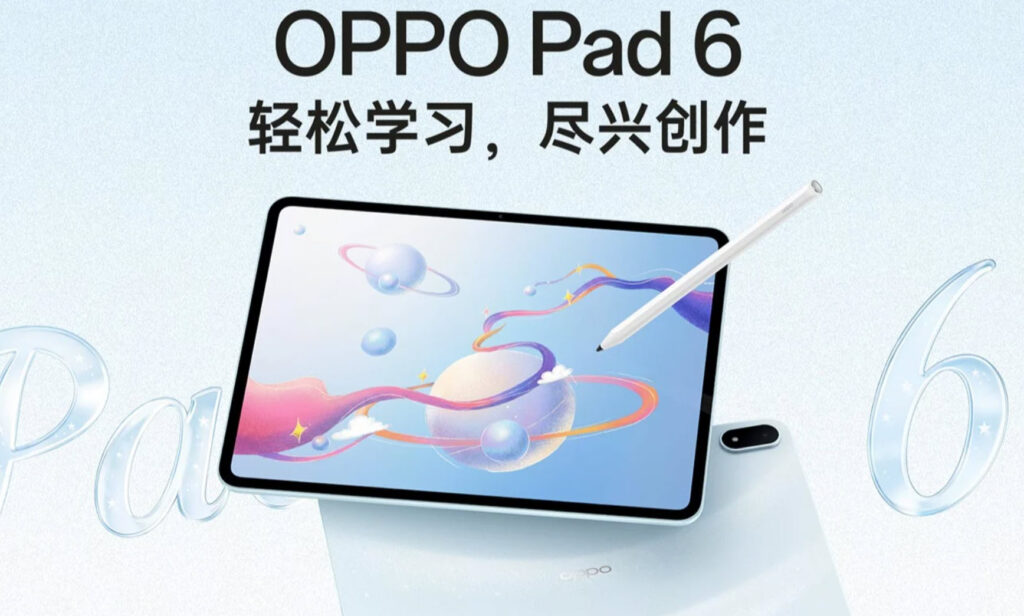
Table of Contents
A Push for Thinness and Performance
OPPO has officially pulled the curtain back on its latest productivity slate, the OPPO Pad 6, during a launch event in China on May 25. While the company has been diversifying its tablet portfolio recently—including the higher-end Pad 5 Pro and the more compact Pad Mini—the Pad 6 is positioned as a balanced flagship designed to bridge the gap between portable media consumption and professional utility.
The first thing that stands out about the Pad 6 is its physical footprint. OPPO has pushed the engineering of the chassis to a slim 5.99 mm, making it one of the thinnest mainstream Android tablets currently on the market. Despite the thin profile, the device maintains a respectable weight of 577 grams, ensuring it doesn’t feel overly fragile or cumbersome during long sessions. It arrives in three distinct finishes: Starlight Blue, Galaxy Silver, and Deep Space Gray.
The Display: Prioritizing Eye Comfort
At the heart of the device is a 12.1-inch 3K LCD panel. While many competitors have pivoted toward OLED for flagship tablets, OPPO is sticking with a high-quality LCD paired with a 144Hz refresh rate to ensure fluid animations and high-speed scrolling.
Of particular interest is the introduction of the “Soft Light” screen technology. This isn’t just a marketing buzzword; it’s a targeted hardware approach to reduce glare and specular reflections. By diffusing incoming light, OPPO claims the screen is significantly easier on the eyes for users who spend hours reading PDFs or drafting documents, mimicking the low-reflectivity of matte paper without sacrificing the sharpness of a 3K resolution.
Under the Hood: MediaTek’s New Heavy Hitter
Performance is driven by the MediaTek Dimensity 9500s. This chipset has recently gained attention for powering the POCO X8 Pro Max, and its transition into the Pad 6 suggests a focus on sustained high-performance multitasking. Early benchmarks indicate the silicon is a powerhouse, reportedly clearing 3 million points on AnTuTu, which places it in direct competition with the upper echelon of Snapdragon-powered tablets.
To keep that power running, the Pad 6 houses a substantial 10,420 mAh battery. While the capacity is impressive, the 67W fast charging is the real win here, allowing users to top up the large cell significantly faster than the standard 18W or 33W chargers often found in mid-range tablets.
Software and the Productivity Ecosystem
Hardware aside, OPPO is attempting to solve the perennial “Android tablet problem”: the lack of a cohesive desktop-class experience. The Pad 6 doubles down on productivity software, integrating PC-style file management and a robust floating window system that allows for true side-by-side multitasking.
The device also features dedicated stylus support, transforming the slate into a digital notebook. Perhaps the most practical addition is the enhanced connectivity suite, which allows the tablet to share a nearby OPPO phone’s 5G connection directly, reducing the friction of setting up mobile hotspots on the go.
When compared to the Pad 5, the Pad 6 is an evolutionary rather than revolutionary update. The jump in processing power and the refinement of the chassis make it a compelling upgrade for power users, though it remains to be seen how quickly these features will migrate from the Chinese market to a global release.