POCO Pad C1 Debuts as a Budget-Friendly 4G Slate Aiming for the Entry-Level Market
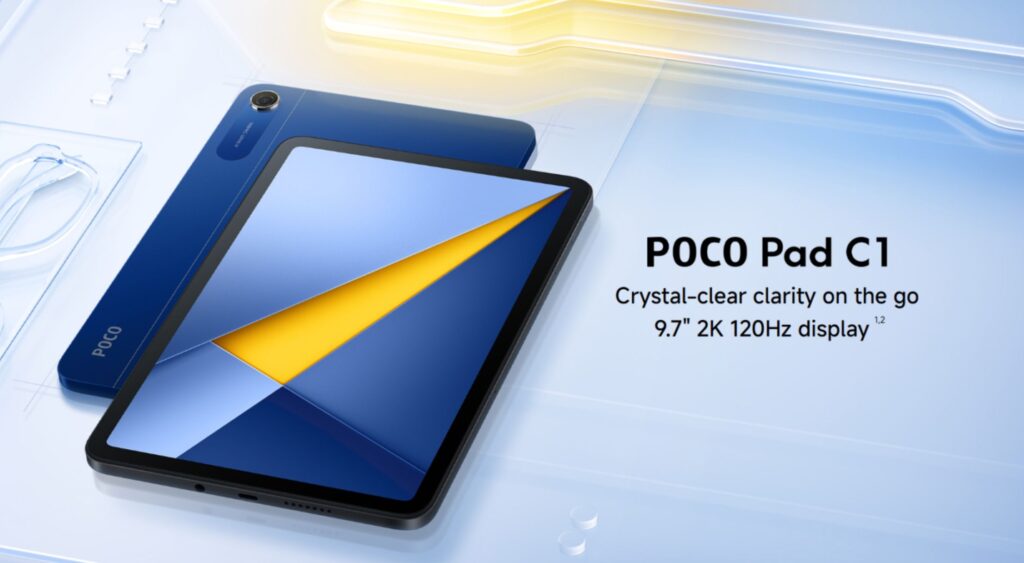
Table of Contents
A Calculated Play for the Budget Segment
Xiaomi has officially expanded its POCO portfolio with the global introduction of the POCO Pad C1. While the industry has seen a surge in high-end, OLED-driven tablets, the C1 is a deliberate pivot toward the entry-level consumer—those who need a reliable device for media consumption and light productivity without the flagship price tag.
The device arrives as a pragmatic solution for users who find 8-inch tablets too cramped and 12-inch slates too cumbersome. With a 9.7-inch IPS display, the POCO Pad C1 sits in a comfortable middle ground, designed primarily for streaming, digital reading, and basic multitasking. The chassis is notably slim at 7.4 mm and maintains a lightweight profile of 406 grams, utilizing a metal body that gives the device a more premium tactile feel than the plastic builds often found in this price bracket.
Display and Visuals: Prioritizing Fluidity
The standout specification of the POCO Pad C1 is undoubtedly its display. Xiaomi has equipped the tablet with a 2K resolution panel that supports a 120Hz refresh rate. In the budget category, 120Hz is still relatively rare, typically reserved for mid-range offerings. This high refresh rate ensures that scrolling through web pages and navigating the HyperOS interface remains smooth, reducing the visual stutter common in 60Hz budget displays.
Brightness levels are tuned for versatility, offering 500 nits of standard brightness and peaking at 600 nits for outdoor visibility. To cater to long-term users, the screen carries TUV Rheinland certification for low blue light and flicker reduction, a necessary addition for a device marketed toward students and casual readers who spend hours staring at the glass.
Under the Hood: 4G Connectivity and AI Integration
Powering the C1 is the Qualcomm Snapdragon 6s 4G Gen 2 chipset. It is important to note that this is a 4G-only device, meaning it avoids the higher cost of 5G modems to keep the price point competitive. Paired with 6 GB of RAM and 128 GB of internal storage, the hardware is sufficient for everyday tasks—PDF rendering, browser-based work, and video streaming—but it will struggle with heavy gaming or intensive video editing.
For those requiring more space, the tablet includes a microSD slot supporting expansion up to 2 TB, making it an attractive option for users who maintain large local libraries of movies or documents. Software-wise, the device runs HyperOS 3.0, which integrates several of Google’s latest AI capabilities. Users will have access to tools like “Circle to Search” and Gemini, bringing a layer of modern intelligence to an otherwise modest hardware package.
Endurance and Connectivity
Battery life is a primary focus for the C1, housing a 7,600 mAh cell. Xiaomi claims this allows for up to 15 hours of continuous video playback or roughly 1.7 days of mixed regular use. While the 18W charging speed is modest by today’s standards and will result in longer top-up times, it is commensurate with the battery size and the device’s expected use case.
In an era where the 3.5 mm headphone jack is nearly extinct in the mobile space, POCO has retained it here, alongside dual speakers for a more immersive audio experience without the need for Bluetooth peripherals.
Positioning and Market Value
While official regional pricing has not been fully detailed across all markets, the POCO Pad C1 is expected to retail below the $300 mark. By combining a high-refresh 2K screen with a stable 4G connection and a large battery, Xiaomi is positioning the C1 as a direct competitor to Samsung’s Galaxy Tab A series and Lenovo’s budget offerings. It isn’t designed to replace a laptop, but as a dedicated media and study tool, it offers a compelling value proposition.