POCO Pad C1 Debuts: A Budget-Conscious 4G Tablet Aiming for the Mid-Range Gap
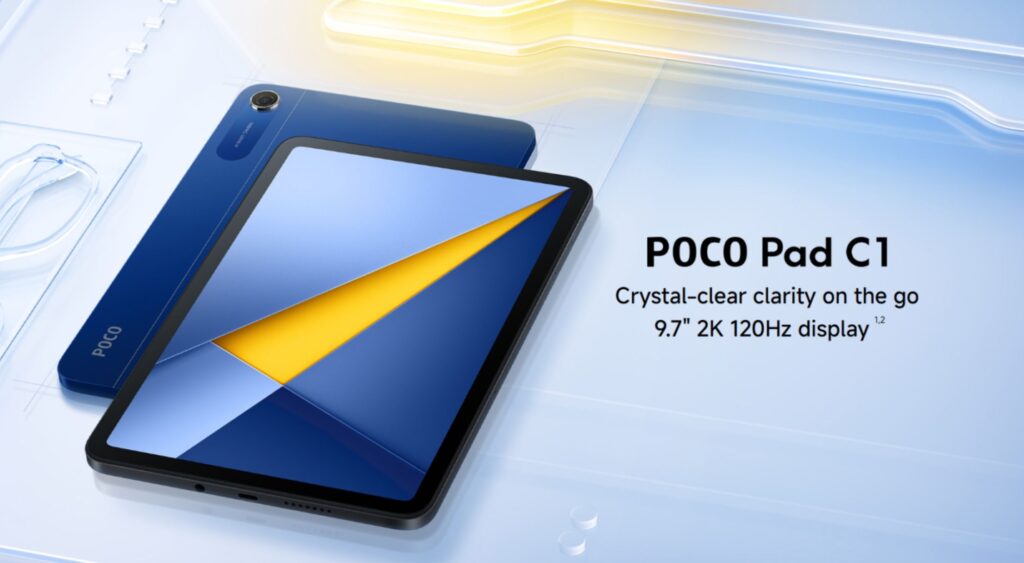
Table of Contents
A New Entry for the Budget Slate Market
Xiaomi has officially expanded its POCO portfolio with the global rollout of the POCO Pad C1. Positioned as a value-driven alternative to the more premium Pad 6 series, the C1 focuses on the essential pillars of a modern media-consumption device: a sharp screen, decent battery life, and the flexibility of 4G connectivity.
The tablet enters a crowded market where budget devices often compromise on display quality to keep costs low. However, the Pad C1 attempts to pivot this trend by offering a 9.7-inch IPS panel boasting a 2K resolution. More importantly, the inclusion of a 120Hz refresh rate suggests a fluidity in navigation that is usually reserved for higher-tier hardware. With a peak brightness of 500 nits—stretching to 600 nits in outdoor environments—the device is designed to be usable beyond the confines of a living room.
To mitigate the eye strain associated with long-form reading and streaming, Xiaomi has secured TUV Rheinland certification for low blue light and flicker reduction, a detail that aligns with the device’s likely use case as a digital notebook or a portable cinema for students and casual users.
The Hardware Compromise: Snapdragon 6s 4G
Under the hood, the POCO Pad C1 is powered by the Qualcomm Snapdragon 6s 4G Gen 2. While the “Gen 2” moniker sounds current, the chip is fundamentally a 4G processor, meaning users won’t find 5G speeds here. This choice reinforces the device’s positioning as a budget-friendly tool rather than a productivity powerhouse.
Pairing the chipset with 6 GB of RAM and 128 GB of internal storage, the C1 is well-equipped for multitasking within the realm of lightweight apps—think Google Docs, Chrome, and Netflix. For those needing more space for offline media, the inclusion of a microSD slot supporting up to 2 TB of expansion is a critical addition, as 128 GB can vanish quickly with high-bitrate video content.
The software experience is driven by HyperOS 3.0. Interestingly, POCO is integrating AI features into this budget tier, including “Circle to Search” and Google Gemini integration. This move suggests that Xiaomi is prioritizing the AI user experience across its entire ecosystem, regardless of the hardware’s raw processing power.
Design and Endurance
Physically, the Pad C1 avoids the plastic feel common in sub-$300 tablets. It features a slim metal chassis measuring 7.4 mm in thickness and weighing in at 406 grams. This makes it highly portable, fitting easily into small bags without adding significant bulk.
The device is powered by a 7,600 mAh battery. While 18W charging is modest by today’s standards—meaning a full charge will take some time—the efficiency of the Snapdragon 6s chip allows for impressive longevity. Xiaomi claims up to 15 hours of continuous video playback and nearly two days of moderate regular use.
In a move that will please audiophiles and legacy hardware users, the Pad C1 retains the 3.5 mm headphone jack, augmenting the built-in dual speakers for a more versatile audio experience.
Positioning in the Global Market
While final regional pricing hasn’t been fully detailed across all markets, the Pad C1 is expected to sit comfortably below the $300 mark. This places it in direct competition with the entry-level offerings from Samsung’s Tab A series and Lenovo’s Tab M line.
The camera setup—an 8 MP rear sensor and a 5 MP front shooter—is utilitarian. It’s sufficient for scanning documents or the occasional Zoom call, but it isn’t designed for photography. In the tablet world, this is an acceptable trade-off for a device that prioritizes screen real estate and battery endurance over imaging capabilities.