Algorithm and Altar: Pope Leo XIV Inaugurates Sagrada Família’s Final Tower
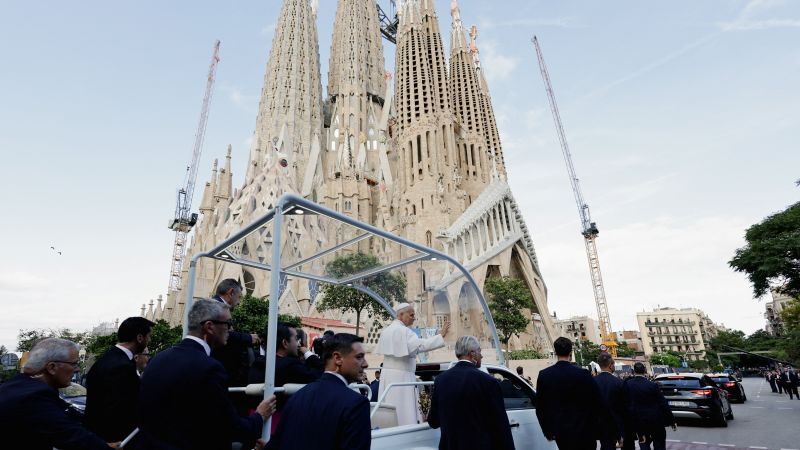
Table of Contents
A Century of Silence and Stone
Exactly one hundred years after Antoni Gaudí was tragically mistaken for a beggar following a tram accident in 1926, the architectural vision he left unfinished has reached a definitive vertical peak. Pope Leo XIV arrived in Barcelona on June 10 to lead a Holy Mass and officially inaugurate the Tower of Jesus Christ, a moment that effectively crowns the Sagrada Família as the tallest church in the world.
The visit served as more than a religious formality; it was a meditation on the nature of completion. In a homily delivered before the King and Queen of Spain and thousands of faithful, the first US-born pope framed the basilica’s unfinished state not as a failure, but as a living promise. “The fact that it is incomplete is not a flaw,” Leo XIV stated, emphasizing that the ongoing construction is a testament to a persistent, generational desire to honor Gaudí’s legacy.
The ceremony concluded with a high-tech tribute to the architect, as the night sky over Barcelona was illuminated by drone swarms forming the image of Gaudí’s face, bridging the gap between the 19th-century naturalist and 21st-century robotics.
Digital Resurrection of a Lost Blueprint
For decades, the Sagrada Família was a puzzle with missing pieces. During the Spanish Civil War in July 1936, anti-clericalist anarchist groups stormed the basilica, incinerating Gaudí’s workshop and destroying a vast array of his original plans. For the successors who followed, the project was less about following a map and more about decoding a logic.
The current chief architect, Jordi Faulí, has transitioned the project from traditional masonry into the era of computational design. To bridge the gap left by the destroyed archives, the construction team has leaned heavily on digital modeling software and 3D printing to extrapolate Gaudí’s geometric intentions. The complex curves and hyperbolic paraboloids that define the church’s interior—inspired by the organic forms of forests and bone structures—would be nearly impossible to execute with precision using only hand-drafted sketches.
Industrial robots are now deployed to carve the massive stone blocks, allowing for a level of precision and speed that has accelerated the timeline for the remaining towers. This marriage of parametric design and automated fabrication has allowed the team to realize the 18 towers—representing the apostles, evangelists, and the Virgin Mary—with a mathematical accuracy Gaudí could only have dreamt of.
Faith in the Age of Conflict
While the event celebrated technological and architectural triumph, the Pope used the platform to address the friction of the modern geopolitical landscape. In a sharp departure from the celebratory tone of the inauguration, Leo XIV spoke against the rationalization of war through religious language, specifically citing his opposition to joint US-Israeli strikes on Iran and current immigration crackdowns.
The juxtaposition was stark: a celebration of a building that symbolizes peace and spiritual pilgrimage, set against a backdrop of global volatility. This thematic tension was mirrored in the architectural details of the church itself, where the towers are likened by some, such as author Peter Stanford, to the Catalan tradition of “castells”—human towers where people support one another to reach a higher point. It is a metaphor for the construction of the basilica itself: a multi-generational effort of human support and technical evolution.
By blessing the Tower of Jesus Christ, Pope Leo XIV follows the precedent set by Pope Benedict XVI in 2010, further legitimizing the basilica not just as a tourist marvel, but as a sanctified space where the ancient ritual of faith meets the cutting edge of architectural science.