POCO Pad C1 Arrives: Xiaomi’s Budget Tablet Bet on 120Hz and 4G Connectivity
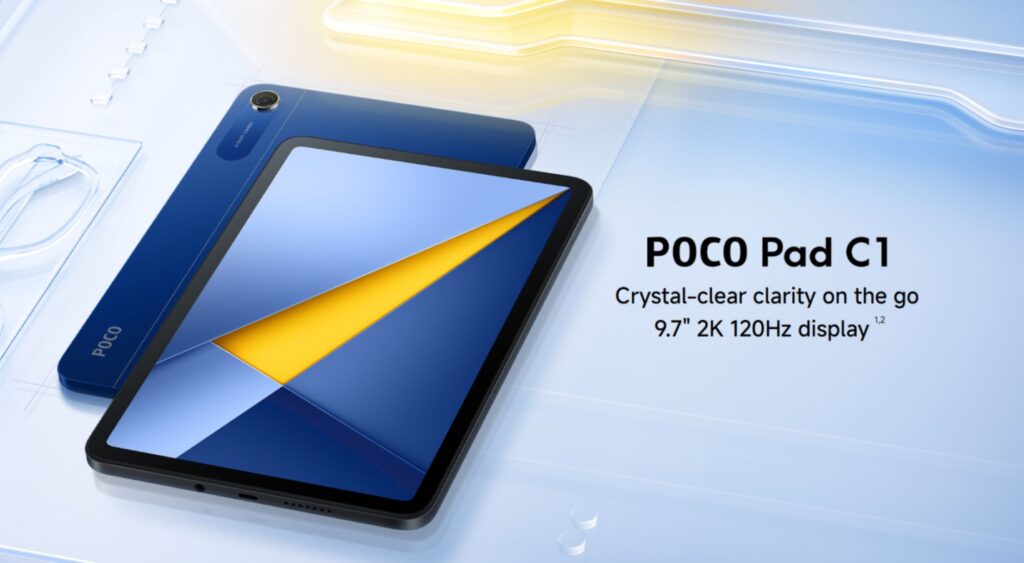
Table of Contents
A New Entry for the Budget Slate Market
Xiaomi has officially expanded its POCO portfolio with the global rollout of the POCO Pad C1. Positioning itself as an accessible alternative to high-end media tablets, the Pad C1 aims to bridge the gap between basic e-readers and expensive productivity machines. While it doesn’t aim for performance benchmarks, it focuses heavily on the consumption experience—prioritizing a high-refresh-rate display and cellular connectivity over raw processing power.
The device arrives in two colorways, Blue and Grey, featuring a slim metal chassis that keeps the weight at a manageable 406 grams. At 7.4 mm thin, the hardware feels more aligned with modern tablet aesthetics than typical budget offerings, which often rely on plastic composites to keep costs down.
The Display: A High-End Spec in a Low-End Device
The standout feature of the POCO Pad C1 is undoubtedly its 9.7-inch IPS panel. In a market where budget tablets often stick to 60Hz or basic Full HD resolutions, POCO has opted for a 2K resolution paired with a 120Hz refresh rate. This ensures that scrolling through web pages and navigating HyperOS 3.0 feels significantly smoother than on competing entry-level slates.
Visibility is handled by a peak brightness of 500 nits, which Xiaomi claims can boost to 600 nits for outdoor use. To mitigate the eye strain associated with prolonged reading or streaming, the display carries TUV Rheinland certification for low blue light and flicker reduction, making it a viable tool for students or professionals who spend hours reviewing PDFs.
Under the Hood: Performance and AI Integration
Powering the Pad C1 is the Qualcomm Snapdragon 6s 4G Gen 2 chipset. By sticking with 4G connectivity rather than 5G, POCO has managed to keep the price point low while ensuring the device remains portable for those who don’t want to rely on Wi-Fi tethering. The internals are modest, featuring 6 GB of RAM and 128 GB of internal storage, though the inclusion of a microSD slot allowing for expansion up to 2 TB is a critical addition for users with large media libraries.
Interestingly, the POCO Pad C1 isn’t just a hardware play; it’s a vehicle for Xiaomi’s latest software ecosystem. Running HyperOS 3.0, the tablet integrates several AI-driven features that were previously reserved for flagship devices. Users have access to Google’s Gemini and the ‘Circle to Search’ functionality, suggesting that Xiaomi is leveraging software to make a budget device feel more “intelligent” despite the hardware limitations.
Battery Life and Connectivity
The tablet is powered by a 7,600 mAh battery. While the 18W charging speed is modest by today’s standards—meaning users should expect a fair amount of downtime when plugging in—the efficiency of the Snapdragon 6s chip helps longevity. Xiaomi claims the device can handle up to 15 hours of continuous video playback or nearly two days of light, intermittent use.
In an era where the 3.5 mm audio jack is vanishing from almost every mobile device, POCO has retained the port. When paired with the dual-speaker setup, the Pad C1 reinforces its identity as a media consumption machine rather than a laptop replacement.
Market Positioning and Value
While official regional pricing has not been fully detailed across all markets, industry indicators suggest the POCO Pad C1 will retail for under $300. This puts it in direct competition with the Samsung Galaxy Tab A series and Lenovo’s entry-level offerings. By offering a 120Hz 2K screen at this price point, POCO is attempting to undercut the competition on visual quality, potentially making it the most attractive option for those who prioritize display quality over multitasking power.