OPPO Pad 6 Debuts with Dimensity 9500s and Ultra-Slim Chassis
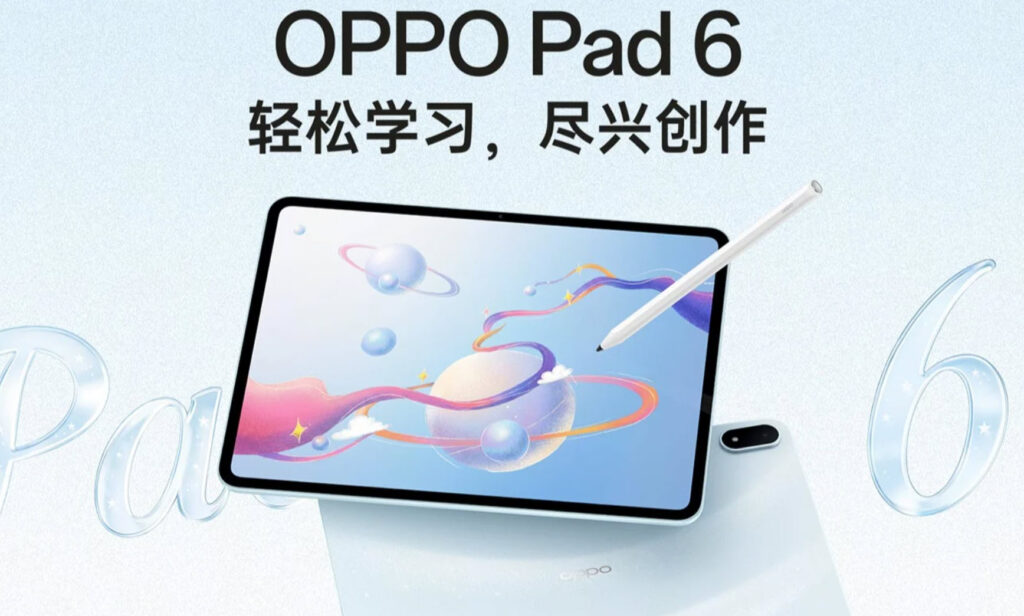
Table of Contents
A Push for Thinness and Power
OPPO has officially pulled back the curtain on the Pad 6 during its May 25th launch event in China. While the company has recently experimented with smaller form factors like the Pad Mini and high-end iterations like the Pad 5 Pro, the Pad 6 arrives as a focused attempt to balance extreme portability with flagship-grade processing power.
The first thing that strikes you about the Pad 6 is its footprint. OPPO has managed to shave the device down to a mere 5.99 mm in thickness, making it one of the slimmest tablets in its class. Despite the thin profile, the device maintains a substantial feel, weighing in at 577 grams. It launches in three distinct finishes: Starlight Blue, Galaxy Silver, and Deep Space Gray, catering to a professional aesthetic that aligns with OPPO’s productivity push.
Display Tech and the ‘Soft Light’ Approach
At the center of the experience is a 12.1-inch 3K LCD panel. While OLED continues to dominate the ultra-premium segment, OPPO is sticking with a high-quality LCD here, bolstered by a 144 Hz refresh rate to ensure fluid animations and a responsive touch experience.
More interesting is the implementation of what OPPO calls a “Soft Light” screen design. This isn’t just a marketing term; it refers to a specific surface treatment intended to diffuse ambient light and minimize the harsh reflections and glare typically associated with glossy glass screens. For users who primarily use tablets for reading PDFs or long-form documentation, this matte-like quality reduces eye strain significantly compared to standard displays.
Silicon and Performance Metrics
Under the hood, the Pad 6 is powered by the MediaTek Dimensity 9500s. This chip has already gained some notoriety for its appearance in the POCO X8 Pro Max, proving its capability in high-demand mobile environments. According to internal benchmarks, the chipset is capable of pushing over 3 million points on AnTuTu, positioning the Pad 6 as a formidable device for multitasking and light gaming.
To keep that silicon running without frequent tethering to a wall, OPPO has integrated a 10,420 mAh battery. Given the slim chassis, maximizing internal volume for the cell was likely a primary engineering challenge. To mitigate the downtime of such a large capacity, the device supports 67W fast charging, which should bring the tablet back to full power in a reasonable window for a device of this size.
Software: Bridging the Gap to Laptop Utility
Hardware specs aside, the Pad 6 is clearly being marketed as a productivity tool rather than a simple media consumption slab. OPPO’s software layer emphasizes a “PC-like” experience. This includes an overhauled file management system that mimics a desktop directory structure and an expanded suite of floating windows, allowing users to run multiple apps side-by-side without the restrictive feel of traditional Android split-screen modes.
The tablet also features full stylus support, targeting the creative and corporate demographic. One notable ecosystem addition is the ability to share a nearby OPPO phone’s 5G connection directly with the tablet, reducing the friction of setting up mobile hotspots during travel. While the jump from the Pad 5 to the Pad 6 isn’t a total reinvention, the refinements in chassis thickness and the leap in raw processing power make it a compelling evolution for those looking for a tablet that can actually handle a workday.


