Before Disney: The 100-Year Legacy of Lotte Reiniger and the First Animated Feature
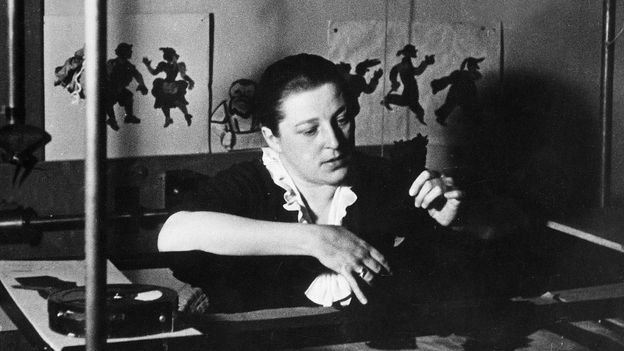
Table of Contents
The Shadow of a Pioneer
The history of feature-length animation is often told as a linear progression starting with Walt Disney’s 1937 release of Snow White and the Seven Dwarfs. However, the archival reality is far different. A century ago, in 1926, Lotte Reiniger released The Adventures of Prince Achmed, a work that stands as the oldest surviving animated feature film in existence. Long before the industrialization of the animation studio, Reiniger was crafting a cinematic language based on shadow, patience, and mechanical ingenuity.
Reiniger’s entry into cinema was far from a directorial debut. During the silent era in Germany, she began as an actress—or more accurately, a technician of the absurd. On the set of an adaptation of The Pied Piper of Hamelin, her primary responsibility was managing the rats. When the live animals refused to follow the piper, the production shifted to wooden models, moved frame by frame. This encounter with stop-motion animation served as the catalyst for Reiniger, who realized she could apply this technique to her lifelong passion: the art of the shadow puppet.
The Artisanal Engine of Innovation
Unlike the sprawling teams that would later define the Golden Age of animation, Reiniger’s process was intensely artisanal. Using cardboard and lead cut into intricate silhouettes and joined with wire hinges, she created a cast of characters that functioned like a complex clockwork mechanism. These figures were laid flat on a glass plate and lit from below, with a camera capturing the action from above.
The sheer labor involved was staggering. To produce a single minute of film, Reiniger had to manually adjust her puppets and capture over a thousand individual frames. By 1919, she had mastered the short form with The Ornament of the Loving Heart, but it was a Berlin banker in 1923 who provided the capital necessary to scale her vision into a feature-length narrative. This funding allowed her to assemble a skeletal crew, including her husband, who acted as the primary cinematographer, to synthesize various Middle Eastern folk tales into the epic journey of Prince Achmed.
The Multiplane Precursor
While the silhouette aesthetic is the most striking visual element of the film, its most significant contribution to technology was the early implementation of the multiplane camera. This device allowed Reiniger to break the flat plane of the image, creating an artificial sense of depth and atmospheric perspective.
Her setup consisted of a tall scaffold with a camera mounted at the top, shooting through multiple layers of glass. By placing characters on one layer and background elements on others—and moving those layers at varying speeds—she achieved a parallax effect that simulated three-dimensional space. In the sequence where Prince Achmed rides his flying horse, the starry sky is composed of three distinct layers moving at different velocities, creating a haunting, ethereal quality that felt impossible for the era.
Despite the technical brilliance of this approach, the historical credit for the multiplane camera largely shifted toward Walt Disney, who was granted a U.S. patent for a more complex version of the device in 1940 and later inducted into the National Inventors Hall of Fame. While Disney’s version was an industrial feat of engineering, Reiniger’s was the conceptual proof of concept that preceded it by more than a decade.
A Timeless Technical Feat
A century later, the sequences in The Adventures of Prince Achmed—particularly the shape-shifting combat between a sorcerer and a witch—remain visually arresting. For Reiniger, animation was not merely a way to tell a story, but a means to visualize events that could not be captured by any other cinematic method.
As Jez Stewart, Curator of Animation at the British Film Institute, notes, the film continues to provoke the same question from modern viewers that it did in 1926: “How did she do that?” In an era of CGI and generative AI, the tactile, hand-cut precision of Reiniger’s work serves as a reminder of the foundational link between physical craftsmanship and digital evolution.


