Oil Shock 2.0: How Geopolitical Instability is Breaking the U.S. Fuel Economy
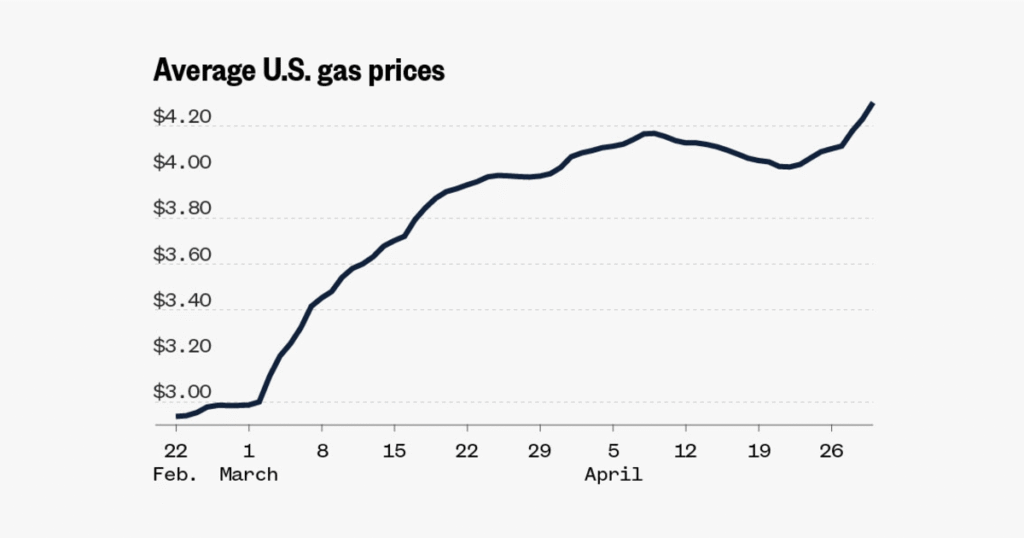
Table of Contents
The New Baseline for the Pump
The American commute has become significantly more expensive over the last several months, as the national average for gasoline has climbed past the $4.50 per gallon mark. According to the latest data from AAA, this surge represents a 50% increase since the onset of military actions involving the U.S., Israel, and Iran. What began as a localized geopolitical conflict has evolved into a systemic shock to the global energy supply chain, stripping away the stability that drivers had come to expect after the post-pandemic recovery.
The volatility isn’t just a matter of cents per gallon; it is a fundamental shift in energy costs. Prices have risen by more than a dollar since the initial strikes against Iran, creating a precarious financial environment for households that are already grappling with cumulative inflation. While markets typically react to news in short bursts, the current trend suggests a more prolonged constriction of the global oil supply that is resisting traditional market corrections.
Regional Divergence and the $6 Threshold
The burden of these price hikes is not being shared equally across the map. In California, the cost of fuel has eclipsed $6 per gallon, marking the highest peak in the nation. This outlier status is exacerbated by the state’s unique refining constraints and strict emissions standards, which often leave it more vulnerable to supply shocks than the rest of the country.
Other regions are seeing similar pressures. In Alaska, Hawaii, Illinois, Nevada, Oregon, and Washington, averages are now hovering near the $5 threshold. Conversely, states in the Midwest continue to report the lowest costs in the country, though even these relatively affordable regions are seeing upward trajectories as the national floor rises.
Beyond the Pump: The Logistics Collapse
The crisis extends far beyond consumer gasoline. The surge in jet fuel prices—a direct byproduct of crude oil volatility—has sent shockwaves through the aviation industry. For low-cost carriers operating on razor-thin margins, the spike in fuel overhead has proven fatal. The recent shuttering of Spirit Airlines serves as a stark case study in how energy instability can dismantle a business model based on affordability and high-volume efficiency.
As airlines are forced to pass these costs onto consumers through increased airfares, the ‘fuel effect’ is creating a secondary wave of inflation across travel and logistics. This is no longer just a problem for commuters; it is a systemic increase in the cost of moving goods and people across the globe.
The Ceasefire Mirage
Market analysts had hoped for a reprieve in April, following a series of announced and extended ceasefires. For a brief window, oil prices see-sawed, leading some to believe the peak had passed. However, that optimism proved premature. After several weeks of gradual decline, prices shot back up to new highs, suggesting that the market is now pricing in a long-term state of instability rather than a temporary disruption.
The disconnect between diplomatic signals and pump prices reveals a deep skepticism among energy traders. Until there is a verifiable stabilization of the Strait of Hormuz and a guaranteed flow of crude, the ‘ceasefire discount’ is likely to be a fleeting phenomenon. For the average driver, the reality is a new, more expensive baseline for energy consumption.