Nvidia Targets the PC Heart: Arm-Based ‘RTX Spark’ Chip to Debut in Microsoft and Dell Laptops
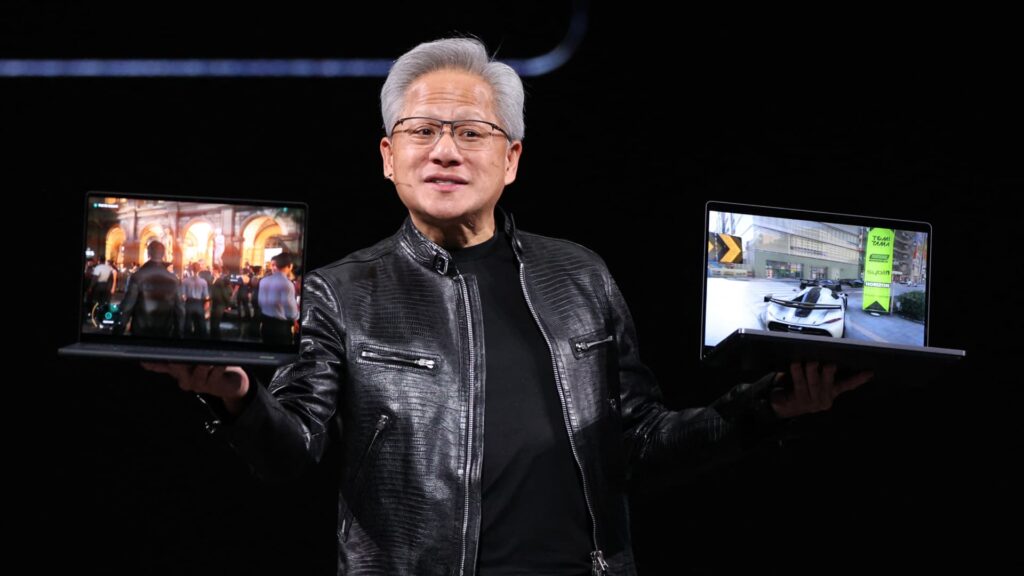
Table of Contents
A Direct Challenge to the x86 Guard
For decades, the architecture of the personal computer has been a predictable stronghold for Intel and AMD. But Nvidia, having already secured the crown of the data center through its AI dominance, is now moving to capture the endpoint. During a keynote at Computex in Taiwan, CEO Jensen Huang unveiled the N1X processor, an Arm-based CPU designed in collaboration with Microsoft and manufactured by TSMC using a cutting-edge 3-nanometer process.
The N1X isn’t arriving as a standalone component but as the core of the RTX Spark “superchip.” By fusing a custom Arm CPU—developed with Taiwanese firm MediaTek—with one of Nvidia’s Blackwell GPUs and 128 gigabytes of unified memory, Nvidia is attempting to erase the traditional boundary between general processing and graphics acceleration. This architecture is specifically designed to handle “agentic AI,” where software agents perform complex, multi-step tasks locally rather than relying entirely on the cloud.
The rollout is aggressive. Nvidia confirmed that the RTX Spark will debut this fall across a wide swath of the Windows ecosystem, appearing in machines from Microsoft, Dell, HP, ASUS, Lenovo, and MSI. The company plans to eventually launch over 30 laptop models and 10 desktop configurations powered by the silicon.
The Shift Toward Agentic Compute
The move signals a fundamental shift in how Nvidia views the PC. Huang described the transition as a “reinvention” comparable to the shift from basic mobile phones to smartphones. For Nvidia, the primary driver isn’t just speed, but the elimination of the CPU bottleneck. In traditional AI workflows, the GPU handles the heavy lifting, but the CPU often struggles to manage the data flow and orchestration required for sophisticated AI agents.
By switching to an Arm-based architecture, Nvidia is following a blueprint successfully implemented by Apple with its M-series chips. The goal is a tighter integration of memory and compute that allows for higher efficiency in a smaller footprint. Early indicators suggest the first wave of laptops will be ultra-portable, with some chassis as thin as 14 millimeters. However, these will likely carry a premium price tag, targeting a high-end demographic of AI developers, creative professionals, and gamers.
While specific benchmarks are being held close to the chest until the fall launch, Nvidia spokespeople have noted that the RTX Spark’s performance is roughly equivalent to the leading RTX 5070 laptop GPUs, suggesting a level of integrated power that could make dedicated eGPUs obsolete for many prosumers.
Scaling the AI Factory from Cloud to Desk
The PC push is only one half of Nvidia’s current strategy. At the same event, Huang announced that the Vera CPU for data centers has entered full production. If the RTX Spark is the “edge” of the AI ecosystem, Vera is the engine. Targeted at giants like OpenAI, Anthropic, and xAI, Vera is designed to maximize “token generation”—the speed at which AI models produce text or code.
According to Ian Buck, Nvidia’s VP of hyperscale and high-performance computing, Vera can produce tokens 1.8 times faster than current x86 alternatives. This performance gain is critical for the emerging economy of AI agents that require “longer-thinking” capabilities. By controlling both the data center CPU (Vera) and the end-user PC CPU (N1X), Nvidia is effectively attempting to own the entire pipeline of AI compute, from the training of the model to the moment a user interacts with it on a laptop.
As Intel continues to iterate on its Xeon and Core Ultra lines, and AMD explores its own Arm-based pivots, the arrival of the RTX Spark transforms the PC market into a three-way battle between legacy x86, Apple’s closed ecosystem, and Nvidia’s AI-first approach.


