China Accelerates ‘Direct-to-Device’ Satellite Race With Latest Multi-Project Launch
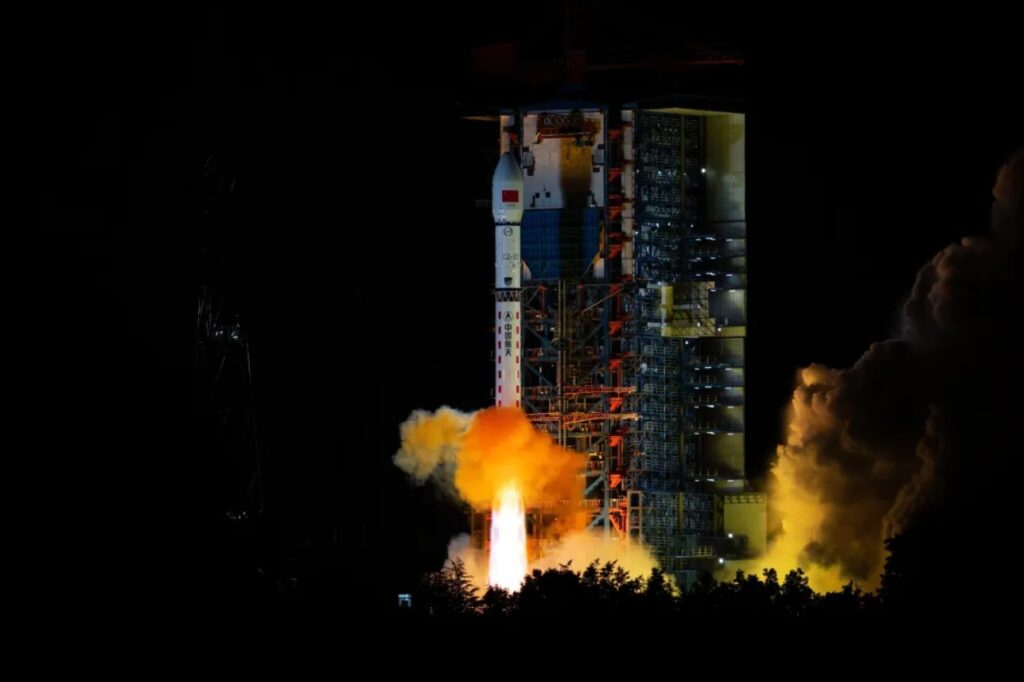
Table of Contents
A Strategic Push for Mobile Connectivity
China has intensified its pursuit of satellite-to-smartphone connectivity, deploying four experimental satellites into orbit via a Long March 2D rocket on May 30. The launch, which took place at the Xichang Satellite Launch Center, is not merely a routine deployment but a critical technology demonstration for several competing and overlapping national projects aimed at bypassing traditional ground-based cellular infrastructure.
According to CASC Commercial Rocket Co., the state-owned arm of the China Aerospace Science and Technology Corporation, the mission’s primary objective is the experimental verification of direct broadband connections to mobile phones. While the official briefing remained characteristically opaque, the composition of the payload suggests a coordinated effort between the state’s most powerful aerospace entities to bridge the gap between space-based internet and consumer hardware.
Fragmentation and Competition: The Entities Involved
Unlike the unified approach seen with SpaceX’s Starlink, China’s satellite internet strategy appears to be a fragmented race between different state-owned and commercial players. Analysis of the payload reveals a mix of interests: one satellite was developed by CASC itself, potentially serving as a precursor to the Guowang (National Network) broadband megaconstellation. Another originated from the Space Engineering Department of the China Aerospace Science and Industry Corporation (CASIC), the primary defense contractor and “sister” organization to CASC.
Adding a commercial layer to the mix, a Beijing Yizhuang government post identified one of the satellites as a product of Hongqing Technology, a subsidiary of the launch provider Landspace. The stakes for Hongqing are significant; the company filed a notification with the International Telecommunication Union (ITU) earlier in 2024 for a staggering constellation of 10,000 satellites, positioning itself as a private-sector challenger in the LEO (Low Earth Orbit) economy.
Scaling the Orbit: A Month of High-Frequency Launches
The May 30 launch was the capstone of an extraordinarily aggressive month for the Chinese space program. In May alone, China executed eight separate launches, including the deployment of 18 additional satellites for the Qianfan (Thousand Sails) constellation via a Long March 8 rocket. The Qianfan project now totals 162 satellites, reflecting a clear urgency to establish a functional orbital shell before international competitors further saturate the available spectrum.
The diversity of the recent flight manifest highlights a dual-track strategy. While the Qianfan and Guowang projects focus on consumer-facing broadband, other missions—such as the TJS-24 satellite launched on May 26—remain classified. Western analysts typically associate the TJS series with signals intelligence and satellite inspection, suggesting that China is simultaneously building a commercial internet web and a sophisticated military surveillance layer.
The 100-Launch Threshold
The use of the Long March 2D—a reliable workhorse that has flown over 100 times since 1992—underscores China’s reliance on proven hardware to maintain its current launch cadence. With 34 launches already completed in 2026, China is on a trajectory to exceed 100 launches in a single calendar year for the first time. For context, the country recorded 92 launches in 2025.
This acceleration is not just about numbers; it is about the transition from “experimental” to “operational.” By testing direct-to-device capabilities across multiple platforms—from the state-run CASC to the ambitious Landspace—Beijing is hedging its bets, ensuring that regardless of which architecture wins, the domestic infrastructure will be ready to support a seamless, space-integrated mobile network.